Introduction
Supplements are now a multi-billion-dollar industry. They are sold in pharmacies, in supermarkets, on every online platform, and increasingly by people at your door with no qualification to advise anyone about anything.
And yet almost nobody asks the first question. Not “which supplement should I take” but “why am I deficient at all?”
There is an old idea worth putting at the front of this. “And the earth We have spread out, and set thereon firm mountains, and caused to grow therein every kind of balanced thing” — Surah Al-Hijr, 15:19. The word that matters is mizaan: balance, proper measure. The earth does not produce nutrients at random. It produces them in proportion, in place, and in season.
Deficiency, then, is not usually a failure of the earth. It is a failure of the relationship we have with it. This article follows that thought where it leads: through seasons, through the food groups modern eating has quietly dropped, through the reason iron so often refuses to reach the blood — and finally to who actually needs a supplement and who is buying one for nothing.
Balance Has Two Dimensions: Place and Season
The first is spatial. Different plants grow in different regions. What thrives in one place will not grow in another. This is not a defect in the map — it is design. Each region produces what suits the climate, the physiology and the life of the people in it.
The second is temporal, and this is the one we have broken. Foods have seasons. No food is meant to be eaten twelve months a year. Yet the modern shopper eats potatoes year-round, carrots year-round, tomatoes year-round.
That is not abundance. That is ikhtilal al-mizan — the collapse of balance.
And it is measurable. The phytochemical content of vegetables varies substantially with growing conditions, season and agricultural practice [1]. Produce grown out of season under artificial conditions carries lower antioxidant content and a narrower phytochemical range. Work on broccoli using vitamin C as a marker found nutritional quality differing by growing method and season [2].
A review in the Proceedings of the Nutrition Society reached the conclusion from the other direction: eating seasonally increases dietary diversity, and supports both human health and environmental sustainability [3].
Here is the part people miss. When you eat potatoes outside their season, the loss is not only the nutrients that potato failed to develop. It is every food you did not eat instead — the food that was actually in season, that you displaced. Year-round eating of one thing is year-round absence of another.
We Have Never Been More Educated, or Known Less About Food
School enrolment in many countries reaches 99%. People spend seventeen years to earn a Master’s, twenty-three to earn a Doctorate.
And they do not know what to eat.
What did they learn in twenty-three years of study, if they do not know what they are eating?
This is the root of the supplement industry. Not greed alone — ignorance of our own sustenance. Most people cannot say which vegetables are in season this month, which wild greens come up in spring, which spices support enzyme function, which seeds carry the fatty acids they are missing, or which legumes would have given them the protein and minerals they are now buying in a capsule.
The ignorance produces the deficiency. The deficiency produces the market.
The Missing Food Groups
Three whole categories of food have quietly left the modern plate. Not reduced — left.
Spices Are a Food Group, Not a Luxury
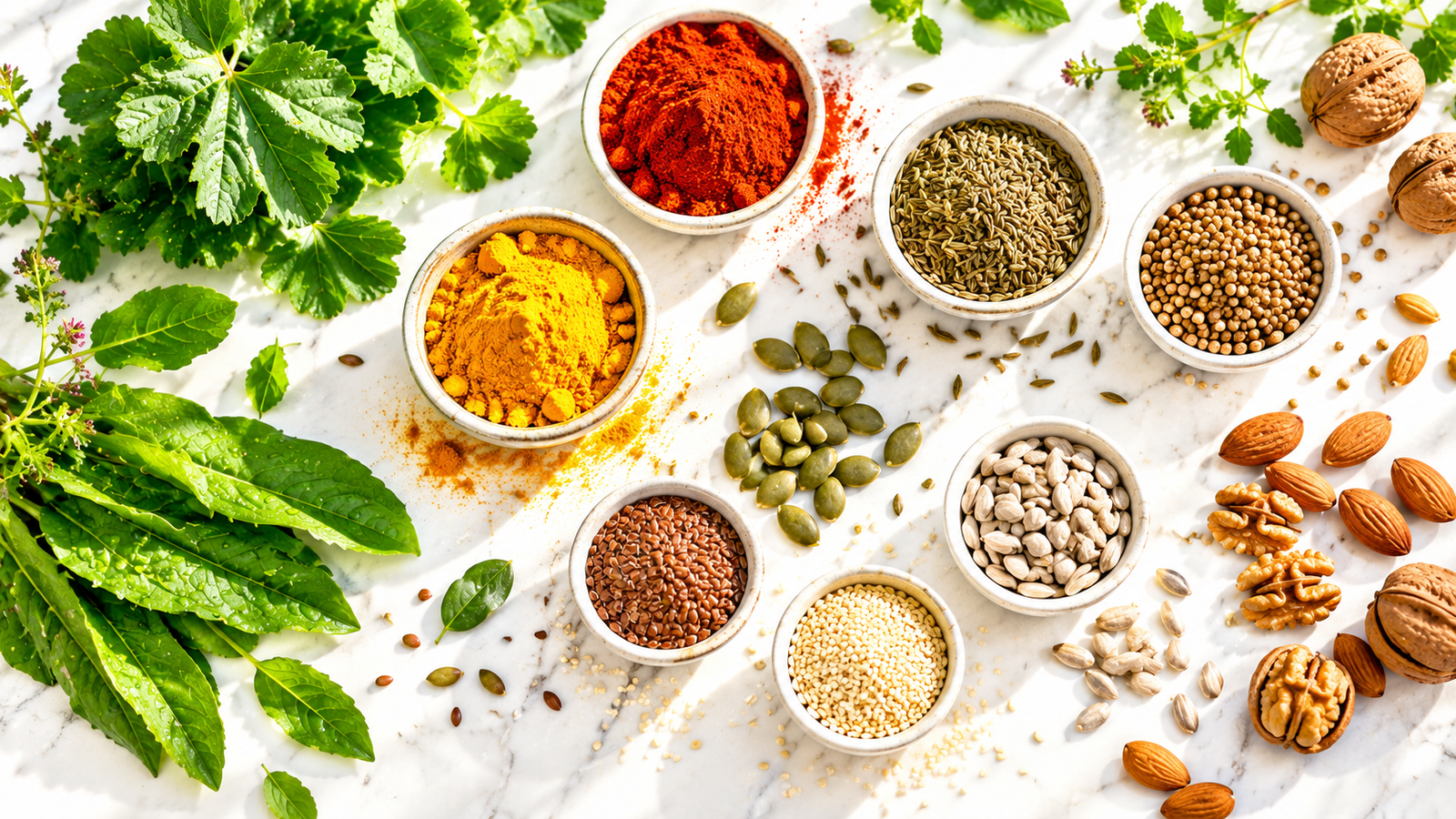
Spices are not decoration and they are not optional seasoning. They are a food group in their own right, and they carry work: they regulate enzymes and hormonal signalling. Take them out and cellular function suffers.
A comprehensive review in the Medical Journal of Australia documented that herbs and spices contain bioactive compounds with antioxidant, anti-inflammatory, antimicrobial and enzyme-modulating activity [4]. Curcumin from turmeric alone modulates dozens of molecular targets — transcription factors, enzymes, cytokines [5].
Thai cooking is a good illustration of what a spice-dense diet actually looks like: Thailand’s food-based dietary guidelines explicitly build local herbs and spices into the recommended pattern rather than treating them as garnish [6]. We have covered one such spice in detail in caraway and the five randomised trials behind it.
And this knowledge is being lost in the places that held it, as Asian diets shift toward Western fried food.
Seeds Are a Forgotten Food Group
Pumpkin, sunflower, flax, sesame — budur. These supply essential fatty acids, minerals and phytoestrogens that modern diets simply do not contain.
A review in Circulation documented that consumption of plant seeds is associated with reduced cardiovascular risk, through unsaturated fatty acids, fibre, phytosterols and polyphenols [7]. Pumpkin seeds in particular are dense in zinc and magnesium [8].
European dietary patterns largely exclude seeds altogether. They are simply absent. That absence is not neutral — it is a standing deficiency built into the pattern. See also dried fruits and nuts.
Wild Greens and Spring Legumes
Mallow, sorrel, wild spinach, the legumes that come up in spring — these grow without cultivation. They are given, not farmed.
Wild edible plants are exceptionally rich in omega-3 fatty acids and antioxidants, frequently exceeding their cultivated relatives [9]. Mallow (Malva sylvestris) has documented anti-inflammatory and mucilage-soothing properties [10]. We treat these at length in wild greens and forgotten roots.
When these leave the diet, what leaves with them is phytosterols, phytoestrogens, antioxidants, chlorophyll and minerals — all at once.
Iron: The Mineral That Never Arrives
Now the claim that matters most, and it runs against almost everything you have been told.
Iron is not missing from the food supply. Iron is failing to reach the blood.
That sentence has been worth repeating for twenty-five years, and the literature supports it.
The Mechanism
Dietary iron is not blood iron. It has to be converted into the form that builds haemoglobin, and that conversion has requirements:
- Copper. Without copper, dietary iron does not become blood iron. Copper is the cofactor for ceruloplasmin, the enzyme that oxidises iron so it can be transported [11]. Iron and copper metabolism are not parallel systems — they are a single crossroads.
- Enzymes to catalyse the transformation.
- The absence of inhibitors — anything blocking the pathway.
This is why iron supplements so often fail. They add supply to a system whose problem was never supply.
Copper does the same job elsewhere in the body, and the pattern is identical. It drives lysyl oxidase, the enzyme that cross-links collagen fibres — which is why collagen powder cannot build collagen on its own either. We set that out in you cannot eat collagen to get collagen.
The Inhibitors: Lead and Inflammation
Lead is the first. Where lead is present, the body assembles zinc protoporphyrin instead of iron protoporphyrin — the enzyme step is diverted and haemoglobin synthesis is blocked [12]. This is not an obscure finding; zinc protoporphyrin is used clinically as a marker precisely because lead does this so reliably.
Chronic inflammation is the second. Inflammatory cytokines raise hepcidin, the hormone that blocks iron absorption and locks iron inside storage cells [13]. This is the reason patients with chronic inflammation become anaemic on a perfectly adequate iron intake.
We follow the assimilation problem further in low glutathione and chronic disease.
The Rural–Urban Paradox
Here is the observation that should end the argument.
Rural people eating bread and tea, little or no meat, working in the fields — do not have anaemia. Urban people eating meat daily across five meals a day — are widely iron deficient.
How?
- Movement. Exercise drives red cell production and oxygen delivery [14]. The body that works builds the blood it needs.
- No processed food. Rural eating is simple and home-cooked, without the emulsifiers and additives shown to disturb the gut microbiota and promote inflammation [15] — a theme we develop in what damages gut bacteria.
- No toxic load. Rural populations are not carrying the heavy-metal burden that blocks iron utilisation [12].
The urban equation is the inverse: no movement, plus toxicity, equals iron that cannot reach the blood — no matter how much meat is on the plate.
When the Gut Cannot Absorb, Everything Is Deficient
There is a second reason intake tells you nothing.
When the intestine is damaged, nothing is absorbed properly — not iron, not calcium, not magnesium, not potassium. All of them fall together, and not one of them because the diet lacked them.
Coeliac disease produces villous atrophy in the small intestine, and with it malabsorption of iron, calcium, vitamin D and B vitamins [16]. Crohn’s disease produces transmural inflammation that impairs absorption across the affected bowel [17].
The gut is the reactor that extracts nutrients from food. When the reactor is damaged, deficiency follows regardless of what goes in.
This is why a deficiency that will not correct on supplements deserves investigation rather than a higher dose.
Women and the Phytoestrogens They No Longer Eat
There is a specific deficiency affecting modern women, and it is almost never named.
Women — especially those carrying work outside the home and inside it — increasingly live on white bread made with industrial yeast. Of everything in the modern diet, this may be the most costly for women specifically.
Because white bread:
- contains no phytoestrogens
- displaces the foods that do
- carries a high glycaemic load that disturbs metabolic and hormonal signalling [18]
What follows is familiar to millions of women: menstrual pain, migraine, neck and back pain, a heaviness in the body — the loss of the lightness and ease of movement they used to have.
This is not simply ageing. Phytoestrogens bind oestrogen receptors and modulate hormonal signalling [19]. A systematic review and meta-analysis of randomised trials found soy isoflavones produce measurable estrogenic effects [20], and a further meta-analysis found benefit for menopausal symptoms in perimenopausal women [21].
Phytoestrogens live in seeds (flax, sesame, sunflower, pumpkin), in legumes (chickpeas, lentils, beans), in wild greens, and in whole grains such as barley and corn — see essential staple foods.
Every one of those is a food that white bread replaced.
The nutritional picture differs between men and women for reasons that are physiological, not habitual — we set out what the evidence documents in physiological differences between men and women.
The Two Categories
Two populations, and they need opposite advice.
Those Who Do Not Need Supplements
People living on a natural system: cooking at home with olive oil, eating vegetables, fruit, spices, seeds, cereals, legumes, barley and corn, eating in season, and moving daily.
This group does not need supplements. The diet is already supplying folate, vitamin D, iron, calcium, magnesium. This is broadly the Mediterranean pattern, and the PREDIMED trial — in its corrected republication — found it reduced cardiovascular events [22].
One exception, and it must not be folded into the principle. Folic acid in pregnancy is not a case of a good diet being sufficient. The neural tube closes in about the fourth week, usually before a woman knows she is pregnant, and the MRC Vitamin Study — a randomised trial stopped early because the result was so clear — found supplementation prevented the majority of neural tube defect recurrences [23]. The Cochrane review reached the same conclusion [24]. A woman who is or may become pregnant should take folic acid regardless of how well she eats. Everything else in this section stands; this one does not bend.
Those Who Do Need Them
People living in cities, not moving, eating fast food, white bread, fried potatoes, soft drinks and tinned goods.
This group is deficient in nearly everything — vitamin D, folate, magnesium, calcium, phosphorus, iron, potassium, phytosterols, phytoestrogens.
For them supplementation is genuinely reasonable — not as a cure, but as a bridge while the diet is being corrected. We set out how to decide, and which tests to ask for, in which supplements do you actually need and the war on supplements.
Omega-3: The Reasonable Exception
Not every supplement deserves suspicion.
If you do not eat fish regularly — and omega-3s also come from walnuts, almonds, flax, sunflower seeds and soy — then taking an omega-3 capsule is not a problem. Omega-3 fatty acids are essential nutrients with documented cardiovascular relevance, and the balance of benefit against contaminant risk has been examined directly [25].
The principle is simple: supplement where intake is genuinely insufficient. That is not a substitute for a natural diet. It is an honest compromise for someone who is not going to eat the fish.
Vitamin D and Cancer Treatment
One clinical point, stated carefully.
Vitamin D status matters in cancer. In early breast cancer, women who were deficient at diagnosis had worse outcomes than those who were replete [26]. Vitamin D is central to immune function, and severe deficiency is not a neutral state to be in while undergoing treatment.
But the honest reading has limits. That study is observational — it shows association, not that correcting vitamin D changes the outcome. So the right action is to have vitamin D checked and corrected alongside oncology care, not ahead of it. Nothing here is a reason to delay or reorder cancer treatment, and no one should. We cover testing and repletion in vitamin D and B12 deficiency.
Why Your Doctor Never Mentions Any of This
There is a structural reason, and it is not conspiracy.
Physicians are trained to prescribe drugs. Medical curricula do not teach nutritional medicine. Doctors are not taught herbs, spices, seeds, or seasonal eating. They are taught pharmacology — so pharmacology is what they reach for, in every condition, including the ones where it has least to offer.
And there is a category of illness that exposes this precisely: autoimmune disease, chronic inflammatory conditions — the diseases for which there is no drug that cures. These are the conditions that humble pharmaceutical medicine and where the dietary foundation stops being optional.
Integrative Medicine Is the Direction
The answer is not to abandon medicine. It is to integrate it — pharmaceutical treatment together with nutritional, herbal and lifestyle medicine. It is the model that China and India never dismantled.
Interest is not fringe. A national survey found that a substantial share of Americans were already using some form of complementary medicine by the late 1990s, and that use was rising [27].
What integration would look like in practice:
- Physicians who consider diet alongside the prescription, not after it
- Cardiovascular patients receiving dietary and omega-3 advice as well as their medication
- Natural products such as propolis taken seriously enough to be studied and discussed rather than ignored [28]
- Vitamin D checked in cancer patients as a matter of routine
Medicine without nutritional knowledge is incomplete. A physician treating a patient who lives on processed food, while never asking what that patient eats, is working against their own prescription.
Frequently Asked Questions
Is iron deficiency really not about eating enough iron?
For most people, no. Iron is abundant in food. What is scarce is absorbed, converted iron — which requires copper, working enzymes, and the absence of inhibitors like lead and inflammation [11][12][13]. If your ferritin will not rise on supplements, the dose is rarely the problem. One genuine exception: ongoing blood loss is neither intake nor absorption, and needs investigating.
Does eating seasonally actually matter, or is it just aesthetics?
It matters. Phytochemical content varies with season and growing conditions [1][2], and seasonal eating measurably increases dietary diversity [3]. The larger effect is displacement: eating one food year-round means never eating the food that should have replaced it.
If I eat well, do I still need folic acid in pregnancy?
Yes. This is the one place where a good diet is not considered sufficient. The neural tube closes around week four, often before pregnancy is known, and randomised evidence shows supplementation prevents most recurrences [23][24]. Take it if you are pregnant or might become pregnant.
Are spices really a food group?
They behave like one. Herbs and spices carry bioactive compounds with antioxidant, anti-inflammatory and enzyme-modulating activity [4][5]. Treating them as flavour rather than food is a modern habit, not a nutritional fact.
Why would rural people who eat less meat have better iron status?
Movement, no processed food, and no heavy-metal load [12][14][15]. All three act on the conversion and absorption of iron rather than on intake — which is exactly the point.
Are seeds worth adding if I eat otherwise well?
Yes, particularly for women. Seeds carry fatty acids, minerals and phytoestrogens that most Western patterns lack entirely [7][8][19].
Should I take supplements during cancer treatment?
Discuss it with your oncologist first, and do not self-prescribe. Vitamin D deficiency is worth identifying and correcting [26], but antioxidant supplementation during treatment is a separate question with real concerns attached, and it is your treating team’s call.
Conclusion
Supplements are not the answer. Knowledge is the answer.
When people return to natural, seasonal, home-cooked eating — vegetables, fruit, spices, seeds, legumes, whole grains, wild greens — they largely stop needing capsules. The body receives what it needs, in proportion, the way it was arranged to.
When people stay on processed food, white bread, fried food and soft drinks, they stay deficient, however many capsules they swallow. You cannot supplement your way out of a pattern.
The real choice was never supplements or no supplements. It is knowledge or ignorance — a natural life, or a processed one.
Nature provides in balance. The body answers. Knowledge is what heals.
Scientific Sources and References
- Jeffery E.H., Brown A.F., Kurilich A.C., et al. — Variation in content of bioactive components in broccoli. Journal of Food Composition and Analysis, 2003; 16(3):323–330.
- Wunderlich S.M., Feldman C., Kane S., Hazhin T. — Nutritional quality of organic, conventional, and seasonally grown broccoli using vitamin C as a marker. International Journal of Food Sciences and Nutrition, 2008; 59(1):34–45. PMID: 17852499. Link
- Macdiarmid J.I. — Seasonality and dietary requirements: will eating seasonal food contribute to health and environmental sustainability? Proceedings of the Nutrition Society, 2014; 73(3):368–375. PMID: 25027288. Link
- Tapsell L.C., Hemphill I., Cobiac L., et al. — Health benefits of herbs and spices: the past, the present, the future. Medical Journal of Australia, 2006; 185(S4):S1–S24. PMID: 17022438. Link
- Aggarwal B.B., Sung B. — Pharmacological basis for the role of curcumin in chronic diseases: an age-old spice with modern targets. Trends in Pharmacological Sciences, 2009; 30(2):85–94. PMID: 19110321. Link
- Sirichakwal P.P., Sranacharoenpong K., Tontisirin K. — Food based dietary guidelines (FBDGs) development and promotion in Thailand. Asia Pacific Journal of Clinical Nutrition, 2011; 20(3):477–483. PMID: 21859670. Link
- Ros E., Hu F.B. — Consumption of plant seeds and cardiovascular health: epidemiological and clinical trial evidence. Circulation, 2013; 128(5):553–565. PMID: 23897849. Link
- Glew R.H., Glew R.S., Chuang L.T., et al. — Amino acid, mineral and fatty acid content of pumpkin seeds (Cucurbita spp) and Cyperus esculentus nuts in the Republic of Niger. Plant Foods for Human Nutrition, 2006; 61(2):51–56. PMID: 16770692. Link
- Simopoulos A.P. — Omega-3 fatty acids and antioxidants in edible wild plants. Biological Research, 2004; 37(2):263–277. PMID: 15455656. Link
- Gasparetto J.C., Martins C.A., Hayashi S.S., et al. — Ethnobotanical and scientific aspects of Malva sylvestris L.: a millennial herbal medicine. Journal of Pharmacy and Pharmacology, 2012; 64(2):172–189. PMID: 22221093. Link
- Collins J.F., Prohaska J.R., Knutson M.D. — Metabolic crossroads of iron and copper. Nutrition Reviews, 2010; 68(3):133–147. PMID: 20384844. Link
- Goyer R.A. — Lead toxicity: current concerns. Environmental Health Perspectives, 1993; 100:177–187. PMID: 8354166. Link
- Ganz T. — Hepcidin and iron regulation, 10 years later. Blood, 2011; 117(17):4425–4433. PMID: 21346250. Link
- Mairbäurl H. — Red blood cells in sports: effects of exercise and training on oxygen supply by red blood cells. Frontiers in Physiology, 2013; 4:332. PMID: 24273518. Link
- Chassaing B., Koren O., Goodrich J.K., et al. — Dietary emulsifiers impact the mouse gut microbiota promoting colitis and metabolic syndrome. Nature, 2015; 519(7541):92–96. PMID: 25731162. Link
- Green P.H., Cellier C. — Celiac disease. New England Journal of Medicine, 2007; 357(17):1731–1743. PMID: 17960014. Link
- Baumgart D.C., Sandborn W.J. — Crohn’s disease. The Lancet, 2012; 380(9853):1590–1605. PMID: 22914295. Link
- Ludwig D.S. — The glycemic index: physiological mechanisms relating to obesity, diabetes, and cardiovascular disease. JAMA, 2002; 287(18):2414–2423. PMID: 11988062. Link
- Patisaul H.B., Jefferson W. — The pros and cons of phytoestrogens. Frontiers in Neuroendocrinology, 2010; 31(4):400–419. PMID: 20347861. Link
- Viscardi G., Back S., Ahmed A., et al. — Effect of soy isoflavones on measures of estrogenicity: a systematic review and meta-analysis of randomized controlled trials. Advances in Nutrition, 2025; 16(1):100327. PMID: 39433088. Link
- Luan H., Zhang X., Wang J., et al. — Effects of soy isoflavones on menopausal symptoms in perimenopausal women: a systematic review and meta-analysis. PeerJ, 2025; 13:e19749. PMID: 40718787. Link
- Estruch R., Ros E., Salas-Salvadó J., et al. — Primary prevention of cardiovascular disease with a Mediterranean diet supplemented with extra-virgin olive oil or nuts. New England Journal of Medicine, 2018; 378(25):e34. PMID: 29897866. Link
- MRC Vitamin Study Research Group — Prevention of neural tube defects: results of the Medical Research Council Vitamin Study. The Lancet, 1991; 338(8760):131–137. PMID: 1677062. Link
- De-Regil L.M., Peña-Rosas J.P., Fernández-Gaxiola A.C., Rayco-Solon P. — Effects and safety of periconceptional oral folate supplementation for preventing birth defects. Cochrane Database of Systematic Reviews, 2015; (12):CD007950. PMID: 26662928. Link
- Mozaffarian D., Rimm E.B. — Fish intake, contaminants, and human health: evaluating the risks and the benefits. JAMA, 2006; 296(15):1885–1899. PMID: 17047219. Link
- Goodwin P.J., Ennis M., Pritchard K.I., et al. — Prognostic effects of 25-hydroxyvitamin D levels in early breast cancer. Journal of Clinical Oncology, 2009; 27(23):3757–3763. PMID: 19451439. Link
- Eisenberg D.M., Davis R.B., Ettner S.L., et al. — Trends in alternative medicine use in the United States, 1990–1997: results of a follow-up national survey. JAMA, 1998; 280(18):1569–1575. PMID: 9820257. Link
- Sforcin J.M. — Propolis and the immune system: a review. Journal of Ethnopharmacology, 2007; 113(1):1–14. PMID: 17580109. Link