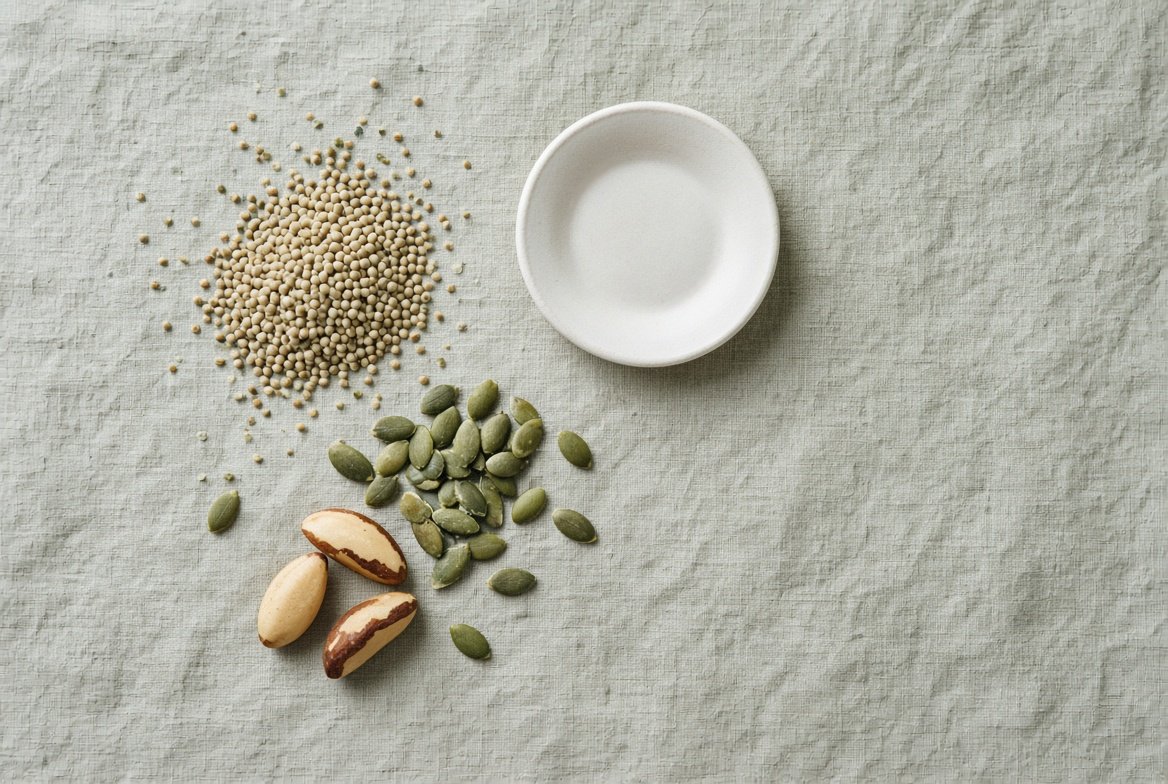
This article is a review of common mineral supplements and their natural food alternatives, based on peer-reviewed literature. It is not medical advice. Speak to a doctor or registered dietitian before changing a supplement regimen — particularly where selenium is concerned.
Introduction
The supplement industry has become a multi-billion-dollar enterprise. Advertisers, influencers and sometimes physicians have traded on their credentials for financial gain, often making claims well outside their expertise.
This review examines three essential minerals — magnesium, selenium and zinc — and asks one question:
Is the supplement you are buying actually absorbed, or are you paying for expensive urine?
The principle underneath it comes from complementary medicine: the whole is better than the part. A food arrives as a complete system, with cofactors and supporting nutrients that aid absorption and buffer against excess. Isolating a single mineral from that matrix can reduce what it does for you.
Modern nutrition science has a name for this — food synergy — and the position of the Academy of Nutrition and Dietetics states it plainly: nutrients should come primarily from foods, because foods provide not only essential nutrients but fibre and other naturally occurring substances that may carry benefits of their own [14].
1. Magnesium: The Rock and the Seed
A. The Problem with Magnesium Supplements
Magnesium oxide — the commonest form on a pharmacy shelf — is made from mineral deposits, and it is very poorly absorbed. Measured against other preparations it comes last [1][2]:
- Magnesium oxide — roughly 4% fractional absorption
- Magnesium citrate — roughly 20–30%
- Magnesium glycinate — roughly 25–35%
- Magnesium chloride — roughly 25–35%
Organic forms outperform inorganic ones consistently [3]. If you take magnesium oxide, most of it passes through you.
B. How Much Is Actually Needed
The recommended intakes are [4]:
- Women 19–30 — 310 mg/day
- Women 31+ — 320 mg/day
- Men 19–30 — 400 mg/day
- Men 31+ — 420 mg/day
The often-quoted “400–450 mg for women” is the figure for adult men. Women’s requirement is lower.
C. The Alternative: Hemp Seeds
Three tablespoons — about 30 g — of hulled hemp seed supply roughly:
| Nutrient | Amount | Share of daily value |
|---|---|---|
| Magnesium | ~210 mg | ~50% |
| Phosphorus | ~495 mg | ~40% |
| Copper | ~0.5 mg | ~56% |
| Thiamin (B1) | ~0.38 mg | ~32% |
| Zinc | ~3 mg | ~27% |
| Iron | ~2.4 mg | ~13% |
| Vitamin B6 | ~0.18 mg | ~11% |
| Potassium | ~360 mg | ~8% |
| Folate | ~33 µg | ~8% |
Source: USDA FoodData Central [5]
Hemp seed is among the most nutritionally complete foods available, carrying complete protein, essential fatty acids and a full spread of minerals [6].
Half your day’s magnesium arrives inside a matrix of amino acids, fats and other minerals — which is the whole argument.
2. Selenium: The Rock and the Brazil Nut
A. The Problem with Selenium Supplements
Most selenium supplements contain inorganic selenium — sodium selenite or selenate, from mineral sources. Organic selenium, chiefly selenomethionine, is better absorbed and better retained, because the body incorporates it into proteins [7]. Bioavailability differs meaningfully by chemical form [8].
B. How Much Is Needed
55 µg/day for adults. 60 µg in pregnancy, 70 µg while breastfeeding [9].
C. The Alternative: Brazil Nuts — With a Real Caution
Brazil nuts are the richest food source of selenium on earth. But their selenium content is wildly variable, because it tracks the selenium in the soil the tree grew in.
This is not a small variation. In a randomised controlled trial, participants ate two Brazil nuts a day expecting about 100 µg of selenium. The measured intake averaged 53 µg per day, with a possible range of 20 to 84 µg [10]. Per nut, that is roughly 26 µg on average — and anywhere from 10 to 42.
Other nuts, from selenium-rich soils, test far higher.
This is why the number of nuts matters.
The Tolerable Upper Intake Level for selenium is 400 µg/day [9]. Because you cannot know which kind of nut is in your hand, four a day carries a real risk of overshooting where the nuts happen to be selenium-rich. Selenium toxicity — selenosis — causes hair loss, brittle nails, a garlic odour on the breath, and neurological symptoms.
Eat one or two Brazil nuts a day, not four. In Thomson’s trial, two nuts daily for twelve weeks raised plasma selenium and glutathione peroxidase activity as effectively as a 100 µg selenomethionine supplement [10]. Two is enough. Two is also safe. That enzyme is the whole reason selenium matters — it is how your body’s master antioxidant neutralises peroxides, and it cannot function without selenium.
3. Zinc: The Rock, the Organ Meat and the Seed
A. The Problem with Zinc Supplements
Zinc oxide — again the cheapest and commonest form — is poorly soluble and poorly absorbed. Absorption varies substantially by form, and is further shaped by what else is on the plate: phytates in plant foods inhibit it, animal protein enhances it [11].
B. The Alternatives
Organ meats. Liver, heart and kidney carry zinc in a highly available form. Animal-source zinc is better absorbed than plant-source zinc for two reasons: there are no phytate inhibitors, and the sulphur amino acids cysteine and methionine actively enhance uptake [12].
Pumpkin seeds. One ounce (28 g) of roasted kernels supplies roughly:
| Nutrient | Amount | Share of daily value |
|---|---|---|
| Magnesium | ~154 mg | ~37% |
| Manganese | ~1.3 mg | ~55% |
| Zinc | ~2.1 mg | ~19% |
| Protein | ~8.3 g | — |
| Potassium | ~220 mg | ~5% |
Source: USDA FoodData Central, roasted kernels [13]; mineral composition confirmed in independent analytical work [13]
A large handful — around 50 g — provides roughly 3.8 mg of zinc. Against a recommended intake of 8 mg for women and 11 mg for men, that is around half a woman’s requirement and about a third of a man’s.
Seafood, eggs and cheese also supply bioavailable zinc.
The Philosophy: The Whole Is Better Than the Part
The underlying principle holds up:
- Food synergy is real. Nutrients behave differently inside a food matrix than in isolation.
- Whole foods generally deliver better. Not because natural always beats manufactured, but because the matrix does work that a tablet cannot.
- The cost comparison favours food. Hemp seed, Brazil nuts and pumpkin seeds cost less per unit of nutrition than the isolated minerals — and carry protein, fat and fibre with them.
This is the position of the Academy of Nutrition and Dietetics: nutrients should come primarily from foods [14].
Conclusion
Magnesium oxide, made from rock, is close to worthless at roughly 4% absorption. Hemp seed is the better answer.
Inorganic selenium is poorly retained. Brazil nuts are the better answer — one or two a day, not four, because their selenium content is unpredictable and the safe ceiling is real.
Zinc oxide is poorly absorbed. Organ meats and pumpkin seeds are the better answer.
The principle that the whole beats the part is sound, and it is what the evidence supports. But nature’s design still has limits, and selenium is where that lesson is written most plainly.
This article is part of our complete guide to Dietary Supplements — which supplements work, which are overhyped, and how to fill nutritional gaps intelligently.
Frequently Asked Questions
Is magnesium oxide really useless?
Close to it. Fractional absorption is around 4%, the lowest of the common preparations [1][2]. If you must supplement, citrate or glycinate absorb far better [3]. If you would rather eat than swallow a tablet, three tablespoons of hemp seed supply about half a day’s magnesium [5].
How many Brazil nuts should I eat a day?
One or two — not four. A nut averaged about 26 µg of selenium in a controlled trial, but the range ran from 10 to 42, and nuts from selenium-rich soils test higher still [10]. The safe ceiling is 400 µg a day [9]. Since you cannot tell by looking which kind you have, two is the sensible number — and two a day for twelve weeks worked as well as a 100 µg supplement in the trial.
Are organ meats really better than supplements for zinc?
Animal-source zinc is absorbed better than plant-source zinc, because there are no phytates blocking it and the sulphur amino acids help carry it in [12]. Organ meats also bring iron, B12 and copper alongside.
What is the best form of zinc if I do supplement?
Not the oxide. Absorption differs markedly across forms, and it is also affected by what you eat alongside it [11]. Ask a pharmacist which form your product uses — it is usually printed and rarely advertised.
Is “the whole is better than the part” actually scientific?
Yes. Food synergy is a recognised concept, and the Academy of Nutrition and Dietetics states that nutrients should come primarily from foods [14]. Whole foods carry fibre, phytochemicals and cofactors that an isolated mineral cannot reproduce.
Scientific Sources & References
Every source below was checked against PubMed and the CrossRef DOI registry. Each link resolves to the paper cited.
- Firoz, M., & Graber, M. (2001). “Bioavailability of US commercial magnesium preparations.” Magnesium Research, 14(4), 257–262. PubMed 11794633
- Walker, A. F., Marakis, G., Christie, S., & Byng, M. (2003). “Mg citrate found more bioavailable than other Mg preparations in a randomised, double-blind study.” Magnesium Research, 16(3), 183–191. PubMed 14596323
- Schuchardt, J. P., & Hahn, A. (2017). “Intestinal Absorption and Factors Influencing Bioavailability of Magnesium: An Update.” Current Nutrition & Food Science, 13(4), 260–278. doi:10.2174/1573401313666170427162740
- Institute of Medicine (US) Standing Committee on the Scientific Evaluation of Dietary Reference Intakes (1997). Dietary Reference Intakes for Calcium, Phosphorus, Magnesium, Vitamin D, and Fluoride. National Academies Press. PubMed 23115811
- U.S. Department of Agriculture, FoodData Central. Seeds, hemp seed, hulled (SR Legacy, FDC ID 170148). fdc.nal.usda.gov
- Callaway, J. C. (2004). “Hempseed as a nutritional resource: An overview.” Euphytica, 140(1–2), 65–72. doi:10.1007/s10681-004-4811-6
- Rayman, M. P. (2004). “The use of high-selenium yeast to raise selenium status: how does it measure up?” British Journal of Nutrition, 92(4), 557–573. doi:10.1079/bjn20041251
- Fairweather-Tait, S. J., Collings, R., & Hurst, R. (2010). “Selenium bioavailability: current knowledge and future research requirements.” American Journal of Clinical Nutrition, 91(5), 1484S–1491S. doi:10.3945/ajcn.2010.28674J
- Institute of Medicine (US) Panel on Dietary Antioxidants and Related Compounds (2000). Dietary Reference Intakes for Vitamin C, Vitamin E, Selenium, and Carotenoids. National Academies Press. PubMed 25077263
- Thomson, C. D., Chisholm, A., McLachlan, S. K., & Campbell, J. M. (2008). “Brazil nuts: an effective way to improve selenium status.” American Journal of Clinical Nutrition, 87(2), 379–384. doi:10.1093/ajcn/87.2.379
- Lönnerdal, B. (2000). “Dietary factors influencing zinc absorption.” The Journal of Nutrition, 130(5S Suppl), 1378S–1383S. doi:10.1093/jn/130.5.1378S
- Solomons, N. W. (2001). “Dietary sources of zinc and factors affecting its bioavailability.” Food and Nutrition Bulletin, 22(2), 138–154. doi:10.1177/156482650102200204
- Glew, R. H., Glew, R. S., Chuang, L. T., et al. (2006). “Amino acid, mineral and fatty acid content of pumpkin seeds (Cucurbita spp) and Cyperus esculentus nuts in the Republic of Niger.” Plant Foods for Human Nutrition, 61(2), 51–56. doi:10.1007/s11130-006-0010-z — table figures from U.S. Department of Agriculture, FoodData Central, Seeds, pumpkin and squash seed kernels, roasted, without salt (SR Legacy, FDC ID 170557). fdc.nal.usda.gov
- Melina, V., Craig, W., & Levin, S. (2016). “Position of the Academy of Nutrition and Dietetics: Vegetarian Diets.” Journal of the Academy of Nutrition and Dietetics, 116(12), 1970–1980. doi:10.1016/j.jand.2016.09.025