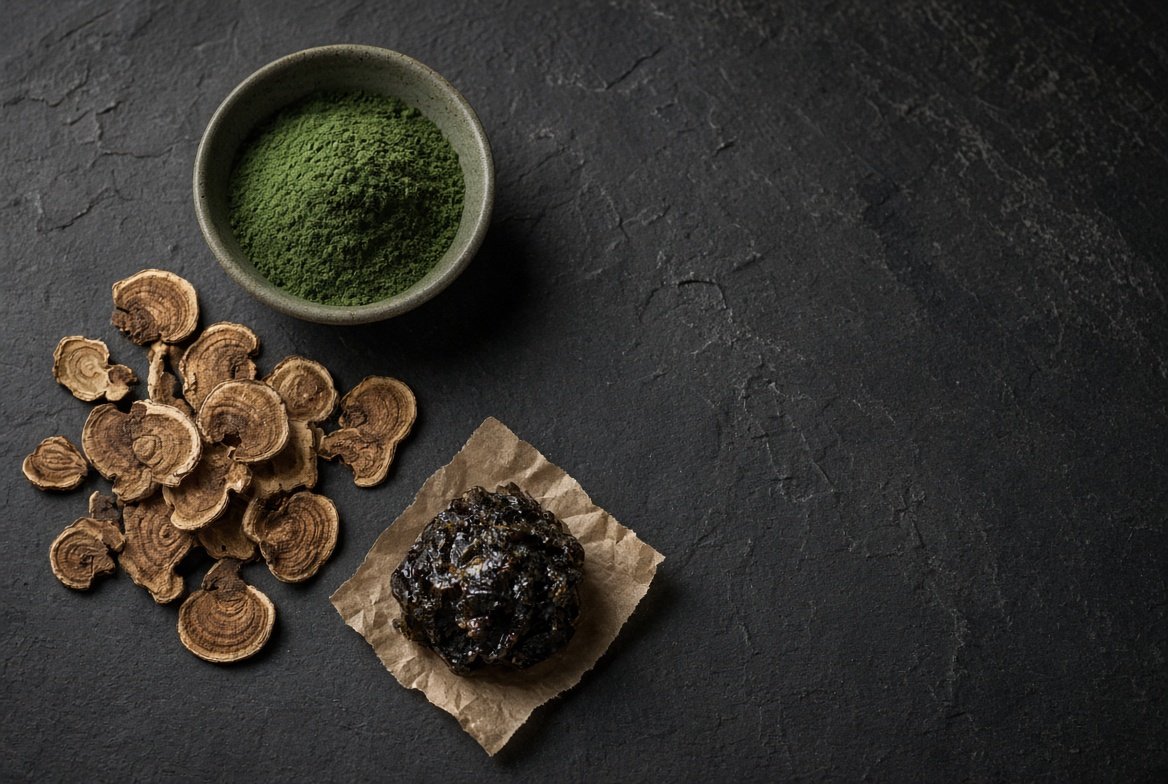
This article reviews the safety of three widely promoted supplements against the published literature. It is not medical advice. Speak to a doctor who knows your history before starting, stopping or changing any supplement — particularly if you have an autoimmune condition, diabetes, a bleeding disorder, or take prescription medication.
Introduction
In an era run by supplement companies and their promoters — influencers, non-specialist doctors, self-declared experts — people spend hundreds every month on products they may not need. Worse, those products can carry side effects, interact with prescriptions, and make an existing condition worse.
The principle underneath this article is simple: do not modify what nature has made. A food or an herb arrives as a complete system, with cofactors and supporting compounds. Isolating one part of it, or taking a potent extract without understanding what it does to a specific disease, is where the danger lives.
1. The Three Pillars of Expertise
Before any discussion of a specific herb, there is a question of who is qualified to speak about it.
A. What Real Expertise Requires
Three things, and all three [1]:
- Formal education — a degree in the relevant field. Not a ten-day course. Not a ten-hour seminar.
- Clinical practice — actually seeing patients, regularly.
- Accumulated experience — the years that separate a consultant from a trainee.
This is the established model of how expertise in medicine is built: formal training, deliberate practice, and time [1].
B. The Problem
People will see a cardiologist for their heart and an endocrinologist for their thyroid. But for herbs and supplements they will listen to an influencer with no training, a self-declared herbal expert with no credentials, or a doctor speaking well outside their own field.
Expertise is domain-specific. A cardiologist is an expert in hearts. That does not make them an expert in Ganoderma.
C. How to Check
Read the “about” section of anyone giving you health advice online. If their training is in complementary or herbal medicine, listen. If it is in something else, be careful — including when the person has “Dr” in front of their name.
2. Who Paid for the Study?
Industry-sponsored research reports favourable results significantly more often than independent research. This is one of the best-documented biases in medicine, established across a Cochrane review of the whole literature [2].
That does not make every company-funded study wrong. It means the funding line is part of the evidence, and worth reading before the conclusion.
3. Reishi (Ganoderma lucidum): The Double Edge
A. What It Does
Reishi contains polysaccharides and triterpenes that act on immune function [3]. It activates macrophages, natural killer cells and T-lymphocytes [4].
B. The Bleeding Risk — Well Established
Reishi inhibits platelet aggregation [5]. This is a genuine anticoagulant effect, and it is the clearest safety signal in the whole Reishi literature.
Anyone taking warfarin, aspirin, clopidogrel or any other blood thinner, and anyone facing surgery, should treat this as a real interaction and speak to their doctor. A safety and tolerability trial in healthy volunteers found Reishi generally well tolerated [6] — but “well tolerated in healthy people” is not the same as “safe alongside an anticoagulant.”
This is not peculiar to Reishi. Food and supplements collide with prescribed medication far more often than patients are told — vitamin K with warfarin, grapefruit with statins, potassium with ACE inhibitors — and the pattern is the same each time: something harmless on its own becomes a dosing problem in combination. We set out the ones that matter in when diet fights medication.
C. Autoimmune Disease — Where the Evidence Is Mixed
The reasoning that immune-stimulating herbs should worsen autoimmune disease is sound on its face: if the immune system is already attacking the body, why provoke it further?
But there is one controlled trial that tested this directly, and it deserves to be read.
Sixty-five patients with active rheumatoid arthritis were randomised to Ganoderma lucidum (4 g daily, with San Miao San) or placebo for 24 weeks, alongside their existing medication [7]. Eighty-nine percent completed. The findings:
- Lymphocyte counts and CD4/CD8/natural killer/B-cell ratios were unchanged between groups
- Inflammatory markers were unchanged — IL-18, IP-10, MCP-1, MIG, RANTES
- Pain and patient global scores improved in the Reishi group
- Thirteen patients reported 22 adverse episodes
So in the one randomised trial in an autoimmune population, Reishi did not measurably stimulate immune cell counts or raise inflammatory markers over six months.
That is worth being honest about. It does not settle the question — rheumatoid arthritis is not Crohn’s disease or ulcerative colitis, the trial combined Reishi with a second herbal formula, and adverse events did occur. But anyone who tells you that Reishi definitely inflames autoimmune disease is going beyond what has been measured.
The defensible position: the bleeding risk is established; the autoimmune risk is a reasonable caution, not a demonstrated fact. If you have an autoimmune condition, that is a conversation for your specialist, not for a comments section.
4. Spirulina: The “Miracle” With Real Interactions
A. What It Does
Spirulina activates the innate immune system — raising interferon production and natural killer cell activity in humans given an oral extract [8].
B. The Blood Sugar Effect — Established
Spirulina significantly reduces fasting blood glucose in people with type 2 diabetes [9].
This is the interaction that matters. If you take metformin, a sulfonylurea, or insulin, adding something that independently lowers blood glucose is a real risk of hypoglycaemia. Not a theoretical one. Anyone on diabetes medication should not start Spirulina without telling the doctor who manages that medication.
The same caution applies to foods with a documented glucose-lowering effect, which are easy to overlook precisely because they are foods. Bitter gourd is the clearest case, and we cover it in bitter gourd, bottle gourd and squash.
C. Psychiatric and Seizure Claims — Not Established
Spirulina is sometimes said to worsen depression, anxiety or schizophrenia, or to increase seizures in epilepsy.
These claims are not documented in the peer-reviewed literature. They circulate as clinical observation. Clinical observation is how many real effects are first noticed — but until it is tested it stays an observation, and it should be labelled as one rather than presented as fact.
That standard is worth applying before you buy anything at all. Supplements are treatments for documented deficiency, not daily insurance for people who already have enough — and the distinction usually costs one blood test. We set out which ones are genuinely indicated in which supplements do you actually need.
5. Shilajit: The Hormonal Wildcard
A. What It Does — Established
Shilajit significantly raises total testosterone, free testosterone and DHEA in healthy men [10], and improves markers of sperm production [11].
B. The Contamination Problem — Established
Unprocessed shilajit can carry heavy metals and other impurities. Purification and standardisation are not optional; they are the difference between a supplement and a source of exposure [12].
Buy only third-party tested, purified product, or do not buy it.
Heavy metals are not a niche concern in this context. Lead in particular interferes directly with haemoglobin synthesis — the body assembles zinc protoporphyrin instead of iron protoporphyrin — which is one reason a supplement taken for energy can leave someone more tired, not less. We set out that mechanism in why you are deficient: the food groups we forgot.
C. What Follows Logically
Testosterone stimulates prostate tissue, and raised androgens in women produce acne, hirsutism and disordered cycles. So a substance that reliably raises testosterone deserves caution in men with prostate enlargement and in women with hormonal conditions such as PCOS.
To be precise about the evidence: the testosterone effect is measured [10][11]. The downstream harms are physiologically expected but have not been demonstrated in trials of shilajit specifically. That is a reason for caution, stated honestly.
6. The Real Message: You Are Not the Average
The single most important point is this: do not take a supplement because someone online recommended it to everyone.
- The labourer who works outdoors all day is making his own vitamin D. He does not need the capsule.
- The person on a blood thinner has a specific reason to avoid Reishi that has nothing to do with whether Reishi is “good.”
- The person on metformin has a specific reason to be careful with Spirulina.
- The man with an enlarged prostate has a specific reason to be careful with shilajit.
None of these people are served by advice addressed to everyone at once. That is what a qualified practitioner is for.
Conclusion
Real expertise takes education, practice and years [1]. Industry funding bends results [2].
Reishi acts on immune function [3][4] and thins the blood [5][6] — the bleeding interaction is established and matters. Its effect in autoimmune disease is less clear than commonly claimed: the one randomised trial in an autoimmune population found immune markers unchanged [7].
Spirulina stimulates innate immunity [8] and lowers blood glucose [9] — the interaction with diabetes medication is real. The psychiatric and seizure claims are not established.
Shilajit raises testosterone [10][11] and is frequently contaminated when unpurified [12].
Nature’s remedies are powerful, and power runs both ways. The herb that helps one person can harm another. That is not an argument against herbs. It is an argument for knowing which person you are.
This article is part of our complete guide to Herbal Remedies — the herbs with genuine clinical evidence behind them, separated from the ones that only have marketing.
Frequently Asked Questions
Is Reishi safe?
It is generally well tolerated in healthy people [6]. The established concern is bleeding: Reishi inhibits platelet aggregation [5], so it matters if you take a blood thinner or have surgery coming. For autoimmune disease the picture is less clear than often claimed — a 24-week randomised trial in rheumatoid arthritis found immune cell counts and inflammatory markers unchanged [7]. Ask your specialist.
Can Spirulina cause low blood sugar?
It can contribute to it. Spirulina significantly lowers fasting blood glucose [9]. On its own that is usually harmless; added to metformin, a sulfonylurea or insulin, it is a genuine hypoglycaemia risk. Tell the doctor managing your diabetes before you start.
Does Shilajit really raise testosterone?
Yes — that part is measured. A clinical trial found significant increases in total and free testosterone and DHEA in healthy men [10]. Whether that helps or harms depends entirely on who is taking it.
Is Shilajit contaminated with heavy metals?
Unprocessed shilajit can be [12]. Only purified, third-party tested product should be used. If a seller cannot show you a test certificate, that is your answer.
How do I know whether someone online is qualified?
Look for the three things: formal education in the field, active clinical practice, and years of it [1]. An engineer, an influencer, or a doctor speaking outside their specialty does not have them — however confident they sound.
Scientific Sources & References
Every source below was checked against PubMed and the CrossRef DOI registry. Each link resolves to the paper cited.
- Ericsson, K. A. (2004). “Deliberate practice and the acquisition and maintenance of expert performance in medicine and related domains.” Academic Medicine, 79(10 Suppl), S70–S81. doi:10.1097/00001888-200410001-00022
- Lundh, A., Lexchin, J., Mintzes, B., Schroll, J. B., & Bero, L. (2017). “Industry sponsorship and research outcome.” Cochrane Database of Systematic Reviews, 2, MR000033. doi:10.1002/14651858.MR000033.pub3
- Wachtel-Galor, S., Yuen, J., Buswell, J. A., & Benzie, I. F. F. (2011). “Ganoderma lucidum (Lingzhi or Reishi): A Medicinal Mushroom.” In Herbal Medicine: Biomolecular and Clinical Aspects, 2nd edition. CRC Press/Taylor & Francis. NCBI Bookshelf NBK92757
- Lin, Z. B. (2005). “Cellular and molecular mechanisms of immuno-modulation by Ganoderma lucidum.” Journal of Pharmacological Sciences, 99(2), 144–153. doi:10.1254/jphs.CRJ05008X
- Tao, J., & Feng, K. Y. (1990). “Experimental and clinical studies on inhibitory effect of Ganoderma lucidum on platelet aggregation.” Journal of Tongji Medical University, 10(4), 240–243. doi:10.1007/BF02887938
- Wicks, S. M., Tong, R., Wang, C. Z., O’Connor, M., et al. (2007). “Safety and tolerability of Ganoderma lucidum in healthy subjects: a double-blind randomized placebo-controlled trial.” The American Journal of Chinese Medicine, 35(3), 407–414. doi:10.1142/S0192415X07004928
- Li, E. K., Tam, L. S., Wong, C. K., Li, W. C., et al. (2007). “Safety and efficacy of Ganoderma lucidum (lingzhi) and San Miao San supplementation in patients with rheumatoid arthritis: a double-blind, randomized, placebo-controlled pilot trial.” Arthritis and Rheumatism, 57(7), 1143–1150. doi:10.1002/art.22994
- Hirahashi, T., Matsumoto, M., Hazeki, K., et al. (2002). “Activation of the human innate immune system by Spirulina: augmentation of interferon production and NK cytotoxicity by oral administration of hot water extract of Spirulina platensis.” International Immunopharmacology, 2(4), 423–434. doi:10.1016/s1567-5769(01)00166-7
- Parikh, P., Mani, U., & Iyer, U. (2001). “Role of Spirulina in the control of glycemia and lipidemia in type 2 diabetes mellitus.” Journal of Medicinal Food, 4(4), 193–199. doi:10.1089/10966200152744463
- Pandit, S., Biswas, S., Jana, U., De, R. K., et al. (2016). “Clinical evaluation of purified Shilajit on testosterone levels in healthy volunteers.” Andrologia, 48(5), 570–575. doi:10.1111/and.12482
- Biswas, T. K., Pandit, S., Mondal, S., et al. (2010). “Clinical evaluation of spermatogenic activity of processed Shilajit in oligospermia.” Andrologia, 42(1), 48–56. doi:10.1111/j.1439-0272.2009.00956.x
- Carrasco-Gallardo, C., Guzmán, L., & Maccioni, R. B. (2012). “Shilajit: a natural phytocomplex with potential procognitive activity.” International Journal of Alzheimer’s Disease, 2012, 674142. doi:10.1155/2012/674142