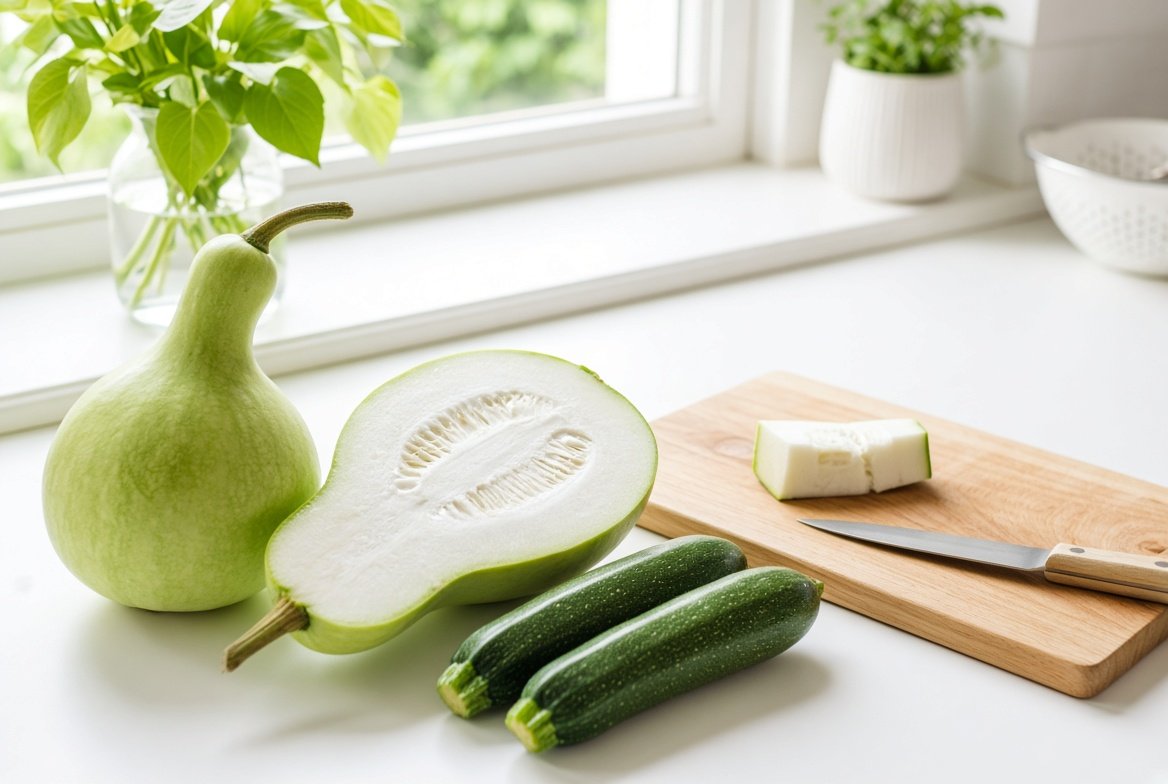
The One Rule
If a piece of bottle gourd, squash, courgette or cucumber tastes bitter — even slightly — spit it out and throw away the whole fruit.
Do not cook it out. Do not dilute it. Do not finish the glass because you paid for it or because it is supposed to be good for you.
That single sentence is the entire safety margin, and it has been enough for as long as people have grown these plants. What follows is why it works, what happens when it is ignored, and why the problem is getting worse rather than better.
What Turns a Gourd Bitter
Plants in the cucumber family — Cucurbitaceae — make a class of compounds called cucurbitacins. They are triterpenoids, and they are among the most bitter substances in nature. Their purpose is defence: they make the plant unpalatable to insects and grazing animals.
Thousands of years of selective breeding removed most of them from the varieties we eat. Cultivated bottle gourd, courgette, cucumber and marrow are bred to be bland.
But the genes are still there. Cucurbitacin B production in these plants is under active genetic regulation, tied to the plant’s stress and cold-tolerance machinery [1]. Drought, heat, irregular watering, poor soil, or a plant grown from saved seed that has cross-pollinated with an ornamental gourd — any of these can switch the pathway back on.
The result is a fruit that looks completely normal and tastes intensely bitter.
The bitterness is not a side effect. It is the warning. Your tongue detects cucurbitacins at extraordinarily low concentrations, and that sensitivity is not an accident of evolution — it is a chemical alarm that works.
What Happens If You Ignore It
Cucurbitacin poisoning is not an upset stomach. It attacks the lining of the gastrointestinal tract.
The published cases follow a consistent pattern. A 41-year-old man in Singapore drank bottle gourd juice and arrived at the emergency department vomiting blood, with diarrhoea. He was resuscitated with fluids and proton pump inhibitors, underwent endoscopy, and was discharged after five days [2].
A 35-year-old man in Bengaluru drank concentrated bottle gourd juice and presented with repeated vomiting, bloody diarrhoea and dizziness. He spent four days in hospital, including critical care [3].
An elderly woman in Gujarat drank bitter bottle gourd juice and was in shock within hours, with bleeding [4].
The clinical picture across reports: violent vomiting, haematemesis, bloody diarrhoea, abdominal pain, dehydration, hypotension, gastrointestinal haemorrhage. Onset is fast — minutes to hours [5].
There is no antidote. Every published case is managed the same way: intravenous fluids, acid suppression, antiemetics, transfusion if bleeding is severe, and supportive care until it passes [2][3][4]. Emergency physicians writing these reports say the same thing each time — the danger is that the diagnosis is not considered, because nobody asks the patient what they drank.
This Is Not Only a Tropical Problem
Bottle gourd poisoning is usually framed as an Indian or South Asian issue, tied to traditional juice therapy. That framing is wrong, and it is the reason European and North American readers dismiss it.
Between 2012 and 2016, French Poison Control Centres recorded 353 patients poisoned by non-edible bitter squash [6].
The details of that series are the most useful thing in this entire article:
- 95.5% were dietary exposures — people eating an ordinary meal
- 55.8% of the squash was bought in a shop. Only a quarter came from a garden
- 71.7% of cases were collective — whole families poisoned at one table
- Average age 38; 204 patients developed symptoms
- Symptoms included diarrhoea, vomiting, abdominal pain, dehydration, hypotension, tachycardia, headache and vertigo
No deaths in that series, and no severe cases — but fourteen of moderate severity, and hundreds of people ill from courgettes and squash bought at a French supermarket.
German physicians have published the same thing [7]. This happens wherever squash is eaten, which is everywhere.
If you grow courgettes from saved seed, this applies to you directly. Home-saved cucurbit seed readily crosses with ornamental gourds, and the offspring can carry the bitter genes back.
Cooking Does Not Save You
This is the part people get wrong most often, and it is worth being precise about.
Cucurbitacins are stable triterpenoids. They are not proteins; there is no enzyme to denature, no volatile to boil off. Work quantifying cucurbitacin B in bottle gourd found that neither gamma irradiation nor β-glucosidase treatment significantly reduced its concentration [8] — two interventions considerably more aggressive than a pan.
The same study measured where it sits: peel highest, then juice, then pulp [8]. Peeling helps a little. It does not make a bitter fruit safe.
Cooking changes nothing that matters. If it was bitter raw, it will be bitter and toxic cooked. The only thing heat reliably does is make it harder to notice, because seasoning masks the taste.
Why the Juice Is the Dangerous Form
Every serious case above involved juice, and that is not coincidence.
Bottle gourd juice is promoted as a health tonic across a large part of the world — for weight loss, for diabetes, for cholesterol, for the liver. The recommendation usually comes from practitioners of alternative therapy, and increasingly from wellness content online [5].
The underlying idea is not baseless. Extracts of Lagenaria siceraria do show antihyperlipidaemic effects — in rats [9]. That is where the evidence stops. There is no human trial establishing that drinking bottle gourd juice lowers cholesterol in a person.
But juicing does three things at once, and each one removes a layer of protection:
It concentrates. A glass of juice contains the soluble content of far more fruit than you would eat in a sitting.
It removes the pause. Eating a cooked dish is slow. A mouthful is tasted, chewed, assessed. Juice is drunk.
It carries an instruction to persist. This is the decisive one. Somebody who is told a bitter drink is medicine will finish it. Bitterness gets reinterpreted as potency — it tastes strong, so it must be working.
That reinterpretation is what puts people in hospital. The alarm still sounded. They were told to override it.
What Tradition Actually Knew
Here is what deserves emphasis, because the usual telling gets it backwards.
Traditional cooking did not fail here. Traditional cooking is the safety system.
Every kitchen tradition that uses bottle gourd — across South Asia, the Middle East, North Africa, the Mediterranean, China — prepares it the same way. It is peeled. It is cut. It is cooked slowly with other ingredients. And critically, the cook tastes as they go. That is not a technique for flavour alone; it is quality control, performed by the person best placed to catch the problem, before anyone else is served.
A cook who tasted a bitter gourd threw it out. No chemistry was required, and no laboratory. The plant announced itself, and the practice was built around listening.
What has changed is not the vegetable. What changed is that a modern wellness industry took the fruit out of the kitchen, removed the cooking, removed the tasting, concentrated it into a glass, attached a health claim to it, and told people to drink it on an empty stomach every morning.
Nature provided the warning. Tradition was built around it. The health-drink trend deleted it.
This is the same pattern we traced through reishi, spirulina and shilajit — a traditional material with a real place, extracted from the practice that made it safe, and sold as a concentrate to people who were never told what to watch for.
The Practical Rules
Taste a small raw piece before you cook. One nibble at the cut end. Bland is fine. Bitter means discard the entire fruit — not the bitter half, all of it.
If you are juicing, taste the juice before you swallow a mouthful. Then swallow. Then wait.
Bitter means bin, not compost-and-eat-the-rest. Cucurbitacin distribution within a fruit is uneven, so a non-bitter slice from a bitter gourd proves nothing.
Never override bitterness because something is “supposed to be healthy.” No traditional system anywhere instructs you to eat a bitter gourd. That instruction is modern and it is wrong.
Be extra careful with home-saved cucurbit seed, and with fruit from plants that were drought-stressed or grown near ornamental gourds.
If someone develops violent vomiting, bloody vomit or bloody diarrhoea after eating or drinking gourd or squash, go to hospital and say what they consumed. Treatment is supportive and effective, but only if the cause is recognised [2][3].
Frequently Asked Questions
Is bottle gourd safe to eat?
Yes — cooked, non-bitter bottle gourd is an ordinary, perfectly good vegetable eaten by hundreds of millions of people. The danger is specifically bitter fruit, and specifically concentrated juice. Taste before cooking and it is a non-issue.
Can I drink bottle gourd juice for weight loss or cholesterol?
There is no human trial supporting it. The lipid-lowering evidence comes from rats [9], and juice is the form implicated in every serious poisoning case in the literature [2][3][4][5]. If you want the vegetable, eat it cooked. The juice adds risk without demonstrated benefit.
Does cooking destroy the toxin?
No. Cucurbitacins are heat-stable triterpenoids. Neither gamma irradiation nor enzymatic treatment reduced them meaningfully in laboratory testing [8], and ordinary cooking is far gentler than either. Cooking only masks the taste.
What does cucurbitacin poisoning feel like?
Rapid onset — minutes to hours — of severe vomiting, abdominal cramping and diarrhoea, which may become bloody. Dehydration, low blood pressure, rapid heartbeat, dizziness and headache follow in more serious cases [6]. Anyone vomiting blood needs emergency care.
Can supermarket courgettes be bitter?
Yes. In the French series, 55.8% of the implicated squash was shop-bought [6]. It is uncommon, but it is not rare enough to ignore — and because families share a dish, one bitter fruit poisons several people at once.
Is bitter melon the same thing?
No. Bitter melon (Momordica charantia, karela) is deliberately bitter, from different compounds, and is eaten intentionally across Asia. Bitterness in bitter melon is normal. Bitterness in bottle gourd, courgette, cucumber or marrow is a warning.
My gourd was only slightly bitter. Is that a problem?
Treat it as one. Cucurbitacin concentration is uneven within a fruit, and “slightly bitter” at the end you tasted does not tell you about the rest. The cost of discarding one vegetable is trivial. The cost of being wrong is an endoscopy.
Conclusion
Bottle gourd, courgette and squash are good vegetables with a long and honourable place in cooking. Nothing here argues against eating them.
What it argues against is the removal of the safety check. The plant evolved a warning that human taste can detect at vanishingly small concentrations. Every traditional cuisine that uses these vegetables built a practice around noticing it — peel, cut, taste, cook, taste again.
Then that fruit was pulled out of the kitchen, concentrated into a glass, labelled a tonic, and handed to people who had been told in advance that it would be good for them. In France, 353 people were poisoned in five years by squash they mostly bought in shops [6]. In emergency departments from Singapore to Gujarat, patients arrive vomiting blood after a health drink [2][3][4].
The remedy is not fear of vegetables. It is the oldest rule in any kitchen worth the name.
Taste it first. If it is bitter, throw it away.
For the wider picture on these plants and the rest of the forgotten vegetable heritage, see wild greens, forgotten roots and herbal infusions. For how vegetables work as a food group, see our guide to fibre, prebiotics and raw versus cooked.
Scientific Sources and References
- Wang, S., Zhao, X., Wang, X., & Wang, M. (2026). “CmBt and CmBr synergistically regulate cucurbitacin B biosynthesis in melon.” Plant Physiology, 201(2). PMID 42184345
- Lee, W. T., Ng, G. G., & Phua, D. H. (2022). “Bottle gourd (Lagenaria siceraria) toxicity diagnosed in the emergency department.” Journal of Emergency Medicine, 63(2), e49–e52. PMID 35871990
- Varun, H. S., Pandya, K., & Muniraju, M. (2024). “Health drink poisoning — an unusual case of bottle gourd toxicity.” Journal of Emergencies, Trauma, and Shock, 17(1), 40–42. PMID 38681874
- Chavda, D. M., Parikh, C., Patel, V. V., & Pandya, P. S. (2022). “Bitter bottle gourd poisoning: a case report and review of literature.” Journal of Family Medicine and Primary Care, 11(7), 4042–4044. PMID 36387703
- Hussain, S., Saini, V., Varshney, V. K., & Bhargava, N. (2023). “Bottle gourd juice: poison or panacea.” Cureus, 15(6), e40886. PMID 37492831
- Le Roux, G., Leborgne, I., Labadie, M., et al. (2018). “Poisoning by non-edible squash: retrospective series of 353 patients from French Poison Control Centers.” Clinical Toxicology, 56(8), 790–794. PMID 29323540
- Jung, C., Steuber, B., & Schwörer, H. (2020). “Food poisoning by cucurbitacines.” Deutsche Medizinische Wochenschrift, 145(14), 988–990. PMID 32668470
- Saurabh, C. K., Ghosh, S. K., & Sanyal, B. (2023). “Novel detection method to rapidly quantify toxic cucurbitacin in Lagenaria siceraria (bottle gourd).” Journal of Food Science and Technology, 60(1), 160–170. PMID 36618033
- Ghule, B. V., Ghante, M. H., Saoji, A. N., & Yeole, P. G. (2009). “Antihyperlipidemic effect of the methanolic extract from Lagenaria siceraria Stand. fruit in hyperlipidemic rats.” Journal of Ethnopharmacology, 124(2), 333–337. PMID 19397976
Last reviewed: September 2026. Vivid Remedy publishes independently researched, evidence-based health content cross-referenced against current peer-reviewed scientific literature. This content does not constitute medical advice. If you suspect poisoning, contact emergency services or your national poison control centre immediately.