Introduction
Chronic conditions — cardiovascular disease, type 2 diabetes, hypertension, autoimmune disease — are lifelong. People living with them take medication daily, monitor themselves closely, and move through a healthcare system that often treats the number on the test rather than the reason it moved.
And underneath all of it sits a fact that rarely gets said plainly: you cannot out-medicate a bad diet.
A person taking medication for a condition their diet is still actively producing is not treating that condition. They are slowing it, at cost, while the cause carries on working. The prescription buys time. It does not buy exemption.
But there is a second layer to this that almost nobody writes about clearly, and it is more urgent than the first. Some foods do not merely work against the condition — they work against the drug itself, changing how much of it reaches your bloodstream or how well it does its job.
This article covers both: the dietary patterns that undermine treatment, and the specific food–medicine interactions that can make a correctly prescribed dose behave like the wrong one.
Part One: Three Interactions Worth Knowing
These are not general advice. They are documented pharmacological interactions, and each affects a drug taken by millions of people every day.
Warfarin and vitamin K — the one most people get backwards
This is the interaction most often misunderstood, including in health writing that should know better.
Warfarin has nothing to do with cholesterol. It is an anticoagulant — it works by interfering with vitamin K–dependent clotting factors. It does not lower cholesterol, and eating a steak does not undermine it.
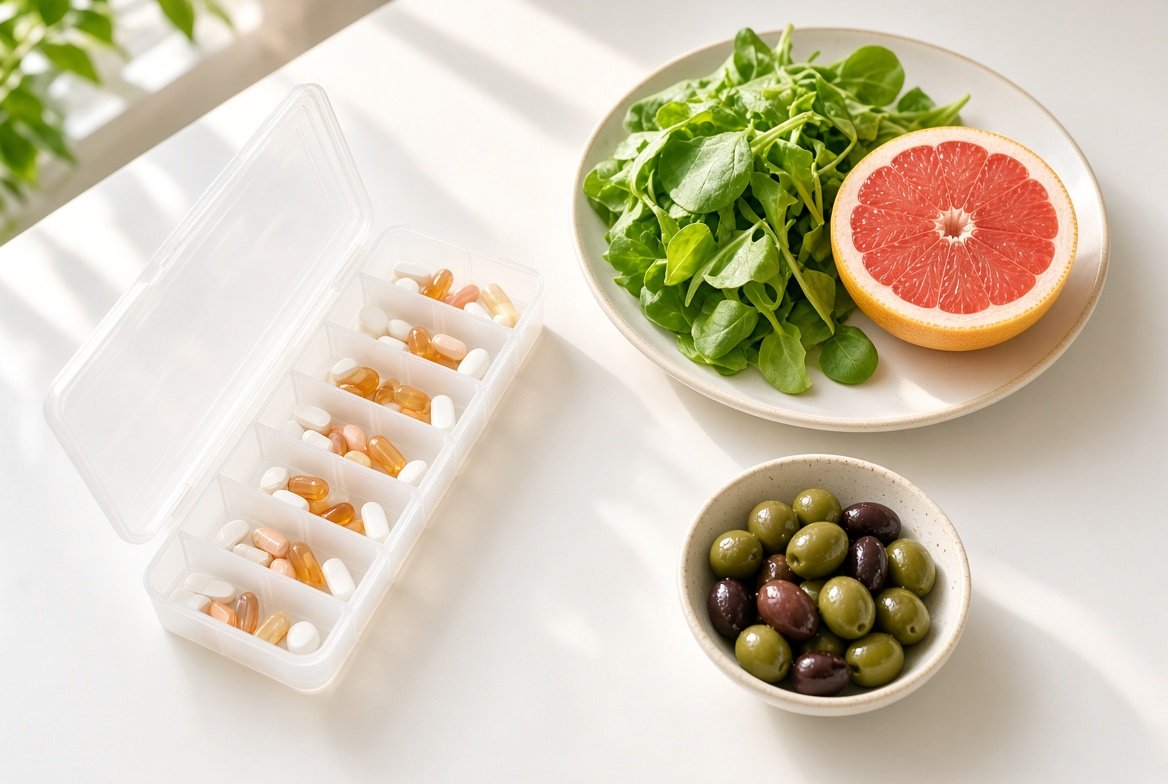
What does affect warfarin is vitamin K itself — and the richest dietary sources are leafy greens. Kale, spinach, chard, broccoli, sprouts. A sudden increase in vitamin K intake opposes warfarin’s action and can push the INR down, raising clot risk. A sudden decrease does the reverse and raises bleeding risk. Case reports of dietary destabilisation are well documented [11].
And here is why this matters for anyone reading health content: an article telling a cardiac patient to “eat abundant vegetables” is giving advice that, for a warfarin patient specifically, can be dangerous — not because greens are bad, but because changing the amount suddenly is.
The rule is consistency, not avoidance. Do not stop eating greens. Do not double them overnight either. Keep intake roughly steady week to week, and tell your anticoagulation clinic if your diet changes substantially. This does not apply to the newer anticoagulants — apixaban, rivaroxaban and similar — which do not work through vitamin K.
Statins and grapefruit
Grapefruit inhibits CYP3A4, the intestinal enzyme that metabolises several statins. Blocking it means more of the drug enters circulation than intended — effectively an unplanned overdose, with elevated risk of muscle toxicity.
It does not affect all statins equally. Simvastatin and atorvastatin are the ones to watch; pravastatin and rosuvastatin take different metabolic routes and are largely unaffected [12].
Check which statin you take, then check the label. This one is easy to get right and easy to get wrong.
Metformin and vitamin B12
The best-evidenced of the three, and the least known by the people it affects.
In the Diabetes Prevention Program Outcomes Study, long-term metformin use was significantly associated with vitamin B12 deficiency — the effect increasing with duration of use [13]. Metformin interferes with B12 absorption in the ileum.
B12 deficiency causes fatigue, cognitive difficulty and peripheral neuropathy — and peripheral neuropathy is also a complication of diabetes itself. Which means a person on long-term metformin developing numb feet may be attributing to their diabetes something their medication is causing, and which is correctable.
If you have taken metformin for several years, ask for a B12 level. We set out what B12 deficiency does, and why it is usually an absorption problem, in vitamin D and B12 deficiency.
Part Two: When the Diet Feeds the Disease
Now the broader argument — and here the evidence is about the condition rather than the drug.
Cardiovascular disease
Saturated fat raises LDL cholesterol and contributes to atherosclerotic plaque formation. Siri-Tarino and colleagues examined the relationship in detail, and the picture that emerges is one of replacement: what matters is not only reducing saturated fat but what takes its place [1]. Swapping it for refined carbohydrate achieves little; swapping it for unsaturated fat and whole plant foods achieves a great deal.
On poultry, a common assumption deserves correction. Chicken is routinely recommended as the “healthy” meat, but Wang and colleagues analysed modern broiler and organic chickens sold for consumption and found they now provide more energy from fat than from protein — a substantial change from the bird of fifty years ago [2]. Chicken is not a low-fat food by default any more.
On reversal, one claim needs correcting because it circulates constantly. Ornish’s lifestyle trial demonstrated regression of coronary stenosis in an intensive-intervention group [3] — a genuine and important result in a small trial. But the claim that “no drug has achieved this” is false. Lipid-lowering therapy produces documented coronary plaque regression, now shown across multiple imaging trials [4].
Diet and medication are not rivals here. They act through different routes on the same disease, and the honest position is that both work.
The strongest single dietary trial remains PREDIMED, where adding extra virgin olive oil or nuts to a Mediterranean pattern cut the rate of heart attack, stroke and cardiovascular death [7] — a result supported by broader meta-analysis of Mediterranean adherence [10]. For a food-level approach to cholesterol specifically, the fibre evidence behind carob is unusually direct.
Type 2 diabetes
There is a trap here that catches people constantly. Told to avoid sugar, they turn to meat — reasoning that meat contains no carbohydrate and therefore cannot raise glucose.
The glucose reading is not the whole disease. Type 2 diabetes is fundamentally a disorder of insulin resistance, and dietary fat quality influences insulin sensitivity independently of carbohydrate intake. Risérus, Willett and Hu reviewed the evidence and found saturated fat associated with worse insulin sensitivity, while unsaturated fats are associated with better [5].
So a diet that avoids sugar while loading saturated fat can hold the glucose number steady in the short term while the underlying resistance worsens.
Barnard and colleagues tested the opposite approach directly: a randomised trial in people with type 2 diabetes found a low-fat plant-based diet improved glycaemic control and cardiovascular risk factors, with a proportion of participants reducing their medication [6].
That last point is the one to hold on to. In a trial, diet change altered how much medication people needed. Any change to diabetes medication belongs with the doctor managing it — but the direction of travel is real.
Sodium and processed food
Reducing salt lowers blood pressure and cardiovascular risk, and the outcome-trial evidence supports it [8]. For anyone on antihypertensive medication, a high-sodium diet is straightforwardly working against the prescription.
Beyond sodium, food additives are a live question. Chassaing and colleagues showed dietary emulsifiers altered the gut microbiota, thinned the intestinal mucus layer and promoted colitis and metabolic syndrome — in mice [9]. We flag the species because it matters. Mouse colitis models do not automatically transfer to human guts, and no equivalent trial in people has been done.
The microbiota side of this is covered properly in fibre, prebiotics and raw versus cooked.
Autoimmune disease
Manzel and colleagues reviewed the role of the Western dietary pattern in inflammatory autoimmune disease, describing plausible mechanisms through gut barrier function, microbiota composition and T-cell differentiation [18].
This is mechanistic and epidemiological work, not trial evidence that diet change treats autoimmune disease. Nobody should reduce immunosuppressive medication on the basis of a dietary change, and this article is not suggesting it. But eating in a way that does not actively drive inflammation is a reasonable thing to do alongside proper treatment.
Prostate enlargement
Bravi and colleagues found dietary patterns higher in saturated fat and cholesterol associated with increased risk of benign prostatic hyperplasia in a case-control study [19].
That is a finding about risk, in an observational design. It is not evidence that removing animal products shrinks an existing prostate, and claims about specific reductions in night-time urination have no trial behind them. Worth knowing; not worth overstating.
Part Three: Hormonal Contraception — A Section That Needs Care
This one requires more caution than the rest, because the decision has consequences the others do not.
The associations are real and worth knowing. Synthetic oestrogen raises thyroid-binding globulin, altering thyroid hormone availability — relevant to anyone being investigated for thyroid dysfunction [14]. A prospective study found oral contraceptive use associated with higher risk of hypertension [15]. Hormonal contraceptives are associated with changes in inflammatory markers [16]. And a large Danish cohort found hormonal contraception associated with subsequent antidepressant use and depression diagnosis, with the strongest association in adolescents [17].
So if you are being treated for headaches, raised blood pressure, thyroid symptoms or low mood, your contraception belongs in that conversation. It is a genuine variable, and it is often left out.
But the framing matters enormously. These are associations, not certainties; the absolute risk increases are modest; and hormonal contraception is highly effective at preventing pregnancy, which carries its own substantial health consequences.
This article is not telling you to stop taking it. It is telling you to raise it with your doctor as a possible contributor, so the decision is made with someone who knows your history — not on the basis of a website.
What This Actually Means
Medication is a tool, not a licence. “I take my blood pressure tablets, so I can eat what I like” describes a person whose treatment and diet are pulling in opposite directions, with their arteries in between.
But the reverse is equally wrong. Diet does not replace medication for established disease, and nothing in this article should be read as encouragement to stop anything. The Barnard trial reduced medication under supervision, as an outcome — not as a starting assumption.
The two work together. Take the medication as prescribed. Then remove the dietary drivers that are working against it, so the drug is not fighting your dinner.
The practical list
Know your interactions. Warfarin — keep vitamin K steady. Simvastatin or atorvastatin — skip grapefruit. Long-term metformin — get B12 checked.
Build the diet that supports treatment. Cook at home. Olive oil rather than industrial seed oils. Vegetables and legumes in real quantity. Whole grains over refined. Put fish where the red meat used to be, and see our staple foods guide for the whole pattern.
Cut processed food and added salt — the two most direct antagonists of blood pressure treatment.
Never adjust medication yourself. If diet improves your numbers, that is a conversation with your doctor, not a decision to make alone.
Frequently Asked Questions
Can I eat leafy greens on warfarin?
Yes — the rule is consistency, not avoidance. Warfarin works by interfering with vitamin K–dependent clotting factors, so a sudden increase or decrease in vitamin K–rich greens shifts your INR [11]. Keep your intake roughly steady and tell your anticoagulation clinic about substantial diet changes. This does not apply to apixaban or rivaroxaban, which do not work through vitamin K.
Which statins interact with grapefruit?
Mainly simvastatin and atorvastatin, which are metabolised by CYP3A4 — the enzyme grapefruit inhibits, raising drug levels and muscle-toxicity risk [12]. Pravastatin and rosuvastatin use different pathways and are largely unaffected. Check which one you take.
Does metformin cause vitamin B12 deficiency?
Long-term use is significantly associated with it, with risk rising over years of treatment [13]. It matters because B12 deficiency causes peripheral neuropathy — which is also a diabetes complication, so the cause can be missed. If you have taken metformin for several years, ask for a B12 level.
Can diet reverse heart disease?
Intensive lifestyle change produced regression of coronary stenosis in Ornish’s trial [3], and the Mediterranean pattern reduced cardiovascular events in PREDIMED [7]. But the claim that no drug achieves this is wrong — lipid-lowering therapy produces documented plaque regression across imaging trials [4]. Both work, by different routes.
Is chicken healthier than red meat?
Less clear-cut than assumed. Modern broiler and organic chickens sold for consumption now provide more energy from fat than protein [2]. Poultry is not automatically a low-fat choice, and the more useful question is what you replace red meat with [1].
Can I come off my diabetes medication if I change my diet?
Possibly, under supervision — a randomised trial of a plant-based diet saw some participants reduce medication [6]. Never do it on your own. Reducing diabetes medication without monitoring risks dangerous glucose swings. Bring the improvement to your doctor and let them adjust it.
Should I stop hormonal contraception if I have these symptoms?
Not on the basis of an article. The associations with blood pressure, thyroid function and mood are documented [14][15][16][17], and they deserve to be part of your conversation with your doctor. But the absolute risks are modest, and stopping contraception has its own consequences. Raise it; don’t decide it alone.
Conclusion
The idea that medication licences a poor diet is one of the more expensive misunderstandings in chronic disease, and it is easy to see how it takes hold. The prescription feels like the treatment. The food feels like a separate matter.
It isn’t. Saturated fat still raises LDL while you take a statin. Sodium still raises pressure while you take an antihypertensive. And in three specific cases, food does something more direct — grapefruit raising your statin level, greens shifting your INR, metformin quietly depleting the B12 that keeps your nerves working.
None of that argues against medication. Take what you are prescribed. The argument is that a prescription works better when it is not being asked to overcome your last three meals.
You cannot out-medicate a bad diet. But you do not have to choose — the two were never in competition.
Nature provides. Physiology responds. Healing follows.
Scientific Sources and References
- Siri-Tarino, P. W., Sun, Q., Hu, F. B., & Krauss, R. M. (2010). “Saturated fatty acids and risk of coronary heart disease: modulation by replacement nutrients.” Current Atherosclerosis Reports, 12(6), 384–390. PMID 20711693
- Wang, Y., Lehane, C., Ghebremeskel, K., & Crawford, M. A. (2010). “Modern organic and broiler chickens sold for human consumption provide more energy from fat than protein.” Public Health Nutrition, 13(3), 400–408. PMID 19728900
- Ornish, D., Scherwitz, L. W., Billings, J. H., et al. (1998). “Intensive lifestyle changes for reversal of coronary heart disease.” JAMA, 280(23), 2001–2007. PMID 9863851
- Ueki, Y., Itagaki, T., & Kuwahara, K. (2024). “Lipid-lowering therapy and coronary plaque regression.” Journal of Atherosclerosis and Thrombosis, 31(11), 1479–1495. PMID 39111840
- Risérus, U., Willett, W. C., & Hu, F. B. (2009). “Dietary fats and prevention of type 2 diabetes.” Progress in Lipid Research, 48(1), 44–51. PMID 19032965
- Barnard, N. D., Cohen, J., Jenkins, D. J., et al. (2006). “A low-fat vegan diet improves glycemic control and cardiovascular risk factors in a randomized clinical trial in individuals with type 2 diabetes.” Diabetes Care, 29(8), 1777–1783. PMID 16873779
- Estruch, R., Ros, E., Salas-Salvadó, J., et al. (2018). “Primary prevention of cardiovascular disease with a Mediterranean diet supplemented with extra-virgin olive oil or nuts.” New England Journal of Medicine, 378(25), e34. PMID 29897866
- He, F. J., & MacGregor, G. A. (2011). “Salt reduction lowers cardiovascular risk: meta-analysis of outcome trials.” The Lancet, 378(9789), 380–382. PMID 21803192
- Chassaing, B., Koren, O., Goodrich, J. K., et al. (2015). “Dietary emulsifiers impact the mouse gut microbiota promoting colitis and metabolic syndrome.” Nature, 519(7541), 92–96. PMID 25731162
- Sofi, F., Cesari, F., Abbate, R., et al. (2008). “Adherence to Mediterranean diet and health status: meta-analysis.” BMJ, 337, a1344. PMID 18786971
- Rangecroft, A., & Prabhu, S. S. (2021). “Pickles and warfarin interaction: a case-based review.” Clinical Rheumatology, 40(4), 1621–1624. PMID 32778973
- Bailey, D. G. (2016). “Better to avoid grapefruit with certain statins.” The American Journal of Medicine, 129(11), e301. PMID 27770845
- Aroda, V. R., Edelstein, S. L., Goldberg, R. B., et al. (2016). “Long-term metformin use and vitamin B12 deficiency in the Diabetes Prevention Program Outcomes Study.” Journal of Clinical Endocrinology and Metabolism, 101(4), 1754–1761. PMID 26900641
- Santin, A. P., & Furlanetto, T. W. (2011). “Role of estrogen in thyroid function and growth regulation.” Journal of Thyroid Research, 2011, 875125. PMID 21687614
- Chasan-Taber, L., Willett, W. C., Manson, J. E., et al. (1996). “Prospective study of oral contraceptives and hypertension among women in the United States.” Circulation, 94(3), 483–489. PMID 8759093
- Divani, A. A., Luo, X., Datta, Y. H., et al. (2015). “Effect of oral and vaginal hormonal contraceptives on inflammatory blood biomarkers.” Mediators of Inflammation, 2015, 379501. PMID 25861161
- Skovlund, C. W., Mørch, L. S., Kessing, L. V., & Lidegaard, Ø. (2016). “Association of hormonal contraception with depression.” JAMA Psychiatry, 73(11), 1154–1162. PMID 27680324
- Manzel, A., Muller, D. N., Hafler, D. A., et al. (2014). “Role of ‘Western diet’ in inflammatory autoimmune diseases.” Current Allergy and Asthma Reports, 14(1), 404. PMID 24338487
- Bravi, F., Bosetti, C., Dal Maso, L., et al. (2006). “Macronutrients, fatty acids, cholesterol, and risk of benign prostatic hyperplasia.” Urology, 67(6), 1205–1211. PMID 16765180
Last reviewed: September 2026. Vivid Remedy publishes independently researched, evidence-based health content cross-referenced against current peer-reviewed scientific literature. This content does not constitute medical advice. Never stop, reduce or change prescribed medication without consulting the doctor who prescribed it. If you take warfarin, discuss any substantial dietary change with your anticoagulation clinic.