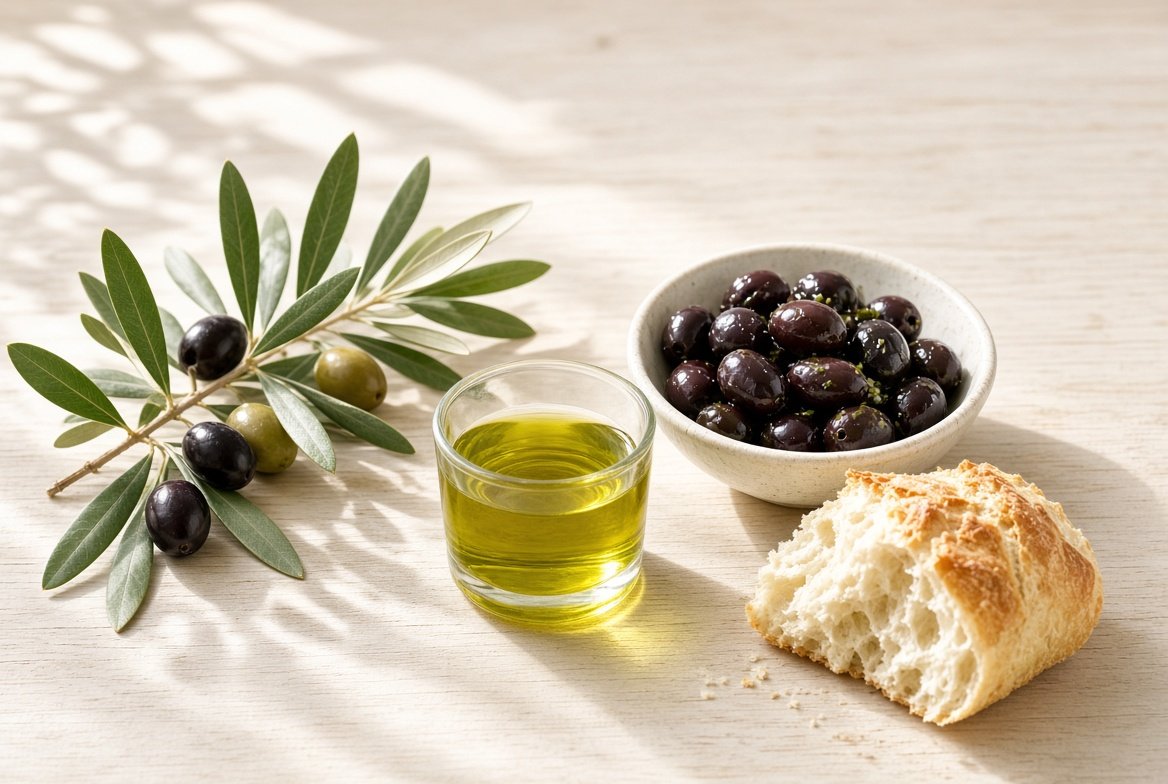
Olea europaea L. · Oleaceae · native to the Mediterranean basin · fruit (table olive), pressed fruit (oil), leaf
Identification
A slow-growing evergreen tree of dry, stony Mediterranean hillsides, 5–10 m tall, with a gnarled grey trunk that can live for many centuries, and narrow, leathery, lance-shaped leaves — dark green above, silvery-white beneath — that give an olive grove its shimmering look in wind. Small cream-white flowers in spring; the fruit is a drupe, 1–3 cm, green when unripe and ripening through violet to black in autumn, with a single hard stone [1].
Raw from the tree, the fruit is inedibly bitter — the one orchard fruit that cannot be eaten from the branch. It becomes food only by pressing (oil) or by curing (table olives), and the method of curing decides what is left of its value [1][2].
Traditional use
Domesticated in the eastern Mediterranean some six thousand years ago, the olive is the tree of the region’s civilisations: its oil was food, lamp fuel, medicine, cosmetic and sacrament, and its branch the sign of peace. Around the whole Mediterranean, olive oil was the household fat — for cooking, for bread, for everything — and table olives the everyday relish [1][2]. The leaf was infused for fevers and, in later folk medicine, for high blood pressure; the oil was used on skin and wounds and as a gentle laxative. Of these, it is the oil-as-sole-fat tradition that modern research has vindicated most completely [2][3].
What’s in it
The oil
Virgin olive oil is about 98–99% triglycerides — dominated by oleic acid (55–83% of fatty acids), with palmitic (8–20%), linoleic (3–21%) and small amounts of stearic and linolenic — and 1–2% of a minor fraction that carries nearly all its distinctive value: squalene (up to 0.7%, more than any other common food), α-tocopherol (100–300 mg/kg), sterols led by β-sitosterol, pigments, aroma volatiles, and the phenolic compounds, 50–800 mg/kg depending on cultivar, ripeness and handling [1][4]. The phenols are what distinguish one extra-virgin oil from another: hydroxytyrosol and tyrosol, their secoiridoid esters oleacein and oleocanthal, oleuropein aglycone, and the lignans pinoresinol and acetoxypinoresinol [1][4].
The fruit
The unripe fruit’s bitterness is oleuropein, a secoiridoid glycoside that hydrolyses on ripening and during fermentation to hydroxytyrosol [1][4]. Ripe fruit is 12–30% oil, with fibre, a little protein, and calcium, iron and vitamin E. Curing decides the rest: naturally brine-fermented olives keep a substantial share of their phenols; industrially lye-debittered olives keep about one-tenth [5]. All cured olives are salty — typically 1–2 g sodium per 100 g.
The leaf
Richer in oleuropein than the fruit — up to several percent of dry weight — with hydroxytyrosol, verbascoside, luteolin and other flavonoids [1]. Leaf extracts are sold as supplements; see the evidence below.
What the evidence shows
Stated carefully: the olive has better human evidence than any other plant in this library. In a randomised crossover trial of 200 men, three oils identical in fat but differing in phenol content raised HDL and lowered oxidised LDL in proportion to their phenol content [6]; the European food-safety authority accepts on that basis a claim that 5 mg/day of hydroxytyrosol and its derivatives — about 20 g of a phenol-rich oil — protects blood lipids from oxidation [7]. In a 7,447-person randomised trial, a Mediterranean diet with extra-virgin olive oil as its fat cut major cardiovascular events by about 30% over five years [3]. The oil’s oleocanthal inhibits the same COX enzymes as ibuprofen; 50 g of oil a day is about a tenth of an ibuprofen dose [8]. For the leaf, a meta-analysis of trials in people with raised blood pressure found olive-leaf extract lowered systolic and diastolic pressure and LDL modestly [9] — the one traditional leaf use with controlled evidence. We go through the oil, the fruit and the processing in our article on why the olive’s bitterness is the gift.
Cautions
- Salt. Cured olives carry 1–2 g sodium per 100 g. Relevant for anyone on a salt-restricted diet; the oil carries none.
- Leaf extracts and blood pressure. They can add to the effect of antihypertensive medication; anyone on such drugs should not add a leaf supplement without medical advice. The oil and the fruit are foods and carry no such caution.
- Allergy. Olive pollen is a major seasonal allergen across the Mediterranean; allergy to the fruit or oil is rare but reported.
- Pregnancy, breastfeeding and children. Oil and fruit are staple foods with no restriction. Concentrated leaf extracts have not been studied in pregnancy and should be avoided.
- Dose. 30–50 g of oil a day, replacing other fats, is the range with trial evidence. Drinking oil as a “cure” has none.
Origin, and how to recognise the real thing
Olive oil is, by most accounts, the most adulterated food product in the world: extra-virgin cut with refined olive oil, with cheaper seed oils, or simply mislabelled from a lower grade. Laboratories detect it through the fatty-acid and sterol profile, UV absorbance and, increasingly, spectroscopy and chemometrics [10]. For the buyer, the tools are simpler:
- Taste it. Real extra-virgin oil is fruity, then bitter on the tongue, then peppery in the throat — the bitterness is oleuropein’s family, the sting is oleocanthal. An oil that is merely smooth and buttery is either low in phenols or not what the label says.
- Smell it. Fresh-cut grass, green tomato, artichoke, apple. Any hint of crayon, putty, wet cardboard or rancid nut is a defect and disqualifies the oil from the extra-virgin grade, whatever the label says.
- The label. A harvest date (not only a best-before), a single origin or a named mill, and — increasingly — a stated phenol content in mg/kg. “Cold-pressed” and “first press” are meaningless: all extra-virgin oil is mechanically extracted by definition. “Pure”, “light” or plain “olive oil” means refined.
- The bottle. Dark glass or tin, from a cool shelf. Clear bottles under shop lights are losing their phenols as you look at them.
- Table olives. Naturally fermented olives are darker, often wrinkled, variable in colour, sold in cloudy brine or from the barrel, and taste bitter and complex. Uniform bright-green olives in clear brine are lye-treated; “sodium hydroxide” or “E524” on the label confirms it.
- The price. A litre of genuine early-harvest extra-virgin oil costs what several kilograms of fruit and a mill’s time cost. A very cheap “extra-virgin” is not.
Back to the Herbs & Plants Index.
References
- Ghanbari R, Anwar F, Alkharfy KM, Gilani AH, Saari N. Valuable nutrients and functional bioactives in different parts of olive (Olea europaea L.) — a review. International Journal of Molecular Sciences. 2012;13(3):3291–3340. PMID 22489153
- Keys A, Menotti A, Karvonen MJ, et al. The diet and 15-year death rate in the Seven Countries Study. American Journal of Epidemiology. 1986;124(6):903–915. PMID 3776973
- Estruch R, Ros E, Salas-Salvadó J, et al. Primary prevention of cardiovascular disease with a Mediterranean diet supplemented with extra-virgin olive oil or nuts. New England Journal of Medicine. 2018;378(25):e34. PMID 29897866
- Romani A, Ieri F, Urciuoli S, et al. Health effects of phenolic compounds found in extra-virgin olive oil, by-products, and leaf of Olea europaea L. Nutrients. 2019;11(8):1776. PMID 31374907
- Nikzad N, Sahari MA, Vanak ZP, Safafar H, Boland-nazar SA. Effect of the processing steps on compositions of table olive since harvesting time to pasteurization. Recent Patents on Food, Nutrition & Agriculture. 2013;5(2):154–165. PMID 23688142
- Covas MI, Nyyssönen K, Poulsen HE, et al. The effect of polyphenols in olive oil on heart disease risk factors: a randomized trial. Annals of Internal Medicine. 2006;145(5):333–341. PMID 16954359
- EFSA Panel on Dietetic Products, Nutrition and Allergies. Scientific opinion on the substantiation of health claims related to polyphenols in olive and protection of LDL particles from oxidative damage. EFSA Journal. 2011;9(4):2033. doi:10.2903/j.efsa.2011.2033
- Beauchamp GK, Keast RS, Morel D, et al. Phytochemistry: ibuprofen-like activity in extra-virgin olive oil. Nature. 2005;437(7055):45–46. PMID 16136122
- Ismail MA, Norhayati MN, Mohamad N. Olive leaf extract effect on cardiometabolic profile among adults with prehypertension and hypertension: a systematic review and meta-analysis. PeerJ. 2021;9:e11173. PMID 33868820
- Ordoudi SA, Strani L, Cocchi M. Toward the non-targeted detection of adulterated virgin olive oil with edible oils via FTIR spectroscopy and chemometrics: research methodology trends, gaps and future perspectives. Molecules. 2023;28(1):337. PMID 36615530
Last reviewed: September 2026. This entry describes traditional and documented use. It is not medical advice.