Introduction
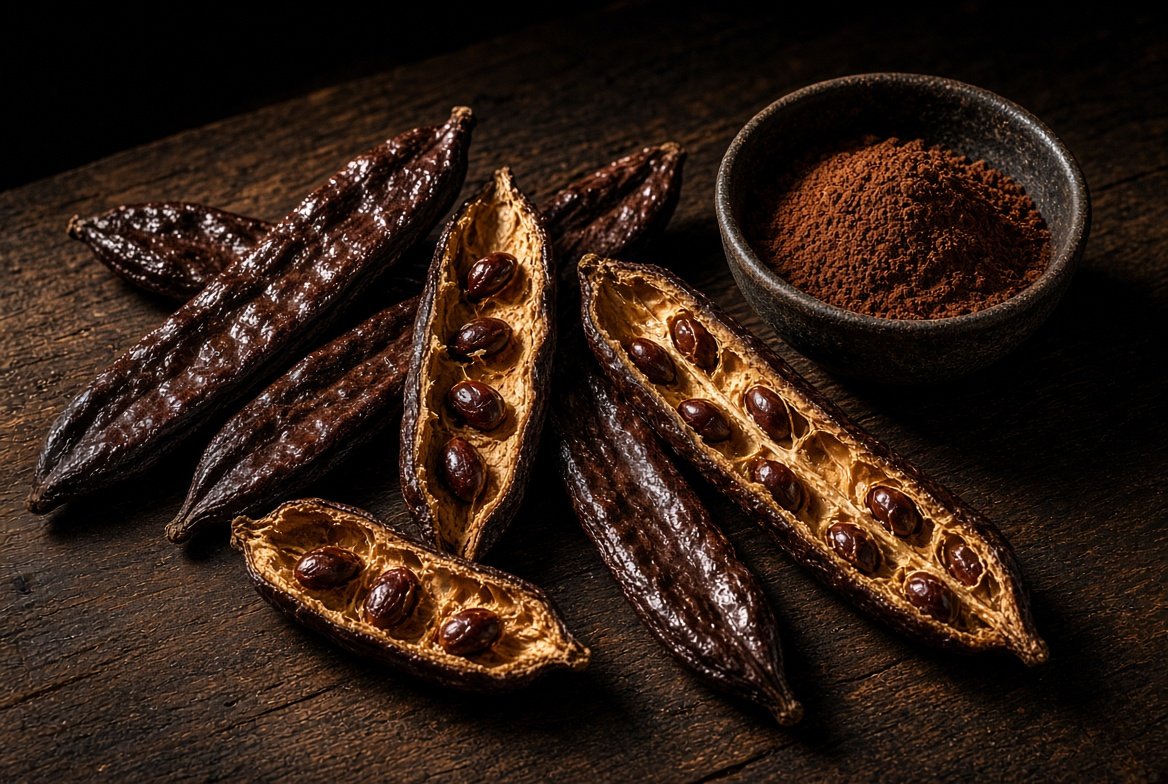
Carob (Ceratonia siliqua) is an ancient Mediterranean tree fruit that has nourished civilizations for over 4,000 years — yet remains tragically underutilized in modern diets.
This long, dark-brown pod contains a wealth of nutritional compounds that modern science is only now fully appreciating: exceptional dietary fiber, mineral-dense electrolytes, powerful polyphenols, and the remarkable ability to suppress hunger naturally.
Native to the Mediterranean basin, carob thrives in warm, sunny climates. Major producers include Spain, Portugal, Italy, Greece and Turkey. The pod pulp is consumed as a sweet, nutritious food or ground into flour, while the seeds are processed into locust bean gum — a natural food thickener.
Key Takeaways
- Carob pods contain 6–8% protein and are rich in potassium, calcium and phosphorus
- Its fiber slows gastric emptying, promotes satiety and lowers the active hunger hormone ghrelin after a meal
- Carob is a documented source of gallic acid — a powerful antioxidant with anti-inflammatory properties
- A carob snack lowers the blood sugar response to the meal that follows it
- Two randomised trials found carob fiber lowered LDL cholesterol in people with high cholesterol
- Carob coffee contains no cafestol — the cholesterol-raising compound found in unfiltered coffee
1. Nutritional Profile: What Makes Carob Special
Carob pods contain approximately 6–8% protein and 15–50% total sugars (dry weight), depending on variety and growing conditions [1].
However, the typical consumption amount — a few pods or a spoonful of carob powder — does not provide meaningful protein or sugar intake.
The real nutritional value of carob lies elsewhere:
| Nutrient | Amount per 100 g | Function |
|---|---|---|
| Dietary fiber | ~40 g, predominantly insoluble | Satiety, gut health, cholesterol |
| Potassium | ~827 mg | Blood pressure regulation, electrolyte balance |
| Calcium | ~348 mg | Bone health, nerve signaling |
| Phosphorus | ~79 mg | Energy production, bone structure |
| Gallic acid | Principal polyphenol | Antioxidant, anti-inflammatory |
Figures for carob flour: USDA FoodData Central [7]; mineral profile confirmed in analytical work on carob fruit, flour and syrup [8].
The philosophy is clear: nature provides complete foods — not isolated compounds. Carob delivers fiber, minerals, antioxidants and polyphenols in a synergistic matrix that no supplement can replicate.
2. The Satiety Effect: How Carob Naturally Suppresses Hunger
A. The Fiber That Fills the Stomach
Carob pod is exceptionally rich in dietary fiber — close to 40% of carob flour by weight [7]. And here the detail matters more than the headline.
The fiber that has been tested in humans is the insoluble kind, carrying polyphenols bound to it [2]. This is worth being precise about, because the gel-forming galactomannans most people associate with carob come from the seed, not the pod — that product is locust bean gum, and it is a different thing entirely.
The pod’s own fiber behaves differently, and it has been measured directly in people:
- Adds bulk and slows gastric emptying
- Lowers the active form of the hunger hormone after a meal
- Promotes a lasting feeling of fullness
This is why carob was traditionally consumed during long fasting periods — it sustained people through hours without food.
B. Ghrelin Suppression: The Hunger Hormone
Ghrelin is the “hunger hormone” produced by the stomach. It signals the brain to trigger hunger and accelerate digestion.
Research confirms that carob significantly lowers postprandial acylated ghrelin — the active form of the hunger hormone. In a randomised crossover trial in twenty healthy adults, carob fiber cut acylated ghrelin to 49% of the control meal over the five hours after eating [3].
One honest qualification. The same research group looked at what happened the next day, and found the opposite: fasting acylated ghrelin was higher the morning after carob fiber than after the control [9]. The appetite benefit demonstrated in the literature is the acute one, in the hours after a meal. Whether it persists across days has not been shown, and the one study that looked found it did not.
C. Clinical Evidence of Satiety
A randomised controlled study found that a carob snack eaten before a meal increased satiety, reduced feelings of hunger and desire to eat, and led participants to consume less food and fewer total calories at the meal that followed [4].
3. The Hard Truth: No Weight Loss Without Hunger
There is no supplement, diet or “magic formula” that can bypass the fundamental law of thermodynamics: weight loss requires a sustained caloric deficit [5].
Every effective weight loss intervention — whether pharmaceutical, surgical or dietary — works by reducing caloric intake relative to expenditure [6].
Carob is not a “weight loss miracle.” It is a tool that makes caloric restriction easier by suppressing hunger naturally.
4. Mineral Density: The Electrolyte Powerhouse
Carob is remarkably rich in three essential electrolytes [7][8]:
- Potassium (~827 mg/100 g): critical for blood pressure regulation and muscle function
- Calcium (~348 mg/100 g): essential for bone health and nerve signaling
- Phosphorus (~79 mg/100 g): key for energy production and bone structure
The Calcium Absorption Problem
Calcium is not deficient in nature. It is abundant in leafy greens, legumes, dairy products and fish with bones.
The real problem is impaired absorption [10]. Calcium absorption efficiency varies substantially depending on:
- Vitamin D status (critical for calcium absorption)
- Age
- Hormonal factors
- Dietary inhibitors (oxalates, phytates)
Taking calcium supplements without addressing these absorption barriers is largely ineffective.
This is not a quirk of calcium. It is the general shape of nutritional deficiency: the mineral is present in the food, and the body cannot convert or absorb it. Iron is the clearest case, and we follow the mechanism through copper, lead and inflammation in why you are deficient: the food groups we forgot.
5. Gallic Acid: The Antioxidant Powerhouse
A. What Is Gallic Acid?
Gallic acid is a polyphenol with documented antioxidant and anti-inflammatory properties [11]. It is the principal phenolic compound in carob [12], and analytical work on carob fiber confirms it as the major individual polyphenol present [2].
B. Anti-Cancer Potential
Gallic acid has shown potential anti-cancer properties in laboratory research, through modulation of cellular signaling pathways and induction of apoptosis — programmed cell death [13].
This is preclinical work. It describes what an isolated compound does to cells and in animal models. It is not evidence that eating carob treats or prevents cancer in people, and it should not be read that way.
C. Gut Healing Properties
Carob has documented anti-inflammatory and anti-ulcer effects on the gastrointestinal tract [14].
Laboratory work adds a specific and modest finding: an aqueous carob extract, and gallic acid itself, protected human colon adenoma cells from DNA damage caused by hydrogen peroxide [15]. The same study induced stress-response genes but found no corresponding rise in protein or enzyme activity — the authors concluded plainly that the gene changes could not be tied to functional consequences.
For patients with Crohn’s disease, ulcerative colitis or IBS: carob is not a cure, and the colon-cell work above is a long way from a clinical result. But as a food, it is a reasonable dietary addition with a real traditional record for soothing the gut [14]. Discuss it with the doctor managing your condition.
And if the gut is the reason you are reading this section, the more productive question is usually what is damaging it in the first place. Medications, emulsifiers, additives and repeated antibiotic courses do more harm than most single foods can undo — we set them out in what damages gut bacteria.
6. The Antioxidant–Anti-Inflammatory Connection
Dietary polyphenols exert both antioxidant and anti-inflammatory effects through modulation of NF-κB and other inflammatory signaling pathways [16].
This is the general mechanism by which polyphenol-rich foods are thought to act on:
- Joint pain and arthritis
- Rheumatoid arthritis
- Autoimmune conditions
- Muscle pain
- Chronic inflammation
To be precise: this is the established pharmacology of dietary polyphenols as a class. Carob is a good source of them. No trial has tested carob against any of these conditions, so treat it as a sound reason to eat the food, not as a treatment claim.
7. Blood Sugar Control: Preventing Postprandial Hyperglycemia
A. The Problem
Postprandial hyperglycemia — the blood sugar spike after meals — is a major concern for diabetic patients. It contributes to:
- Oxidative stress
- Endothelial dysfunction
- Long-term diabetic complications
B. The Carob Solution
A carob snack is a genuinely low-glycemic food. In a randomised trial it measured a glycemic index of 40, against 78 for a chocolate cookie containing the same available carbohydrate. Eaten before a meal, it lowered the blood sugar response to that meal [4].
And here is the caveat that matters, because it cuts the other way. When isolated carob fiber was added to a straight 50 g glucose load, it did not blunt the spike — plasma glucose and insulin responses went up, not down [17].
The distinction is practical and worth holding onto: carob works by replacing a high-glycemic food, not by being sprinkled onto sugar. A carob snack instead of a biscuit is supported. Carob powder stirred into something already sweet is not.
Recommendation: 1 tablespoon of carob powder used in place of a sweet or a high-GI snack is the form the evidence supports. Anyone taking diabetes medication should tell the doctor managing it before making the change.
That warning is not a formality. Any food with a real effect on blood glucose becomes a dosing question the moment it meets a glucose-lowering drug, and the same logic applies to a long list of everyday foods and prescriptions — we set out the ones that matter in when diet fights medication.
C. The Dietary Context
Diabetics should:
- Avoid industrial trans fats and limit refined carbohydrate
- Use olive oil as the primary fat source
This aligns with American Diabetes Association guidance [18] and with the Mediterranean diet trial evidence [19].
8. Carob Coffee: The Caffeine-Free, Cafestol-Free Alternative
Carob can be roasted and ground into a coffee-like beverage. But why is it preferable to regular coffee for some people?
Cafestol is a diterpene found in unfiltered coffee that raises LDL cholesterol [20]. It is specific to the coffee bean — carob is a legume pod and contains none of it, nor any caffeine. That makes carob coffee a reasonable choice for:
- Those sensitive to coffee’s cardiovascular effects
- Pregnant women
- Children
- Anyone avoiding caffeine
The Stronger Cholesterol Story
Carob does not merely lack the compound that raises LDL. There is trial evidence that it lowers it.
Two independent randomised, double-blind, placebo-controlled trials tested carob fiber in people with high cholesterol:
| Trial | Participants | Dose and duration | Result |
|---|---|---|---|
| Zunft et al., 2003 [21] | 58 hypercholesterolemic adults | 15 g/day, 6 weeks | LDL cholesterol down 10.5% |
| Ruiz-Roso et al., 2010 [22] | 88 hypercholesterolemic adults | 8 g/day, 4 weeks | Total cholesterol down 17.8%, LDL down 22.5% |
Two trials, two research groups, two countries, the same direction. This is the best-evidenced health effect carob has — and notably, it comes from the insoluble fiber fraction, the same one behind the satiety findings.
Carob is not the only ordinary food with randomised evidence behind a cholesterol claim, and the pattern repeats: a modest, real, thoroughly non-miraculous effect that gets overstated the moment it is sold in a bottle. Garlic has been through the same scrutiny, with the same result — we set out what those trials actually show in garlic, blood pressure and cholesterol.
How to Incorporate Carob Into Your Diet
- Carob powder: add 1–2 tablespoons to smoothies, oatmeal, yogurt or baked goods
- Carob chips: use as a caffeine-free alternative to chocolate chips
- Carob coffee: roast and grind carob pods for a coffee-like beverage
- Whole pods: consume as a sweet, chewy snack
This article is part of our complete guide to Essential Staple Foods — the everyday foods that carry the most nutrition per bite, and how to use them.
Frequently Asked Questions
Is carob safe for daily consumption?
Yes. Carob is a food, not a supplement. It is safe for regular consumption as part of a balanced diet.
How much carob should I consume daily?
1–2 tablespoons of carob powder per day is a reasonable amount for most adults. The cholesterol trials used more — 8 to 15 g of concentrated carob fiber daily [21][22].
Does carob contain caffeine?
No. Carob is naturally caffeine-free, making it suitable for children, pregnant women and those sensitive to caffeine.
Does carob lower blood sugar?
It depends how you use it. A carob snack has a low glycemic index and lowers the blood sugar response to the meal that follows [4]. But carob fiber added to a glucose load raised glucose and insulin rather than lowering them [17]. Use it to replace a sweet snack, not to sweeten one.
Can carob replace my diabetes medication?
No. Carob may help manage the glycemic impact of meals but does not replace prescription diabetes medication. Always consult your physician.
Can carob cure Crohn’s disease or ulcerative colitis?
No. Carob has a traditional record and some laboratory support for gut-soothing effects [14][15], but there are no clinical trials in inflammatory bowel disease. It is a food to consider alongside treatment, not a treatment.
Is carob better than chocolate?
Carob is naturally sweet, caffeine-free and contains no theobromine (the stimulant in chocolate). For anyone avoiding caffeine it is the better choice — and in the one head-to-head test, the carob snack came in at a glycemic index of 40 against the chocolate cookie’s 78 [4].
The Verdict
Carob is a forgotten staple that deserves a place in the modern diet:
- Exceptional dietary fiber — promotes satiety and lowers the active hunger hormone in the hours after a meal
- Rich in potassium, calcium and phosphorus — essential electrolytes
- Powerful antioxidants — gallic acid as the principal polyphenol
- LDL cholesterol reduction — the strongest evidence carob has, from two independent randomised trials
- A low-glycemic replacement — for the sweet snack it stands in for
- Cafestol-free and caffeine-free — a coffee alternative without the cholesterol-raising diterpene
Nature provides complete foods — not isolated compounds. Carob delivers fiber, minerals, antioxidants and polyphenols in a synergistic matrix that no supplement can replicate.
Scientific Sources and References
Every source below was checked against PubMed and the CrossRef DOI registry. Each link resolves to the paper cited.
- Avallone, R., Plessi, M., Baraldi, M., & Monzani, A. (1997). “Determination of chemical composition of carob (Ceratonia siliqua): protein, fat, carbohydrates, and tannins.” Journal of Food Composition and Analysis, 10(2), 166–172. doi:10.1006/jfca.1997.0528
- Owen, R. W., Haubner, R., Hull, W. E., et al. (2003). “Isolation and structure elucidation of the major individual polyphenols in carob fibre.” Food and Chemical Toxicology, 41(12), 1727–1738. doi:10.1016/S0278-6915(03)00200-X
- Gruendel, S., Garcia, A. L., Otto, B., et al. (2006). “Carob pulp preparation rich in insoluble dietary fiber and polyphenols enhances lipid oxidation and lowers postprandial acylated ghrelin in humans.” Journal of Nutrition, 136(6), 1533–1538. doi:10.1093/jn/136.6.1533
- Papakonstantinou, E., Orfanakos, N., Farajian, P., et al. (2017). “Short-term effects of a low glycemic index carob-containing snack on energy intake, satiety, and glycemic response in normal-weight, healthy adults: results from two randomized trials.” Nutrition, 42, 12–19. doi:10.1016/j.nut.2017.05.011
- Hall, K. D., Sacks, G., Chandramohan, D., et al. (2011). “Quantification of the effect of energy imbalance on bodyweight.” The Lancet, 378(9793), 826–837. doi:10.1016/S0140-6736(11)60812-X
- Heymsfield, S. B., & Wadden, T. A. (2017). “Mechanisms, pathophysiology, and management of obesity.” New England Journal of Medicine, 376(3), 254–266. doi:10.1056/NEJMra1514009
- U.S. Department of Agriculture, FoodData Central. Carob flour. FDC ID 173755. fdc.nal.usda.gov
- Özcan, M. M., Arslan, D., & Gökçalik, H. (2007). “Some compositional properties and mineral contents of carob (Ceratonia siliqua) fruit, flour and syrup.” International Journal of Food Sciences and Nutrition, 58(8), 652–658. doi:10.1080/09637480701395549
- Gruendel, S., Garcia, A. L., Otto, B., et al. (2007). “Increased acylated plasma ghrelin, but improved lipid profiles 24-h after consumption of carob pulp preparation rich in dietary fibre and polyphenols.” British Journal of Nutrition, 98(6), 1170–1177. doi:10.1017/S0007114507777127
- Institute of Medicine (US) Committee to Review Dietary Reference Intakes for Vitamin D and Calcium (2011). Dietary Reference Intakes for Calcium and Vitamin D. National Academies Press. NCBI Bookshelf NBK56070
- Xiang, Z., Guan, H., Zhao, X., et al. (2024). “Dietary gallic acid as an antioxidant: a review of its food industry applications, health benefits, bioavailability, nano-delivery systems, and drug interactions.” Food Research International, 180, 114068. doi:10.1016/j.foodres.2024.114068
- Kumazawa, S., Taniguchi, M., Suzuki, Y., et al. (2002). “Antioxidant activity of polyphenols in carob pods.” Journal of Agricultural and Food Chemistry, 50(2), 373–377. doi:10.1021/jf010938r
- Jiang, Y., Pei, J., Zheng, Y., et al. (2022). “Gallic acid: a potential anti-cancer agent.” Chinese Journal of Integrative Medicine, 28(7), 661–671. doi:10.1007/s11655-021-3345-2
- Rtibi, K., Selmi, S., Grami, D., et al. (2017). “Chemical constituents and pharmacological actions of carob pods and leaves (Ceratonia siliqua L.) on the gastrointestinal tract: a review.” Biomedicine & Pharmacotherapy, 93, 522–528. doi:10.1016/j.biopha.2017.06.088
- Klenow, S., Jahns, F., Pool-Zobel, B. L., & Glei, M. (2009). “Does an extract of carob (Ceratonia siliqua L.) have chemopreventive potential related to oxidative stress and drug metabolism in human colon cells?” Journal of Agricultural and Food Chemistry, 57(7), 2999–3004. doi:10.1021/jf802872b
- Zhang, H., & Tsao, R. (2016). “Dietary polyphenols, oxidative stress and antioxidant and anti-inflammatory effects.” Current Opinion in Food Science, 8, 33–42. doi:10.1016/j.cofs.2016.02.002
- Gruendel, S., Otto, B., Garcia, A. L., et al. (2007). “Carob pulp preparation rich in insoluble dietary fibre and polyphenols increases plasma glucose and serum insulin responses in combination with a glucose load in humans.” British Journal of Nutrition, 98(1), 101–105. doi:10.1017/S0007114507701642
- American Diabetes Association (2021). “Standards of Medical Care in Diabetes — 2021.” Diabetes Care, 44(Suppl 1). care.diabetesjournals.org
- Estruch, R., Ros, E., Salas-Salvadó, J., et al. (2018). “Primary prevention of cardiovascular disease with a Mediterranean diet supplemented with extra-virgin olive oil or nuts.” New England Journal of Medicine, 378(25), e34. doi:10.1056/NEJMoa1800389
- Urgert, R., & Katan, M. B. (1997). “The cholesterol-raising factor from coffee beans.” Annual Review of Nutrition, 17, 305–324. doi:10.1146/annurev.nutr.17.1.305
- Zunft, H. J., Lüder, W., Harde, A., et al. (2003). “Carob pulp preparation rich in insoluble fibre lowers total and LDL cholesterol in hypercholesterolemic patients.” European Journal of Nutrition, 42(5), 235–242. doi:10.1007/s00394-003-0438-y
- Ruiz-Roso, B., Quintela, J. C., de la Fuente, E., et al. (2010). “Insoluble carob fiber rich in polyphenols lowers total and LDL cholesterol in hypercholesterolemic subjects.” Plant Foods for Human Nutrition, 65(1), 50–56. doi:10.1007/s11130-009-0153-9