Introduction
Most writing about gut bacteria is about feeding them. Eat this fibre, take this culture, buy this drink.
This article is about the other side: what damages them, and how long the damage lasts.
That question turns out to be more useful, because the friendly bacteria in the colon are remarkably good at looking after themselves when they are simply left alone with decent food. What they are not good at is recovering from repeated chemical assault — and modern life delivers that assault from four directions most people never consider: the antibiotics they take, the additives they eat, the meat they digest, and the capsules they buy instead of changing any of it.
The colon is not a holding area. It is a fermentation chamber, and what happens in it determines how much inflammation your body carries, how well your gut wall holds together, and — over decades — your risk of the fourth most common cancer in the world.
For what these bacteria eat and how to feed them, we covered that in vegetables: fibre, prebiotics and raw versus cooked. This is the damage side.
First: What You Are Protecting
A brief note on stakes, because the rest of this article only matters if you know what is at risk.
When colonic bacteria ferment dietary fibre, they produce short-chain fatty acids — principally acetate, propionate and butyrate. Butyrate is the main fuel for the cells lining your colon, it stabilises the gut barrier, and it suppresses inflammatory signalling [1].
Louis, Hold and Flint put the consequence plainly in their review of the microbiota and colorectal cancer: short-chain fatty acids function in the suppression of inflammation and cancer, while other microbial metabolites — secondary bile acids among them — promote carcinogenesis [2].
That is the balance. The same organ, the same bacteria, producing either protective or carcinogenic metabolites depending substantially on what you send down there.
Damage One: Antibiotics, and How Long They Last
Antibiotics save lives. Nothing here argues otherwise. But the cost to the gut community is larger and lasts longer than most people are told.
The short-term effect is obvious — anyone who has had diarrhoea on a course of antibiotics has experienced it directly.
The long-term effect is the part nobody mentions. Jernberg and colleagues reviewed the evidence on antibiotic exposure and the human intestinal microbiota and found that the impacts of some antibiotics extend far beyond the course itself, with altered community composition and persistence of resistance genes detectable long after treatment ended [3].
When the bacterial community is knocked back, the space it occupied does not stay empty. Opportunistic organisms expand into it, and Candida is the familiar one — gastrointestinal colonisation and inflammation interact in both directions [8]. This is the mechanism behind the thrush that so often follows a course of antibiotics, and it is a visible sign of an invisible change further down.
This is not an argument against taking antibiotics when they are indicated. It is an argument against taking them when they are not — for viral illness, for a cold, “just in case.” Each unnecessary course spends something that takes a long time to rebuild.
And it is not only antibiotics. Maier and colleagues screened over a thousand marketed drugs against human gut bacterial strains and found that a substantial fraction of non-antibiotic drugs — proton pump inhibitors, antipsychotics, and others — inhibited the growth of gut commensals [4]. Medications you would never think of as antimicrobial are acting on your microbiome anyway.
If you take long-term medication, that is not a reason to stop it. It is a reason to be more deliberate about everything else in this article.
Damage Two: Emulsifiers and Ultra-Processed Food
Look at an ingredients list on almost any packaged food and you will find emulsifiers — carboxymethylcellulose, polysorbate 80, carrageenan. They keep textures smooth and stable and they have been treated as inert for decades.
Chassaing and colleagues put that assumption to the test, and the result was not what “inert” predicts [5].
Focus on one specific finding, because it is the one that matters here. Your colon lining is coated in a layer of mucus, and that layer is not decoration — it is the physical distance between a dense bacterial population and your own tissue. In the study, emulsifier exposure thinned that layer, letting bacteria sit closer to the gut wall than they should. Community composition shifted, and colitis and metabolic disturbance followed.
The mechanism is not that emulsifiers kill bacteria. It is that they erode the separation. Detergent-like molecules do to a mucus layer roughly what you would expect detergent to do.
One qualification, and it is not small: this was done in mice. A mouse colon is not a human colon, and no equivalent human trial exists. What makes it worth acting on regardless is that the cost of acting is zero — nobody’s health depends on eating polysorbate 80.
Damage Three: What Happens When Protein Reaches the Colon
This is the mechanism almost nobody explains, and it is the one that connects diet to the most serious outcome in this article.
Most protein is absorbed in the small intestine. What is not absorbed continues into the colon — and the bacteria there ferment it. But protein fermentation produces very different products from fibre fermentation.
“`
FIBRE fermentation → acetate, propionate, butyrate
anti-inflammatory, protective
PROTEIN fermentation → ammonia, hydrogen sulfide,
phenols, polyamines
irritant, pro-inflammatory
“`
Ammonia and hydrogen sulfide are toxic to colonocytes at the concentrations that can be reached. Louis and colleagues describe how the balance of these metabolites — protective short-chain fatty acids against pro-carcinogenic products including secondary bile acids — shapes colorectal cancer risk [2].
The quantity of protein reaching the colon rises with how much you eat and falls with how much fibre accompanies it. Fibre both dilutes the protein load and gives bacteria something better to ferment. A large steak with no vegetables and a large steak with a plate of them are not the same event in your colon.
The IARC classification
The evidence on meat and colorectal cancer is often reported vaguely. It is worth stating precisely.
The World Health Organization’s International Agency for Research on Cancer evaluated the evidence and classified [6]:
“`
Processed meat Group 1 — carcinogenic to humans
Red meat Group 2A — probably carcinogenic to humans
“`
Group 1 means the evidence is considered sufficient. It does not mean processed meat is as dangerous as tobacco, which sits in the same category — the classification describes strength of evidence, not magnitude of risk. That distinction gets lost constantly, in both directions.
The proposed mechanisms include the protein fermentation products above, plus haem iron and N-nitroso compounds [6].
What that means practically: processed meat — bacon, ham, salami, sausages, cured products — is the category with the strongest evidence against it. Unprocessed red meat is a weaker signal. And in both cases the dose matters, which is why “less often, with vegetables” is a more useful instruction than “never.”
Damage Four: Buying Capsules Instead of Changing Anything
Probiotic supplements have a real place. After a course of antibiotics, there is genuine evidence for them, and Marco and colleagues reviewed the broader case for fermented foods and their effects on the microbiota [7].
But a capsule cannot outrun the four problems above.
Taking a probiotic while eating ultra-processed food daily is planting seeds in soil you are still treating with herbicide. The organisms in the capsule arrive, find nothing to eat and a hostile environment, and mostly leave. Colonisation by supplemented strains is generally transient.
The bacteria you want are already there. They have been there since infancy. They do not need to be shipped in — they need to be fed and not poisoned. That is a cheaper proposition than any supplement, and a more reliable one.
Where capsules genuinely help: after antibiotics, during recovery from gut illness, and in specific clinical situations under medical guidance. As a daily purchase layered on top of an unchanged diet, they are the most expensive way to not fix the problem.
What Actually Rebuilds It
Four things, in order of how much they matter.
Stop the damage first. No antibiotics for viral illness. Fewer ultra-processed products. Less protein reaching the colon unaccompanied. This alone does more than anything you can add.
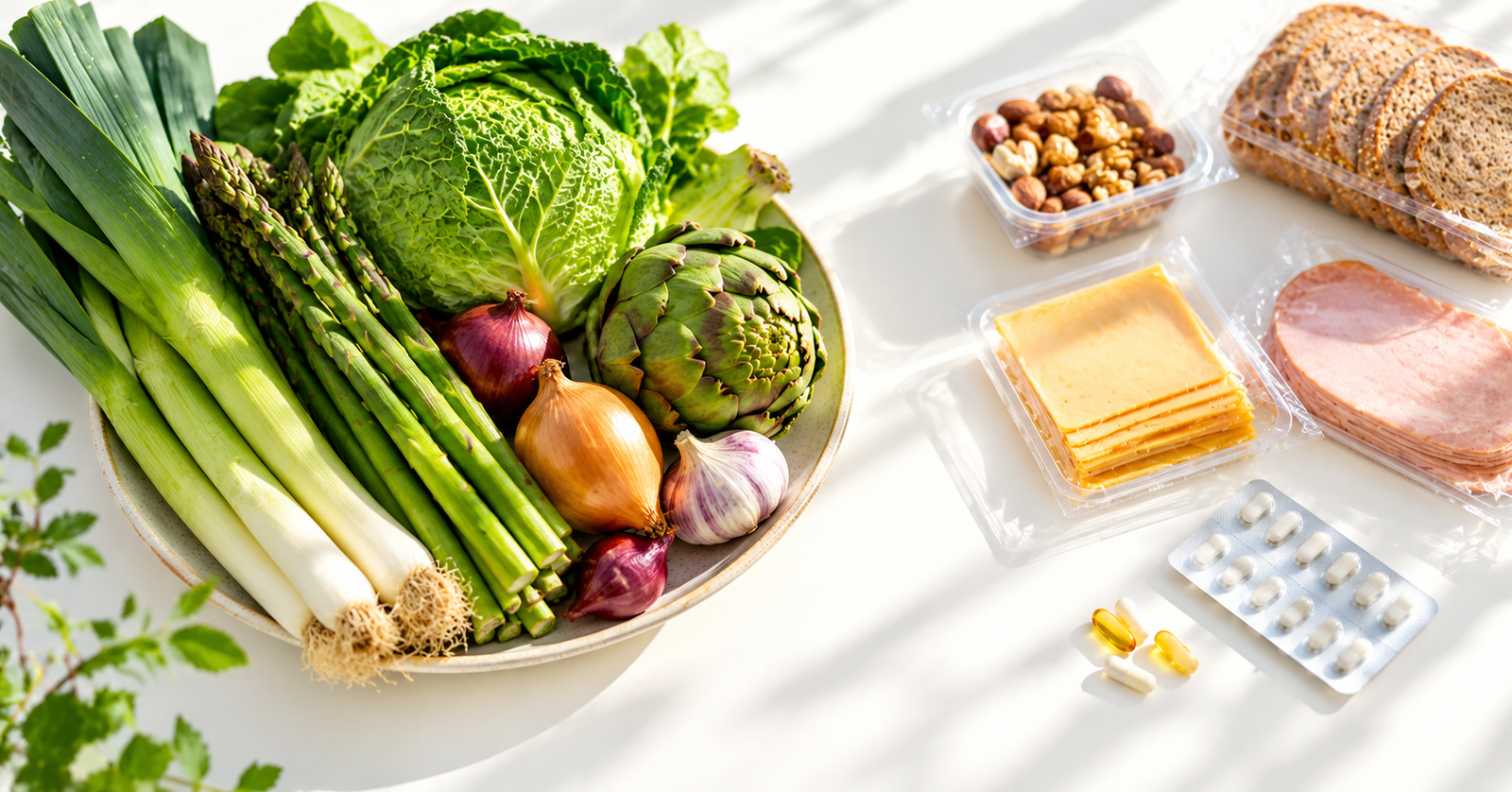
Feed the bacteria that are already there. Fermentable fibre — the inulin-type fructans and related prebiotics found in onions, leeks, garlic, asparagus, artichoke, chicory, cabbage, and in soft and dried fruits. This is the food that produces butyrate. We set out the sources and the mechanism in vegetables: fibre, prebiotics and raw versus cooked, and the wild plants that carry it in wild greens, forgotten roots and herbal infusions.
Eat fermented food regularly. Marco and colleagues reviewed the evidence for fermented foods on microbiota composition and beyond [7]. Yoghurt, kefir, traditional fermented dairy, properly fermented vegetables. Every food culture has some, and they were not invented for gut health — they were invented for preservation, and the benefit came along with it.
Pair protein with fibre, every time. This is the smallest change with the clearest mechanism. The vegetables on the plate are not decoration; they change what your bacteria do with what arrives.
Where This Connects
The gut community is not a separate system. Its condition shows up in inflammation, in immune regulation, and in how well nutrients are absorbed:
- The immune consequences are in what actually weakens your immune system
- Iron absorption depends substantially on gut condition — which supplements do you actually need
- And H. pylori, gastric damage and B12 absorption run through vitamin D and B12 deficiency
Frequently Asked Questions
How long does it take for gut bacteria to recover after antibiotics?
Longer than the course. Some effects on community composition and resistance genes persist well beyond treatment [3]. Most people recover substantially within weeks to months, but repeated courses compound the damage. Support recovery with fermentable fibre and fermented foods — and avoid antibiotics for viral illness, where they do nothing but cost you.
Do probiotic supplements actually work?
In specific situations, yes — after antibiotics and in some clinical contexts. As a daily purchase layered on an unchanged diet, they are far less useful than the marketing suggests, because supplemented strains generally do not establish permanently. Feeding the bacteria you already have works better and costs less [7].
Are food emulsifiers bad for the gut?
Probably, though the evidence is preclinical. In mice, emulsifier exposure eroded the mucus barrier separating bacteria from the gut wall, shifted which species dominated, and produced inflammation and metabolic disturbance [5]. No human trial has replicated it. Since eating fewer packaged products costs you nothing, waiting for certainty is not much of a strategy.
Does eating meat cause colorectal cancer?
The IARC classifies processed meat as Group 1 (carcinogenic to humans) and red meat as Group 2A (probably carcinogenic) [6]. Group 1 describes strength of evidence, not size of risk — processed meat is not as dangerous as smoking despite sharing the category. Proposed mechanisms include protein fermentation products, haem iron and N-nitroso compounds [6][2]. Frequency and quantity matter, and fibre eaten alongside changes what reaches the colon.
What is butyrate and why does it matter?
A short-chain fatty acid your gut bacteria produce from fermentable fibre. It is the primary fuel for the cells lining your colon, it strengthens the gut barrier and it suppresses inflammatory signalling [1]. You cannot usefully eat butyrate — you grow it, by eating the fibre that bacteria ferment.
Can non-antibiotic medications damage gut bacteria?
Yes. A screen of over a thousand marketed drugs against human gut bacterial strains found a substantial proportion of non-antibiotic drugs inhibited commensal growth [4]. This is not a reason to stop prescribed medication. It is a reason to take diet, fibre and fermented food more seriously if you are on something long-term.
What is the single most useful change?
Pair protein with fibre at every meal. It costs nothing, requires no product, and directly changes the ratio of protective to irritant metabolites your bacteria produce [2].
Conclusion
The gut microbiome has been sold to the public as something to buy. It is more usefully understood as something to stop breaking.
The bacteria that matter are already in place. They were established in your first years of life and they are entirely capable of doing their job — producing the butyrate that feeds your colon wall and suppresses inflammation — provided they are fed fermentable fibre and not repeatedly assaulted.
The four assaults are identifiable and mostly avoidable. Antibiotics taken when they were never indicated. Ultra-processed food thinning the mucus layer that separates bacteria from tissue. Protein arriving in the colon without fibre, fermented into ammonia and hydrogen sulfide instead of butyrate. And the capsule bought monthly in place of changing any of the first three.
None of that requires a purchase to fix. It requires vegetables on the plate beside the meat, fewer packets, fermented food a few times a week, and a harder question the next time someone offers antibiotics for a cough.
Nature provides. The bacteria respond. Health follows.
Scientific Sources and References
- Koh, A., De Vadder, F., Kovatcheva-Datchary, P., & Bäckhed, F. (2016). “From dietary fiber to host physiology: short-chain fatty acids as key bacterial metabolites.” Cell, 165(6), 1332–1345. PMID 27259147
- Louis, P., Hold, G. L., & Flint, H. J. (2014). “The gut microbiota, bacterial metabolites and colorectal cancer.” Nature Reviews Microbiology, 12(10), 661–672. PMID 25198138
- Jernberg, C., Löfmark, S., Edlund, C., & Jansson, J. K. (2010). “Long-term impacts of antibiotic exposure on the human intestinal microbiota.” Microbiology, 156(11), 3216–3223. PMID 20705661
- Maier, L., Pruteanu, M., Kuhn, M., et al. (2018). “Extensive impact of non-antibiotic drugs on human gut bacteria.” Nature, 555(7698), 623–628. PMID 29555994
- Chassaing, B., Koren, O., Goodrich, J. K., et al. (2015). “Dietary emulsifiers impact the mouse gut microbiota promoting colitis and metabolic syndrome.” Nature, 519(7541), 92–96. PMID 25731162
- Bouvard, V., Loomis, D., Guyton, K. Z., et al. (2015). “Carcinogenicity of consumption of red and processed meat.” The Lancet Oncology, 16(16), 1599–1600. PMID 26514947
- Marco, M. L., Heeney, D., Binda, S., et al. (2017). “Health benefits of fermented foods: microbiota and beyond.” Current Opinion in Biotechnology, 44, 94–102. PMID 27998788
- Kumamoto, C. A. (2011). “Inflammation and gastrointestinal Candida colonization.” Current Opinion in Microbiology, 14(4), 386–391. PMID 21802979
Last reviewed: September 2026. Vivid Remedy publishes independently researched, evidence-based health content cross-referenced against current peer-reviewed scientific literature. This content does not constitute medical advice. Never stop or decline prescribed antibiotics or other medication without consulting the doctor who prescribed them. Persistent changes in bowel habit, or blood in the stool, require medical assessment.