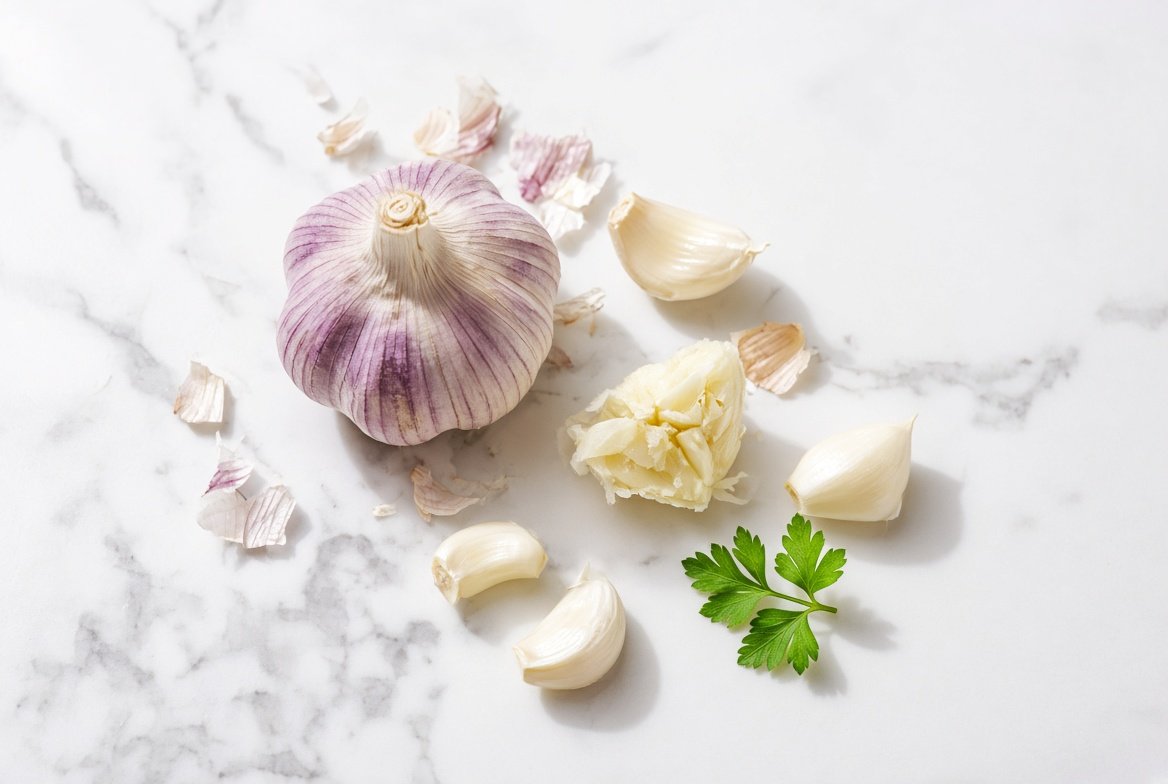
Introduction
Garlic (Allium sativum) is one of the most heavily trialled foods in nutritional medicine. Thirty-nine randomised controlled trials have measured its effect on blood lipids alone [3]. Twenty more have measured its effect on blood pressure [4]. That is a larger evidence base than most prescription supplements can claim.
Read carefully, that record tells a more interesting story than the one usually told — and a different one. Garlic’s cardiovascular benefits are real and replicated. But they are not where thirty years of commercial effort went looking for them, and the single most instructive trial in the whole literature is one in which garlic did nothing at all.
This article covers what garlic does to blood pressure, cholesterol and arterial plaque, which preparation the trials actually used, and what the most famous garlic study really found. Its companion article covers garlic’s effects on cancer risk and infection, and the safety rules that matter — including the anticoagulant interaction that sends people to hospital.
The Bioactive Chemistry: What Makes Garlic Work
Garlic’s therapeutic power derives from its sulfur chemistry, a complexity that single-compound pharmaceuticals do not attempt to reproduce [1]. The primary active compound, allicin, does not exist in intact garlic. It forms only when fresh garlic is crushed, chopped, or chewed — when the enzyme alliinase comes into contact with its substrate, alliin [2].
The practical implication is real. Crushing garlic and letting it stand for roughly ten minutes before it meets heat allows that enzymatic conversion to proceed. Cooking immediately after crushing inactivates the heat-sensitive enzyme and reduces allicin yield. This single step — patience in the kitchen — meaningfully changes what ends up on the plate.
Beyond allicin, garlic contains ajoene, allyl sulfides and sulfoxides, along with copper, phosphorus, selenium and folate, all delivered inside the intact food matrix. This is the central principle of our approach: nature supplies complete foods, not isolated actives — and as this article will show, the trial record on garlic makes that case better than any slogan could.
Garlic and Blood Pressure: The Strongest Evidence
On blood pressure the evidence is the most consistent in the entire garlic literature.
Ried’s updated meta-analysis of twenty trials in 970 participants found a mean reduction of 5.1 mmHg systolic and 2.5 mmHg diastolic against placebo. In the subgroup that actually had hypertension at baseline, the effect roughly doubled: 8.7 mmHg systolic and 6.1 mmHg diastolic [4].
For a food, in the people who need it, that is a serious number. It is comparable in magnitude to a single first-line antihypertensive — though garlic has never been tested head-to-head against one, and it should not be presented as a replacement for prescribed treatment. Anyone already on blood pressure medication changes nothing without the prescribing physician.
Two details matter for anyone planning to act on this. The effect appears over months, not days — the trials ran eight to twenty-four weeks. And it was largest in people whose pressure was genuinely elevated; in normotensive participants the change was small.
The plausible mechanism is vascular rather than metabolic: nitric-oxide-mediated vasodilation and effects on arterial stiffness, not a statin-like blockade of cholesterol synthesis. Hold on to that distinction — the next two sections turn on it.
Arterial Plaque: What the Famous Calcification Study Actually Found
The most-cited cardiovascular study on garlic deserves to be reported precisely, because the version circulating online is not the version that was published.
Budoff and colleagues at Harbor-UCLA ran a randomised, double-blind, placebo-controlled pilot in patients already established on statin therapy [8]. Over one year, coronary artery calcium was measured by electron beam tomography. The garlic group’s calcium score rose by 7.5 percent. The placebo group’s rose by 22.2 percent. The difference was statistically significant.
That is a genuine and encouraging result, and it is worth stating what it is: garlic slowed the progression of arterial calcification to roughly a third of the placebo rate, on top of statin therapy that every participant was already receiving. Nineteen patients completed the protocol. It is a pilot study, and its authors described it as one.
It is not a reversal. The calcium score in the garlic group still went up. Any account claiming that garlic reversed existing plaque, or achieved something no drug has achieved, is describing a study that was not performed. We would rather tell our readers the smaller true thing than the larger false one — particularly when every reference in this article carries a link they can check in a single click.
Two further details cut against the popular telling. The preparation used was aged garlic extract, not garlic powder. And the trial ran for a year, not three months.
The Cholesterol Question, and Why the Null Result Matters
Here the evidence delivers its most useful lesson, and it is not the one usually reported.
Ried’s meta-analysis of thirty-nine trials found that garlic preparations reduced total cholesterol by 17 ± 6 mg/dL and LDL cholesterol by 9 ± 6 mg/dL in people whose total cholesterol was already elevated above 200 mg/dL, provided the garlic was taken for longer than two months. That is roughly an 8 percent reduction in total cholesterol — clinically meaningful, and associated with a substantially lower coronary event risk over a lifetime. HDL improved only slightly. Triglycerides were not significantly affected at all [3].
Then came Stanford. Gardner and colleagues ran a six-month, four-arm randomised trial in 192 adults with moderately raised LDL. One arm received raw garlic. One received a powdered garlic supplement. One received aged garlic extract. One received placebo. Every product was chemically characterised throughout the trial, so nobody could later blame a degraded preparation.
None of the three forms lowered LDL. Not the supplements — and not the raw garlic either [7].
In fairness, the picture is not uniform, and we will not tidy it. Sobenin and colleagues tested a time-released garlic powder tablet at 600 mg daily in forty-two men with mild hypercholesterolaemia and found total cholesterol down 7.6 percent and LDL down 11.8 percent against baseline over twelve weeks, with HDL rising [5]. That is a positive result, and it is on the record. It is also a small single-centre trial of one specific commercial formulation, run by an institute closely associated with that product — the kind of study that generates a hypothesis rather than settling one. Set beside Stanford’s 192 participants, four arms, six months and independent chemical characterisation, it does not overturn the null finding. It does explain why the meta-analysis lands where it does: a modest average effect, assembled from trials that disagree with each other.
The supplement industry’s response to Gardner was predictable: the preparations must have been wrong, the dose too low, the allicin yield insufficient. We think that response misses what the trial actually demonstrated, and we read it differently.
Garlic is not a cholesterol drug. It was never a cholesterol drug. Thirty years of commercial effort went into isolating, standardising and encapsulating garlic so that it would behave like one — and it does not, because that is not what it does. Where garlic shows a consistent signal, it shows it in blood pressure, in endothelial function, in platelet behaviour, and in the rate at which arterial plaque advances. Those are vascular effects, and they are the effects that survive replication.
This is the reductionist error in a single experiment. Take a whole food with dozens of interacting compounds, decide in advance which pharmaceutical category it belongs to, build a product around that assumption, and then be surprised when the trial disagrees. Gardner’s null result is not an argument against garlic. It is an argument against the model that produced the pill.
The kitchen was never confused about this. Garlic was food that kept people well. It was not a tablet aimed at a number on a lab report. Our own war on supplements coverage traces the same pattern through magnesium, selenium and zinc: the isolate underperforms the food, and the marketing outruns the evidence in both directions.
For readers focused specifically on lowering cholesterol through food, the fibre and polyphenol evidence behind carob is considerably more direct than anything garlic offers.
Raw, Cooked, Powdered, Aged: Which Form Should You Use?
Each form has a different profile, and the honest summary is less tidy than the usual one.
Raw garlic, crushed and rested ten minutes, delivers the highest allicin yield and the strongest laboratory antimicrobial and antiproliferative activity. It is also the most irritating to the stomach lining. Best used crushed into salads, dressings, and dishes finished off the heat.
Cooked garlic loses alliinase and therefore most allicin formation, but retains other organosulfur compounds and the mineral profile. This is the form humans have actually eaten for five thousand years, and it is the form underlying the population evidence on cancer risk [6]. Cooked garlic is not a failed version of raw garlic. It is garlic as food, which is how the population-level benefits were observed in the first place.
Garlic powder retains meaningful activity if properly prepared, and standardised powder preparations appear across the blood pressure and lipid trials. One caution: commercial culinary garlic powder from a supermarket shelf is not the same product as the standardised, enteric-coated tablets used in those trials, and the allicin release differs substantially [2].
Aged garlic extract deserves a fair hearing, because the popular account has this backwards. AGE is the form with the most trial data behind it — the calcification pilot [8], the blood pressure dose-response trial [4], and much of the endothelial work all used it. To claim that aged extract failed in clinical trials while garlic powder succeeded is to reverse the actual literature.
Our position is different, and it is not a claim about potency. AGE dominates the trial record because it is the most commercially developed preparation and the one with a manufacturer willing to fund studies. An evidence base built that way tells you which product had a research budget; it does not tell you which form is best for a human being eating dinner. The Stanford trial [7] is the relevant control here, and it found no lipid advantage for any form — aged, powdered, or raw.
So we come down where we always do, but for defensible reasons rather than convenient ones: eat the bulb. Not because a trial has shown fresh garlic beats aged extract — no trial has shown that — but because the whole food is cheap, safe, culturally embedded, delivers the full compound spectrum, and carries five thousand years of use behind it. The extract has a marketing department. The bulb has a track record.
Nature’s Pharmacy and Human Manufacturing
Garlic makes the case for whole foods better than almost anything else in the pharmacy of the kitchen — but not in the way the argument is usually made.
The usual version says the natural form beat the processed form in a trial. On garlic, that is simply not what happened, and repeating it hands critics an easy correction.
The stronger version is this. Industry spent thirty years and considerable money trying to turn a food into a cholesterol tablet. It built standardised powders, aged extracts, allicin-yield specifications, enteric coatings. Then Stanford tested three of those products against placebo under rigorous chemical control, and none of them moved LDL — including the raw clove [7]. The premise was wrong. Garlic’s benefits are vascular, cumulative, and dietary: blood pressure that comes down over months [4], plaque that advances more slowly [8], cancer risk that falls across populations eating garlic for decades [6].
You cannot buy that in a bottle, because it was never in a bottle. It is in the food, eaten regularly, for years. That is what the trial record actually says, and it happens to be what every traditional kitchen already knew. The same reasoning runs through our work on essential staple foods and on wormwood, where the isolated derivative won a Nobel Prize while the whole plant remained a very different proposition.
Before spending money in the supplement aisle, look first at what is already in the kitchen. Not because nature is automatically superior to chemistry — that is a slogan, not an argument — but because in this specific case, the trials went looking for a drug and found a food.
Frequently Asked Questions
How much garlic should I eat to lower blood pressure?
The trials that showed an effect used a sustained daily intake over several months, typically equivalent to one or two cloves a day or a standardised preparation at comparable dose. The reduction appears after weeks, not days, and is largest in people whose blood pressure is genuinely elevated [4]. Garlic supplements treatment; it does not replace it, and medication is never adjusted without the prescribing physician.
Does garlic really lower cholesterol?
Less reliably than commonly claimed. A meta-analysis of thirty-nine trials found roughly an 8 percent reduction in total cholesterol in people whose levels were already raised, with a smaller effect on LDL and none at all on triglycerides [3]. But the largest and best-controlled single trial — 192 participants, six months, four arms, chemically verified products — found no effect on LDL from raw garlic, powdered garlic or aged extract [7]. Treat garlic as a vascular food, not a cholesterol agent.
Is raw garlic better than cooked?
For allicin, yes — allicin only forms when raw garlic is crushed, and heat inactivates the enzyme that makes it. For cardiovascular and cancer-risk benefits, the picture is different: the population evidence comes from people eating garlic as ordinary cooked food [6]. Raw garlic is also the most irritating to the stomach. Use both, and take either with a meal.
Can garlic reverse arterial plaque?
No. The study behind that claim measured coronary calcium over one year in patients already taking statins. Calcium scores in the garlic group still rose — by 7.5 percent, against 22.2 percent on placebo [8]. Garlic slowed progression to about a third of the placebo rate. It did not reverse anything, and it was aged garlic extract, not garlic powder.
Are garlic supplements worth buying?
Usually not, on this evidence. The best-controlled trial found no lipid benefit from any commercial form [7], and the forms with the most trial data behind them are the ones with a manufacturer funding the research. Fresh garlic is cheaper, safer, and carries the full compound spectrum. If you take a blood thinner, see the safety article before taking any concentrated garlic product.
Conclusion
Garlic earns its cardiovascular reputation, though not for the reasons it is usually given.
Its blood pressure evidence is solid and replicated, strongest in the people who actually have hypertension. Its effect on the progression of arterial calcification is real, measured over a year, in patients already receiving good medical care. Its effect on cholesterol is modest at best and absent in the most rigorous trial ever run on it.
That null result is the most instructive finding in the whole literature. It is not garlic’s failure. It belongs to the assumption that a food must justify itself by behaving like a drug.
Used with food, in ordinary amounts, over years, garlic remains one of the best-evidenced additions to a human diet. Before you use it therapeutically, read the companion article on safety, dosing and drug interactions — garlic is potent enough to matter before surgery and potent enough to interact with anticoagulants, and the same chemistry that protects the artery thins the blood.
The wisdom is ancient. The science is modern. Read carefully, they agree — just not on the terms the supplement aisle would prefer. God’s creation works. It simply does not work the way a pill does.
Scientific Sources and References
- Bayan, L., Koulivand, P. H., & Gorji, A. (2014). “Garlic: a review of potential therapeutic effects.” Avicenna Journal of Phytomedicine, 4(1), 1–14. PMID 25050296
- Lawson, L. D., & Hunsaker, S. M. (2018). “Allicin bioavailability and bioequivalence from garlic supplements and garlic foods.” Nutrients, 10(7), 812. PMID 29937536
- Ried, K., Toben, C., & Fakler, P. (2013). “Effect of garlic on serum lipids: an updated meta-analysis.” Nutrition Reviews, 71(5), 282–299. PMID 23590705
- Ried, K., Frank, O. R., & Stocks, N. P. (2013). “Aged garlic extract reduces blood pressure in hypertensives: a dose-response trial.” European Journal of Clinical Nutrition, 67(1), 64–70. PMID 23169470
- Sobenin, I. A., Andrianova, I. V., Demidova, O. N., et al. (2008). “Lipid-lowering effects of time-released garlic powder tablets in double-blinded placebo-controlled randomized study.” Journal of Atherosclerosis and Thrombosis, 15(6), 334–338. PMID 19060427
- Fleischauer, A. T., & Arab, L. (2001). “Garlic and cancer: a critical review of the epidemiologic literature.” Journal of Nutrition, 131(3s), 1032S–1040S. PMID 11238811
- Gardner, C. D., Lawson, L. D., Block, E., et al. (2007). “Effect of raw garlic vs commercial garlic supplements on plasma lipid concentrations in adults with moderate hypercholesterolemia: a randomized clinical trial.” Archives of Internal Medicine, 167(4), 346–353. PMID 17325296
- Budoff, M. J., Takasu, J., Flores, F. R., et al. (2004). “Inhibiting progression of coronary calcification using aged garlic extract in patients receiving statin therapy: a preliminary study.” Preventive Medicine, 39(5), 985–991. PMID 15475033
Last reviewed: September 2026. Vivid Remedy publishes independently researched, evidence-based health content cross-referenced against current peer-reviewed scientific literature. This content does not constitute medical advice. Always consult a licensed physician or qualified healthcare provider regarding your specific health conditions.