This article reviews the published evidence on caraway. It is not medical advice. Where research is laboratory or animal work rather than human trials, that is stated. Speak to a doctor or pharmacist before using caraway therapeutically, particularly alongside prescription medication or in infants.
Introduction
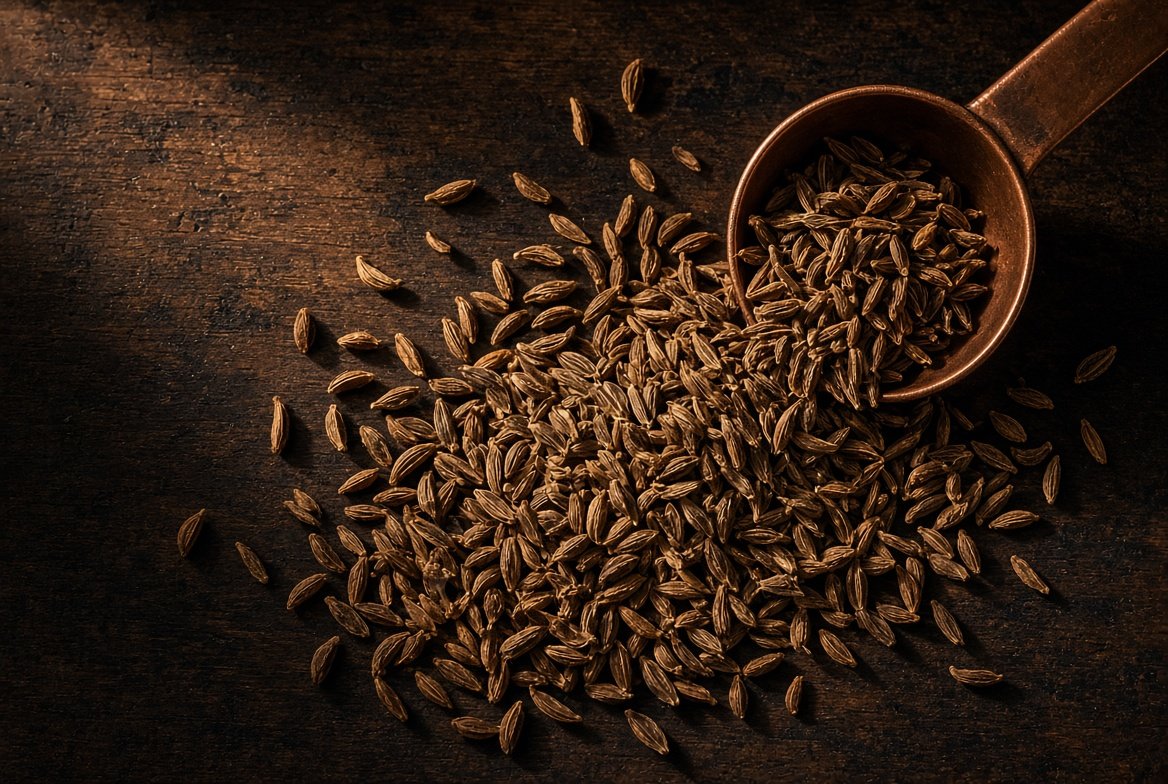
Caraway (Carum carvi) is one of the oldest cultivated spices in human history. Archaeological evidence traces its use back thousands of years, and it has remained a staple of both cooking and folk medicine across the Mediterranean, the Middle East and North Africa — prized for its aroma and its digestive properties.
Yet caraway’s therapeutic record is better than most people realise, and better than most exotic supplements sold at twenty times the price. Modern research documents antimicrobial, antioxidant, antispasmodic and metabolic activity — and in one area, the clinical evidence is genuinely strong.
This article examines what the evidence establishes, what it doesn’t, and where caution is needed.
The Active Compounds
Caraway’s activity comes from a distinctive phytochemical profile:
- Carvone — the principal aroma compound, and the one behind the antispasmodic effect
- Limonene — a terpene with antioxidant and antimicrobial activity
- Flavonoids — polyphenols that reduce oxidative stress
- Essential oils — volatile compounds with documented antibacterial activity [1]
Carvone and limonene together account for the large majority of caraway essential oil, and both vary with growing conditions and processing [2].
Digestive Health: This Is Where the Evidence Is Strong
Functional Dyspepsia — Five Randomised Trials
This is the best-evidenced use of caraway by a wide margin, and it deserves to lead.
A proprietary combination of peppermint oil and caraway oil has been tested repeatedly in functional dyspepsia — the syndrome of upper abdominal pain, bloating, early fullness and nausea. A 2023 systematic review and meta-analysis found five randomised trials involving 580 patients, showing significant benefit over placebo, and effects comparable to a reference drug [3]. Earlier controlled work found the benefit held regardless of H. pylori status [4].
Five randomised trials is not folklore. It is a stronger evidence base than most herbal products on the market can claim, and it is specific: caraway oil, in combination, for functional dyspepsia.
The Antispasmodic Mechanism
Caraway’s carminative reputation rests on smooth muscle relaxation in the gastrointestinal tract — the action that relieves cramping and helps trapped gas move. This is the mechanism behind its traditional use for indigestion, bloating, flatulence and abdominal cramping, and it is consistent with the dyspepsia trial results [3][4].
Caraway is one instance of a larger point about spices generally. They are a food group in their own right rather than decoration, and their near-disappearance from modern cooking is a nutritional loss rather than a culinary one — we argue that in why you are deficient: the food groups we forgot.
Infant Colic — Traditional Use, and a Real Warning
Caraway water has been given to colicky infants for generations across the Mediterranean and Middle East, and the carminative logic is sound.
But two things must be said plainly.
There is no clinical trial of caraway in infant colic. Trials often cited in support of herbal colic remedies tested other plants — chamomile, fennel and lemon balm — not caraway. The traditional use is real; the clinical evidence for caraway specifically does not exist.
And herbal teas given to infants have caused documented harm. Pediatrics reported neurotoxicity — including seizures — in infants given star anise tea for colic, caused by contamination with a toxic related species [5]. Infants are not small adults: they have little margin for contamination, dosing error, or fluid that displaces milk.
That last point deserves emphasis, because it is the one parents least expect. Fluid other than milk given to a young infant can lower blood sodium far enough to cause seizures, entirely separately from whatever is steeped in it — we set that out in when to drink water, and at what temperature.
If you are considering anything for a colicky infant, that conversation belongs with your paediatrician first. This is not a case for improvising at home.
Antimicrobial Activity
Caraway essential oil has documented antibacterial activity, tested directly against bacterial pathogens alongside cumin oil [1]. Further work profiles its activity against Vibrio species and its anti-biofilm and anti-quorum-sensing effects [6].
Read this correctly. These are laboratory studies of the essential oil against bacteria in culture. They explain caraway’s traditional role as a food preservative, and they justify further research. They do not establish caraway as a treatment for infection, SIBO, or fungal disease in people, and no trial has tested it for those.
It is also worth noting which direction the traffic usually runs in the gut. Antibiotics, additives, emulsifiers and a long list of ordinary prescriptions do more measurable damage to the bacteria you want to keep than any spice can undo — we set those out in what damages gut bacteria.
Antioxidant Activity
Caraway essential oil shows genuine antioxidant and hepatoprotective activity, demonstrated alongside coriander oil [7], and its phenolic content and radical-scavenging capacity have been characterised in detail [2].
On the claim that caraway beats vitamin C: comparisons of this kind come from test-tube assays — chemical reactions in a cuvette, measuring how fast a compound quenches a synthetic radical. They say almost nothing about what happens in a human body, where absorption, distribution and metabolism decide everything. Caraway is a genuinely good antioxidant source. It does not follow that it outperforms vitamin C in a person, and no study has shown that it does.
Anticancer Research: Rats, Not People
Caraway has been studied in colon carcinogenesis models. Dietary caraway reduced aberrant crypt foci — the earliest visible precursor lesions of colon cancer — and altered faecal steroid and intestinal enzyme profiles in rats [8]. A dose-response study in the same model found improvements in tissue lipid peroxidation and antioxidant status [9].
These are rat studies. Caraway is not a cancer treatment, does not replace one, and should not be added to a cancer regimen without an oncologist’s knowledge — several antioxidants interact with chemotherapy and radiotherapy.
What the research supports is modest and still worth having: caraway as a dietary component with measurable antioxidant activity in the gut, in a model relevant to colon cancer prevention.
Metabolic Effects: Two Human Trials
Weight
A randomised, triple-blind, placebo-controlled trial tested caraway extract in overweight and obese women [10]. This is a real human trial with a proper design — the strongest metabolic evidence caraway has.
One correction to how it is usually described: trials of this kind are conducted under controlled conditions with monitoring, and results should not be read as “weight loss without any change to diet or exercise.” Caraway is a modest adjunct, not a substitute for the fundamentals.
Blood Sugar
Black caraway (Bunium persicum — a different species from Carum carvi) was tested in a double-blind randomised placebo-controlled trial in 60 overweight and obese patients with type 2 diabetes, at 1,000 mg twice daily for eight weeks [11]. In animal models, caraway fruit lowered cholesterol and triglycerides in diabetic rats [12].
This matters for safety as much as for benefit. If caraway affects glucose, then combining a therapeutic dose with metformin, a sulfonylurea or insulin is a genuine hypoglycaemia risk. Tell the doctor who manages your diabetes before starting.
That warning generalises, and it catches people out precisely because the culprits are foods rather than drugs. Bitter gourd is the clearest example, with a documented glucose-lowering effect strong enough to matter — we cover it in bitter gourd, bottle gourd and squash. The wider set of food–medication collisions is in when diet fights medication.
Respiratory and Menstrual Uses: Traditional, Not Yet Tested
Caraway has a long record as an expectorant and as an emmenagogue — a substance to encourage menstrual flow. Both uses are widely documented in traditional practice across the regions where caraway grows.
Neither has been tested in a clinical trial of caraway. Studies frequently cited in support of the menstrual claim tested fennel, a different plant. The traditional record stands on its own terms; it is not the same as evidence, and this article will not pretend otherwise.
If a caraway tea helps your cough or your cramps, there is little harm in it at culinary strength. Just know which kind of claim you are relying on.
Preparation
Standard tea
- Take 1 teaspoon of caraway seeds
- Crush them lightly to release the essential oils
- Pour just-boiled water over them
- Cover and steep 10 minutes — covering matters, since the active compounds are volatile
- Strain, and sweeten with honey if you wish
- Taken after meals for digestive support
For functional dyspepsia specifically, the trial evidence used a standardised peppermint-and-caraway oil preparation, not tea [3]. If you want the effect the trials measured, that is the form to ask a pharmacist about.
For infants — see the warning above. Ask your paediatrician; do not improvise.
Safety and Contraindications
Pregnancy. Caraway has traditional emmenagogue use and may stimulate uterine activity. Culinary amounts in food are not a concern; medicinal doses should be avoided in pregnancy, and herbal products in pregnancy generally warrant caution [13].
The postpartum tradition is different and worth distinguishing — caraway preparations given to new mothers after birth are a separate practice from use during pregnancy, and the timing is the whole point.
Concentrated essential oil is not the same as tea. Caraway essential oil is potent and should not be swallowed by the spoonful; excess can irritate the stomach and cause nausea.
Drug interactions. Diabetes medication is the important one, given the trial evidence [11][12]. Caution also with iron supplements, where polyphenol-rich infusions can reduce absorption if taken together with a meal.
The Philosophy: Local Medicine, Global Validation
There is a real point buried in caraway’s story, and the evidence supports it.
You do not need an imported supplement with a premium price and unverifiable sourcing. Caraway sits in ordinary spice shops across the Mediterranean, the Middle East and North Africa. It costs very little. And it carries five randomised trials behind its main indication [3] — more clinical evidence than the large majority of exotic botanicals sold at many times the price.
The contrast is worth drawing explicitly. Reishi, spirulina and shilajit arrive with far larger claims and far smaller evidence bases, and with interactions their sellers rarely mention — we go through them in when natural remedies make you worse.
That is the lesson, and it is worth more than any single health claim: look first at what your own kitchen and your own tradition already contain. Then check what the evidence says about it — honestly, including where the evidence runs out.
Conclusion
Caraway is more than a culinary spice, and it is also less than the miracle sometimes described.
Established: relief of functional dyspepsia, in combination with peppermint oil, across five randomised trials [3][4]. Antibacterial activity of the essential oil in the laboratory [1][6]. Antioxidant and hepatoprotective activity [7]. Human trial evidence in weight [10] and in blood glucose for black caraway [11].
Preclinical: the colon cancer work, in rats [8][9].
Traditional, untested: infant colic, respiratory use, menstrual regulation.
Requires care: infants, pregnancy, and anyone on diabetes medication.
Nature does provide complete medicines — and this one has earned its reputation in one specific area, honestly, in trials. That is worth more than a longer list of claims with less behind them.
This article is part of our complete guide to Herbal Remedies — the herbs with genuine clinical evidence behind them, separated from the ones that only have marketing.
Frequently Asked Questions
Does caraway actually help indigestion?
Yes — this is its best-evidenced use. A combination of peppermint oil and caraway oil improved symptoms of functional dyspepsia across five randomised controlled trials involving 580 patients [3]. Note that the trials used a standardised oil preparation, not tea.
Can I give caraway tea to my baby for colic?
Ask your paediatrician first. There is no clinical trial of caraway in infant colic — studies often cited tested chamomile, fennel and lemon balm instead. And herbal teas given to infants have caused documented harm: Pediatrics reported seizures in infants given star anise tea for colic [5]. Infants have very little margin for error.
Is caraway a stronger antioxidant than vitamin C?
That claim comes from test-tube assays, which measure chemical reactivity in a cuvette rather than any effect in a body. Caraway does have genuine antioxidant activity [7], but no study shows it outperforms vitamin C in a person.
Does caraway help with weight loss?
A randomised, triple-blind, placebo-controlled trial found an effect of caraway extract in overweight and obese women [10]. It is a real result, and it is a modest adjunct — not a replacement for diet and activity.
Is caraway safe in pregnancy?
In food, yes. In medicinal doses, no — it has traditional uterine-stimulant use, and herbal products in pregnancy warrant caution generally [13]. Postpartum use is a separate tradition with different timing.
Can I take caraway with diabetes medication?
Not without telling your doctor. Black caraway lowered glycaemic measures in a randomised trial in type 2 diabetes [11], and caraway lowered lipids in diabetic animal models [12] — so adding it to metformin, a sulfonylurea or insulin carries a real hypoglycaemia risk.
Scientific Sources and References
Every source below was checked against PubMed and the CrossRef DOI registry. Each link resolves to the paper cited.
- Iacobellis, N. S., Lo Cantore, P., Capasso, F., & Senatore, F. (2005). “Antibacterial activity of Cuminum cyminum L. and Carum carvi L. essential oils.” Journal of Agricultural and Food Chemistry, 53(1), 57–61. doi:10.1021/jf0487351
- Alizadeh Behbahani, B., et al. (2023). “Effects of methyl jasmonate elicitation on the carvone and limonene contents, phenolic compounds and antioxidant activity of caraway.” Natural Product Research, 37(24), 4221–4226. PubMed 36661234
- Madisch, A., Frieling, T., Zimmermann, A., et al. (2023). “Menthacarin, a proprietary peppermint oil and caraway oil combination, improves multiple complaints in patients with functional gastrointestinal disorders: a systematic review and meta-analysis.” Digestive Diseases, 41(3), 522–532. doi:10.1159/000528553
- Madisch, A., Heydenreich, C. J., Wieland, V., et al. (2003). “Effects of a fixed combination of peppermint oil and caraway oil on symptoms and quality of life in patients suffering from functional dyspepsia.” Phytomedicine, 10(Suppl 4), 56–57. doi:10.1078/1433-187X-00310
- Ize-Ludlow, D., Ragone, S., Bruck, I. S., et al. (2004). “Neurotoxicities in infants seen with the consumption of star anise tea.” Pediatrics, 114(5), e653–e656. PubMed 15492355
- Snoussi, M., et al. (2022). “GC-MS profiling, vibriocidal, antioxidant, antibiofilm, and anti-quorum sensing properties of Carum carvi L. essential oil.” Plants, 11(8). PubMed 35448799
- Samojlik, I., Lakić, N., Mimica-Dukić, N., et al. (2010). “Antioxidant and hepatoprotective potential of essential oils of coriander (Coriandrum sativum L.) and caraway (Carum carvi L.).” Journal of Agricultural and Food Chemistry, 58(15), 8848–8853. doi:10.1021/jf101645n
- Kamaleeswari, M., Deeptha, K., Sengottuvelan, M., & Nalini, N. (2006). “Effect of dietary caraway (Carum carvi L.) on aberrant crypt foci development, fecal steroids, and intestinal alkaline phosphatase activities in 1,2-dimethylhydrazine-induced colon carcinogenesis.” Toxicology and Applied Pharmacology, 214(3), 290–296. PubMed 16483625
- Kamaleeswari, M., & Nalini, N. (2006). “Dose-response efficacy of caraway (Carum carvi L.) on tissue lipid peroxidation and antioxidant profile in rat colon carcinogenesis.” Journal of Pharmacy and Pharmacology, 58(8), 1121–1130. doi:10.1211/jpp.58.8.0014
- Kazemipoor, M., Radzi, C. W., Hajifaraji, M., et al. (2013). “Antiobesity effect of caraway extract on overweight and obese women: a randomized, triple-blind, placebo-controlled clinical trial.” Evidence-Based Complementary and Alternative Medicine, 2013, 928582. PubMed 24319489
- Jafari-Maskouni, S., Shahraki, M., Daneshi-Maskooni, M., et al. (2020). “Metabolic and clinical responses to Bunium persicum (black caraway) supplementation in overweight and obese patients with type 2 diabetes: a double-blind, randomized placebo-controlled clinical trial.” Nutrition & Metabolism, 17, 74. doi:10.1186/s12986-020-00494-4
- Lemhadri, A., Hajji, L., Michel, J. B., & Eddouks, M. (2006). “Cholesterol and triglycerides lowering activities of caraway fruits in normal and streptozotocin diabetic rats.” Journal of Ethnopharmacology, 106(3), 321–326. doi:10.1016/j.jep.2006.01.033
- Ernst, E. (2002). “Herbal medicinal products during pregnancy: are they safe?” BJOG: An International Journal of Obstetrics and Gynaecology, 109(3), 227–235. doi:10.1111/j.1471-0528.2002.t01-1-01009.x