Introduction
Water is the most fundamental nutrient in human physiology. It is roughly 60% of adult body weight, the medium for every biochemical reaction, and indispensable to circulation, digestion, temperature control and the removal of waste [1].
And yet almost nobody uses it deliberately. Water is something people have, not something they do.
The position of this article is simple: water becomes a genuine factor in treatment when its quality, quantity, timing and temperature are respected. Most people drink too little, drink at the wrong moments, and never think about temperature at all. Correcting those habits changes how the day feels — and, in some documented cases, changes outcomes.
We have covered the first two elsewhere: how much water you actually need and what is really in your drinking water. This article is about the two nobody talks about — timing and temperature.
Quality, Briefly
For ordinary daily drinking, filtered water is fine. For any deliberate therapeutic use — a cleansing period, recovery, illness — use the lightest, cleanest water available: natural spring water, mineral water, or clean well water from a trusted source.
Municipal tap water is generally safe to drink, but chlorination produces disinfection by-products — trihalomethanes and haloacetic acids — which have been reviewed extensively for genotoxicity and carcinogenicity [2]. Spring and mineral waters do not contain them.
Two cautions on the traditional sources. Rainwater and snowmelt are clean at the point of formation but collect atmospheric and surface contamination on the way to your glass; do not drink them untreated. And distilled or demineralised water is not a health drink — the WHO review sets out the risks of drinking water stripped of minerals, including effects on mineral balance [3]. Use it as a solvent if a protocol calls for one, not as your daily water.
Quantity, Briefly
Chronic mild dehydration underlies a surprising number of ordinary complaints. Too little water concentrates the urine and raises kidney-stone risk [4], lowers blood volume enough to produce fatigue and headache [1], and measurably impairs concentration [5].
The strongest single piece of evidence in this whole field is about stones. In a five-year randomised trial, increasing water intake enough to raise urine volume cut the recurrence of calcium stones by roughly half [4]. That is a drug-sized effect from water.
One honest correction, because it is widely repeated and mostly wrong. Drinking extra water does not treat constipation in someone who is already well hydrated — the landmark review of constipation myths addresses exactly this [6]. Fluid helps when you are dehydrated. It is not a laxative.
People think about food constantly and about water almost never. That is the error. Water is the first nutrient, and the most neglected.
Timing: When Water Does Its Best Work
When Thirst Appears
Thirst is not an early warning. It is a sign the deficit has already begun [1]. Drink then — waiting only deepens it.
On Waking
After seven or eight hours without fluid you are mildly dehydrated. One or two glasses of warm water on waking rehydrates you, stimulates gut motility, and prepares the digestive system for the day.
For a short deliberate course — a week to ten days, not year-round — some people take a larger morning volume and wait around forty minutes before breakfast. Build up to it and keep it sensible. Very large volumes drunk quickly can drop blood sodium dangerously, and the point at which water starts to harm rather than help is real — we set it out in how much water you actually need.
After Physical Work or Sweating
Rest five to fifteen minutes first, then drink. Rehydration after exertion works better when it is deliberate rather than frantic, and the volume and sodium content of what you drink both matter to how much you actually retain [7][8].
During Stress, Anxiety or Anger
Drink a large glass of water. Hydration supports kidney filtration and circulation at exactly the moment the body is under load.
Stated honestly: the evidence that hydration status directly regulates cortisol is thin, and we are not going to claim it. What is documented is that dehydration worsens mood and cognition [5] — which is enough. When you are angry, the glass of water is doing something. It is also thirty seconds in which you are not doing anything else.
While Studying or Concentrating
Mild dehydration — 1–2% of body weight — measurably impairs attention, working memory and mood [5]. Keep water beside you.
And the correction that matters: the nervous system needs water far more than it needs sugar. A student who keeps chocolate and biscuits beside them through a long session has the wrong thing on the desk. The brain runs on water, not sweets.
Through the Working Day
Anyone standing for long hours — teachers, security staff, traffic police, shop workers — benefits from steady intake. Adequate blood volume supports circulation and reduces the fatigue of long standing [9].
One claim we will not make: varicose veins are caused by incompetent venous valves, not by dehydration. Water will not prevent them. It will make a long shift more bearable.
For Long-Distance Drivers
Sitting for hours with a heavy meal inside you slows everything down.
- Carry water and light plant food — dates, fruit, vegetables
- Drink at every stop
- Avoid heavy meat while driving; it is slow to digest sitting still
- Tea is fine
During Heavy Medical Treatment
After chemotherapy, generous fluid intake helps the kidneys clear drug metabolites, and hydration is one of the recognised protections against drug-induced kidney injury [10]. This is real and it matters.
But follow your oncology team’s instructions on fluid, not a general article. Some regimens come with specific hydration protocols and some conditions require fluid restriction. Ask them what your number is.
For Headache
Dehydration headache is documented, and increasing daily water intake has been trialled as headache prophylaxis with modest benefit [11]. One or two glasses of warm water is a reasonable first move before reaching for anything else.
Temperature: Drink It Warm
Drink water at roughly 25–30°C — neither cold nor hot.
Being straight about the evidence: the claim that warm water empties from the stomach faster than cold is not well established in humans, and we are not going to dress up tradition as physiology. What is true is more practical, and more useful.
Warm water is easier to drink in volume. Cold water is drunk in sips; warm water is drunk in glasses. If the goal is to actually get the fluid in — on waking, during illness, after exertion — temperature is the difference between intending to hydrate and doing it. Chinese medicine and Ayurveda both arrived at the same preference long before anyone measured gastric emptying, and on this the traditions and ordinary experience agree.
Practical Details
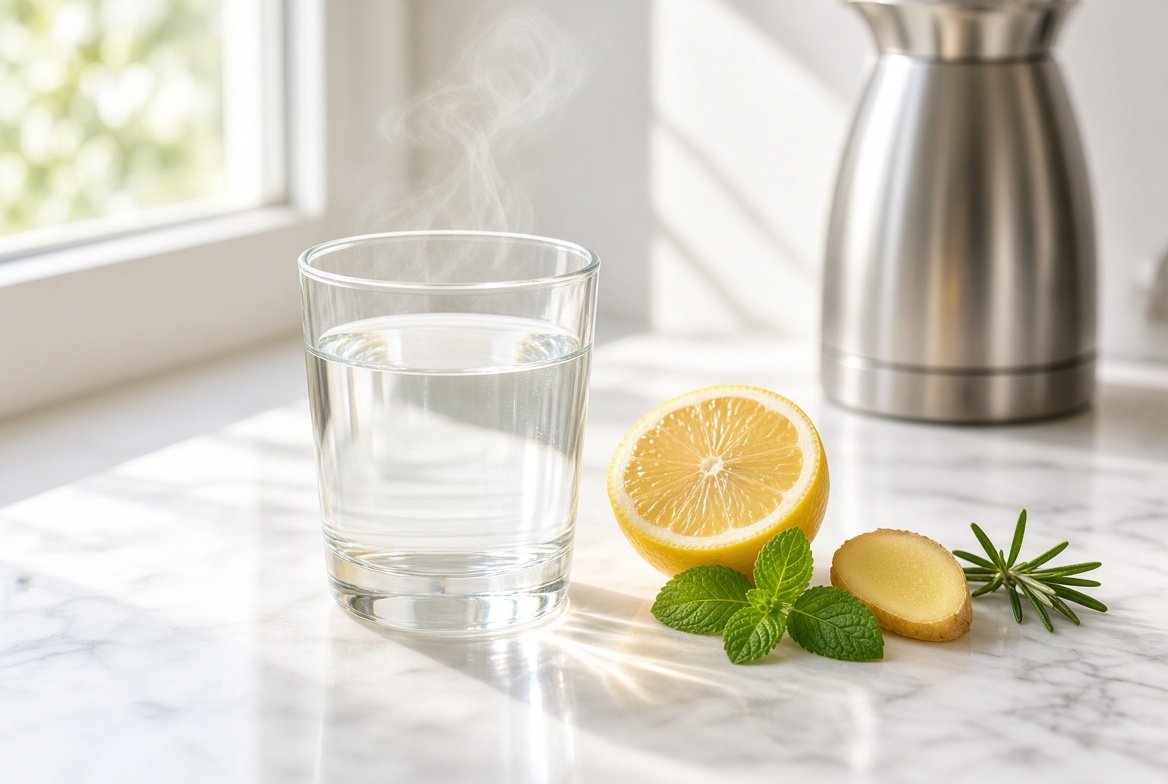
If plain water bores you, add a drop of lemon, a mint leaf, a sprig of rosemary, a thin slice of ginger, or a few coriander seeds. Mint in particular has a documented profile of its own [12]. This beats sugar and beats artificial flavouring.
Storage. Clay or stainless steel in preference to plastic.
Medication. Take pills with a full glass of clean water, never a single sip — the reasons are set out in the medication-dehydration trap.
Infants — Read This One Carefully
Do not give additional water to a young infant. An exclusively breastfed or formula-fed baby under about six months needs no water beyond their milk; breast milk is already about 87% water. ESPGHAN’s guidance supports exclusive milk feeding through roughly the first six months [13].
This is not a minor point of preference. An infant’s kidneys cannot excrete a water load, and extra water can drop their blood sodium far enough to cause seizures — there are published cases of exactly that in babies given supplemental water [14]. Small volumes of water can be offered once solid food begins, and in hot weather or illness ask your paediatrician rather than guessing.
Everything else in this article is for adults. This paragraph is the exception, and it runs the other way.
Water Alone Is Not the Protocol
Here is the part the wellness market leaves out.
True cleansing is never water by itself. It is water together with appropriate fasting, with movement, and with a temporary return to simple, clean food. You cannot keep eating fried food and sweets and expect water — or clay, or charcoal, or any agent — to produce a lasting result.
The elements work together or they do not work. We set out what actually holds up in detox: what actually works.
And the cleansing has a place at each stage — before treatment, after treatment, and continuing after treatment for serious illness. Not instead of medical care. Alongside it, and after it.
Frequently Asked Questions
Is it bad to drink cold water?
Not harmful. Just less effective in practice — people sip cold water and drink warm water. If the goal is volume, warm wins.
Should I really drink a litre first thing in the morning?
Start with one or two glasses. Large morning volumes are a short deliberate course, not a daily habit, and drinking a lot very fast can lower blood sodium. See how much water you actually need.
Does drinking more water cure constipation?
Only if you were dehydrated. The review of constipation myths addresses this directly — extra fluid in an already-hydrated person is not a treatment [6].
Does water really prevent kidney stones?
Yes, and this is the best evidence in the field: a five-year randomised trial found roughly half the recurrence rate in the higher-water group [4].
Can I give my baby water?
Not before around six months — milk supplies all the water an infant needs, and extra water risks dangerously low blood sodium [13][14]. Ask your paediatrician about hot weather or illness.
Is distilled water good for me?
No. The WHO review covers the risks of drinking demineralised water [3]. Use it as a solvent if a protocol requires one, not as your daily drink.
Should I drink more during chemotherapy?
Usually yes — hydration protects the kidneys from drug injury [10] — but your oncology team sets the amount. Some protocols restrict fluid.
Conclusion
Water is simple. Water is powerful. Water is the first medicine.
The protocol, in short:
- Clean, light water — not tap water when the purpose is therapeutic
- Warm, not cold
- A glass or two on waking
- Through stress, study, work and exertion
- During illness and after treatment, guided by your medical team
- For headache, before anything stronger
- Flavoured naturally if that is what gets it drunk
- Never extra water for a young infant
- Never water alone — with fasting, movement and simpler food
Nature provides it. The body responds to it. Used correctly and at the right moment, water heals.
Scientific Sources and References
- Popkin B.M., D’Anci K.E., Rosenberg I.H. — Water, hydration, and health. Nutrition Reviews, 2010; 68(8):439–458. PMID: 20646222. Link
- Richardson S.D., Plewa M.J., Wagner E.D., et al. — Occurrence, genotoxicity, and carcinogenicity of regulated and emerging disinfection by-products in drinking water: a review and roadmap for research. Mutation Research, 2007; 636(1–3):178–242. PMID: 17980649. Link
- Kozisek F. — Health risks from drinking demineralised water. In: Nutrients in Drinking Water. World Health Organization, Geneva, 2005; pp. 148–163. Link
- Borghi L., Meschi T., Amato F., et al. — Urinary volume, water and recurrences in idiopathic calcium nephrolithiasis: a 5-year randomized prospective study. Journal of Urology, 1996; 155(3):839–843. PMID: 8583588. Link
- Ganio M.S., Armstrong L.E., Casa D.J., et al. — Mild dehydration impairs cognitive performance and mood of men. British Journal of Nutrition, 2011; 106(10):1535–1543. PMID: 21736786. Link
- Müller-Lissner S.A., Kamm M.A., Scarpignato C., Wald A. — Myths and misconceptions about chronic constipation. American Journal of Gastroenterology, 2005; 100(1):232–242. PMID: 15654804. Link
- Maughan R.J., Leiper J.B., Shirreffs S.M. — Recovery from prolonged exercise: restoration of water and electrolyte balance. Journal of Sports Sciences, 1997; 15(3):297–303. PMID: 9232555. Link
- Shirreffs S.M., Taylor A.J., Leiper J.B., Maughan R.J. — Post-exercise rehydration in man: effects of volume consumed and drink sodium content. Medicine and Science in Sports and Exercise, 1996; 28(10):1260–1271. PMID: 8897383. Link
- Manz F. — Hydration and disease. Journal of the American College of Nutrition, 2007; 26(5 Suppl):535S–541S. PMID: 17921462. Link
- Perazella M.A., Rosner M.H. — Drug-induced acute kidney injury. Clinical Journal of the American Society of Nephrology, 2022; 17(8):1220–1233. PMID: 35273009. Link
- Spigt M.G., Kuijper E.C., van Schayck C.P., et al. — Increasing the daily water intake for the prophylactic treatment of headache: a pilot trial. European Journal of Neurology, 2005; 12(9):715–718. PMID: 16128874. Link
- McKay D.L., Blumberg J.B. — A review of the bioactivity and potential health benefits of peppermint tea (Mentha piperita L.). Phytotherapy Research, 2006; 20(8):619–633. PMID: 16767798. Link
- ESPGHAN Committee on Nutrition; Agostoni C., Braegger C., Decsi T., et al. — Breast-feeding: a commentary by the ESPGHAN Committee on Nutrition. Journal of Pediatric Gastroenterology and Nutrition, 2009; 49(1):112–125. PMID: 19502997. Link
- Alshaikh A., Alanazi A., Alhazmi A., et al. — Infantile status epilepticus: a case of excessive water intake in a five-month-old girl. Cureus, 2024; 16(4):e58857. PMID: 38680823. Link