This article reviews the flavour and the human evidence for argan oil as a food. It is not medical advice. Argan oil is a food, not a treatment; anyone on lipid-lowering or glucose-lowering medication should not change it on the strength of an article.
Introduction: More Than Just a Cooking Oil
Among the world’s edible oils, argan oil occupies a peculiar position. It is simultaneously ancient and modern, local and global, humble and luxurious. Pressed from the kernels of Argania spinosa — a tree endemic to south-western Morocco — it has been eaten with bread for centuries in Amazigh households, yet it now commands prices that rival fine olive oil and sits on the shelves of speciality food shops from Paris to Tokyo.
What makes it worth a health-conscious reader’s attention is not marketing but molecular composition: its fatty-acid profile, its unusual tocopherol distribution and its sterol signature set it apart from the familiar oils in our kitchens [8]. We set out that chemistry in full in the Argan entry of our herb library. But before turning to what it does inside the body, we should begin where most people actually meet it: on the tongue.
The Flavour: Nutty, Toasted, and Deeply Pleasant
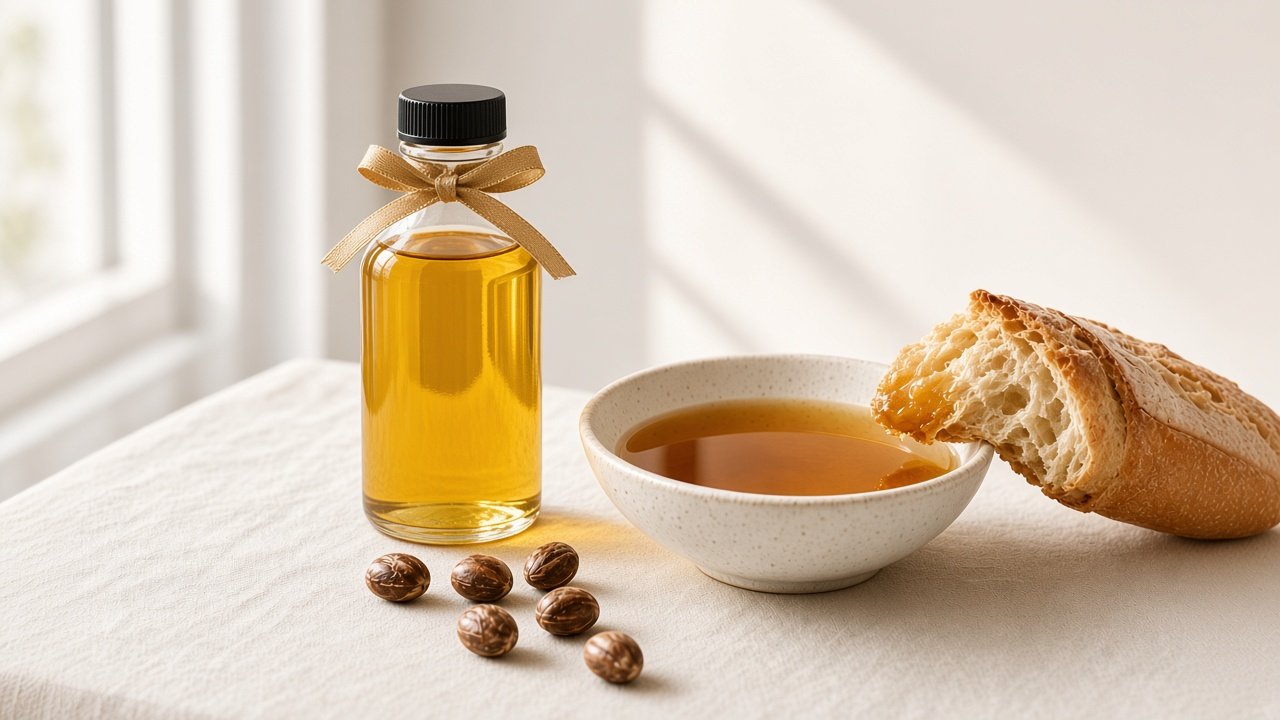
Argan oil destined for the table is pressed from roasted kernels. That single step transforms its sensory character. Cosmetic argan oil, from unroasted kernels, is golden and nearly odourless; edible argan oil carries a warm copper hue and an aroma somewhere between toasted sesame oil and hazelnut.
The dominant descriptors in the scientific literature are “nutty” and “roasty” — precisely the attributes trained panels use to identify high-quality edible argan oil [9]. The volatile compounds behind them are Maillard reaction products, pyrazines among them, generated during roasting [8][9]. When you open a bottle of good edible argan oil you are smelling chemistry — but chemistry the human nose has evolved to find deeply appealing.
The oil is smooth on the palate, with a slightly sweet, almost buttery finish and no harsh bitterness. It does not overpower food; it complements it. A drizzle over a salad, a dip of fresh bread, a finishing touch on grilled vegetables — these are the traditional uses, and they remain the best ways to appreciate its character.
What about defects? Sensory panels also describe the negative attributes that signal poor quality or mishandling: cheese-like, rancid, fusty or musty notes. These trace back to badly stored fruit, kernels recovered from fruit that goats have eaten, or poor roasting control [9]. A high-quality edible argan oil should smell inviting, never challenging.
The Nutritional Foundation: What Makes Argan Oil Different
Fatty acids: a balanced profile
Unsaturated fats make up roughly 80% of argan oil’s fatty acids [8]. The two dominant components are oleic acid (omega-9), about 43–49%, and linoleic acid (omega-6), about 29–36%.
Compared with olive oil, argan carries more linoleic and somewhat less oleic acid. Linoleic acid is essential — the body cannot make it — and it plays a role in skin-barrier function and in inflammatory signalling. That higher linoleic content is one molecular reason argan oil behaves differently from olive oil, and it is also why it oxidises more readily and should be used raw.
Vitamin E: a distinctive tocopherol profile
Vitamin E is not one compound but a family of tocopherols. In most edible oils α-tocopherol predominates. Argan oil is unusual: its profile is dominated by γ-tocopherol, with total tocopherols on the order of 600–900 mg/kg — well above olive oil [8].
This matters because γ-tocopherol does something α-tocopherol does poorly: it traps reactive nitrogen species, a class of radicals that α-tocopherol handles less efficiently [10]. The γ-dominance of argan oil is not a marginal detail; it is part of what makes its antioxidant chemistry genuinely different from that of more common oils.
Sterols and squalene: minor components, major interest
Argan oil’s principal sterols are schottenol and spinasterol — a profile distinct from the β-sitosterol dominance of olive and sunflower oils — and it carries squalene, a triterpene with antioxidant properties [8]. These are small quantities, but not negligible: much of the recent research on argan oil’s effects focuses precisely on these compounds.
Health Effects: What the Evidence Actually Shows
The literature on argan oil is growing, but it is not uniform in quality. Some findings rest on human trials; others on animal models or test-tube experiments. A responsible review distinguishes between them. Here is what the evidence supports.
Blood lipids: the strongest human evidence
A 2012 controlled trial in the British Journal of Nutrition gave twenty healthy subjects 15 g/day of argan oil with toasted bread at breakfast for four weeks, against twenty matched controls on their habitual diet. The argan group showed higher plasma vitamin E, lower total and LDL cholesterol, lower triglycerides, and an improved plasma and cellular antioxidant profile [1].
A 2005 intervention study in Annals of Nutrition and Metabolism went further: sixty volunteers took either 25 g/day of virgin argan oil or extra-virgin olive oil for three weeks. Both oils raised HDL cholesterol and apolipoprotein A-I (in the argan group, +8.4% and +5.2%), but the triglyceride reduction — about 17% — appeared only in the argan group, a finding the authors highlighted as novel [2].
The most clinically relevant study came in 2013 in Lipids in Health and Disease: thirty-nine dyslipidaemic patients (79% women) took 25 mL/day of argan oil for three weeks. Total cholesterol fell by 23.8% and LDL by 25.6%, while HDL rose by 26% compared with baseline. Beyond lipids, thrombin-induced platelet aggregation fell and oxidative status improved [3]. One honest qualifier: this was a before-and-after study without a control arm, which is why its numbers are larger than the controlled trials’.
Assessment: the human evidence for a lipid-modulating effect is consistent across three trials. The samples are modest (20–60 people) and the interventions short (3–4 weeks), but the direction of effect is uniform. This is not one outlier study; it is a pattern — a small one, from a single research community, awaiting a larger trial.
Antioxidant and anti-inflammatory effects
Argan oil’s antioxidant capacity is consistently reported as higher than that of other vegetable oils [8][9]. A 2025 review in Antioxidants examined the mechanisms: the oil’s bioactive compounds modulate the Nrf2/Keap1 pathway — a master regulator of cellular antioxidant defences — and inhibit NF-κB, a key transcription factor in inflammation [9]. In practical terms, the components may help cells respond to oxidative stress and dampen excessive inflammatory signalling.
The same review is candid that these effects come from preclinical models and limited human studies, and that direct human outcome data remain scarce [9].
Assessment: strong mechanistic rationale, limited human outcome data. The biology is convincing; the clinical proof is incomplete.
Metabolic syndrome and insulin resistance
The evidence here is animal, but it is consistent enough to note. In glucose-fed rats — a model of diet-induced metabolic disturbance — five weeks of argan oil (5 mL/kg/day) prevented or reduced the rises in blood pressure, glucose, insulin and insulin resistance, an effect the authors attributed to reduced superoxide production in the aorta [5]. A twelve-week study in the same model extended this to fat mass, triglycerides, leptin and neuropathic pain markers, and described argan oil as a potential “nutri-therapeutic agent” [6]. Earlier work found that argan oil given before chemically induced diabetes in rats limited weight loss and lowered blood glucose [7].
Assessment: consistent animal data, no human trials. A promising area, not an established one — and rat doses of 5 mL/kg have no human equivalent in a kitchen.
Skin, from within
One human study looked at what eating argan oil does to skin. A 2015 randomised trial in Clinical Interventions in Aging enrolled sixty postmenopausal women: thirty ate dietary argan oil, thirty ate olive oil, and all applied cosmetic argan oil to one forearm. After sixty days, the argan-eating group showed significant improvements in every measured elasticity parameter [4].
Assessment: a randomised human trial with a positive result, in a specific population. It is the closest thing to evidence for the traditional belief that the oil works from the inside as well as the outside.
How to Use Argan Oil for Eating
Amounts used in the trials
- 15 g/day — about one tablespoon — in the four-week British Journal of Nutrition trial [1]
- 25 g or 25 mL/day — about two tablespoons — in the three-week lipid trials [2][3]
These were consumed for three to eight weeks. No health authority has set a long-term intake recommendation; a spoonful or two a day, as in the traditional diet, is the only quantity with human data behind it.
In the kitchen
- Drizzled over bread at breakfast — the original use
- On salads, in place of or alongside olive oil
- As a finishing oil on grilled vegetables, fish or a tagine, added after cooking
- Ground with roasted almonds and honey into amlou, the traditional spread
Use it raw. Heat destroys the roasted aroma you paid for and degrades the tocopherols; its high linoleic content makes it a poor frying oil in any case. Keep it in dark glass, closed, away from the stove.
Safety
- Calories. Like every oil, about 120 kcal per tablespoon. It replaces other fat; it does not sit on top of it.
- Allergy. Argan is not botanically a tree nut, but anaphylaxis to argan oil has been reported [11]. Anyone with nut or seed allergies should try a small amount first.
- Not a medication. The lipid effects above are real but small, and come from three-week trials. Argan oil does not replace prescribed lipid-lowering or glucose-lowering drugs. The same principle as everywhere on this site: a food or supplement helps where there is a gap, and does not work miracles.
Conclusion: A Food Worth Knowing
Argan oil is not a miracle cure, and the more breathless claims about it deserve scepticism. But it is a genuinely interesting food with a distinctive molecular profile and a small, consistent body of human evidence for an effect on blood lipids.
What makes it worth trying is not only what it might do — it is how it tastes. The roasted, nutty character of edible argan oil is pleasant in a way few “health foods” can claim. It is a reminder that eating well does not require trading pleasure for function. Sometimes the two align.
If you decide to explore it, start with a small bottle from a source that can tell you the cooperative and the pressing year — how to recognise genuine argan oil is set out in the herb entry. Taste it on bread. Drizzle it on a salad. Let the flavour tell you what the science already suggests: this is an oil worth paying attention to. It belongs beside olive oil in the staple foods of the Mediterranean and Maghrebi kitchen, not instead of it.
Scientific Sources and References
- Sour S, Belarbi M, Khaldi D, et al. Argan oil improves surrogate markers of CVD in humans. British Journal of Nutrition. 2012;107(12):1800–1805. PMID 22082585
- Derouiche A, Cherki M, Drissi A, et al. Nutritional intervention study with argan oil in man: effects on lipids and apolipoproteins. Annals of Nutrition and Metabolism. 2005;49(3):196–201. PMID 16020940
- Haimeur A, Messaouri H, Ulmann L, et al. Argan oil prevents prothrombotic complications by lowering lipid levels and platelet aggregation, enhancing oxidative status in dyslipidemic patients. Lipids in Health and Disease. 2013;12:107. PMID 23870174
- Boucetta KQ, Charrouf Z, Aguenaou H, Derouiche A, Bensouda Y. The effect of dietary and/or cosmetic argan oil on postmenopausal skin elasticity. Clinical Interventions in Aging. 2015;10:339–349. PMID 25673976
- El Midaoui A, Haddad Y, Couture R. Beneficial effects of argan oil on blood pressure, insulin resistance, and oxidative stress in rat. Nutrition. 2016;32(10):1132–1137. PMID 27161594
- El Midaoui A, Haddad Y, Filali-Zegzouti Y, Couture R. Argan oil as an effective nutri-therapeutic agent in metabolic syndrome: a preclinical study. International Journal of Molecular Sciences. 2017;18(11):2492. PMID 29165388
- Bellahcen S, Mekhfi H, Ziyyat A, et al. Prevention of chemically induced diabetes mellitus in experimental animals by virgin argan oil. Phytotherapy Research. 2012;26(2):180–185. PMID 21584872
- Gharby S, Charrouf Z. Argan oil: chemical composition, extraction process, and quality control. Frontiers in Nutrition. 2022;8:804587. PMID 35187023
- Rabbaa S, et al. Argan oil: a natural bioactive lipid modulating oxidative stress and inflammation. Antioxidants. 2025;14(5):515. PMID 40427397
- Christen S, Woodall AA, Shigenaga MK, et al. γ-Tocopherol traps mutagenic electrophiles such as NOx and complements α-tocopherol: physiological implications. Proceedings of the National Academy of Sciences. 1997;94(7):3217–3222. PMID 9096373
- Astier C, Benchad Yel A, Moneret-Vautrin DA, Bihain BE, Kanny G. Anaphylaxis to argan oil. Allergy. 2010;65(5):662–663. PMID 19839978
Last reviewed: September 2026. Vivid Remedy publishes independently researched, evidence-based content cross-referenced against current peer-reviewed literature. This content does not constitute medical advice.