This article describes what meat is — its colour, its chemistry, what happens to it after slaughter, and where it sits among protein foods. It is not medical advice. It does not tell you to eat meat or to avoid it. Anyone managing cholesterol, iron status or kidney disease should discuss protein intake with a clinician.
Introduction: A Term That Misleads
Every day, in clinics around the world, a patient with high cholesterol hears the same instruction: “Avoid red meat. You can eat chicken.” The advice sounds reasonable. As stated, it is scientifically wrong.
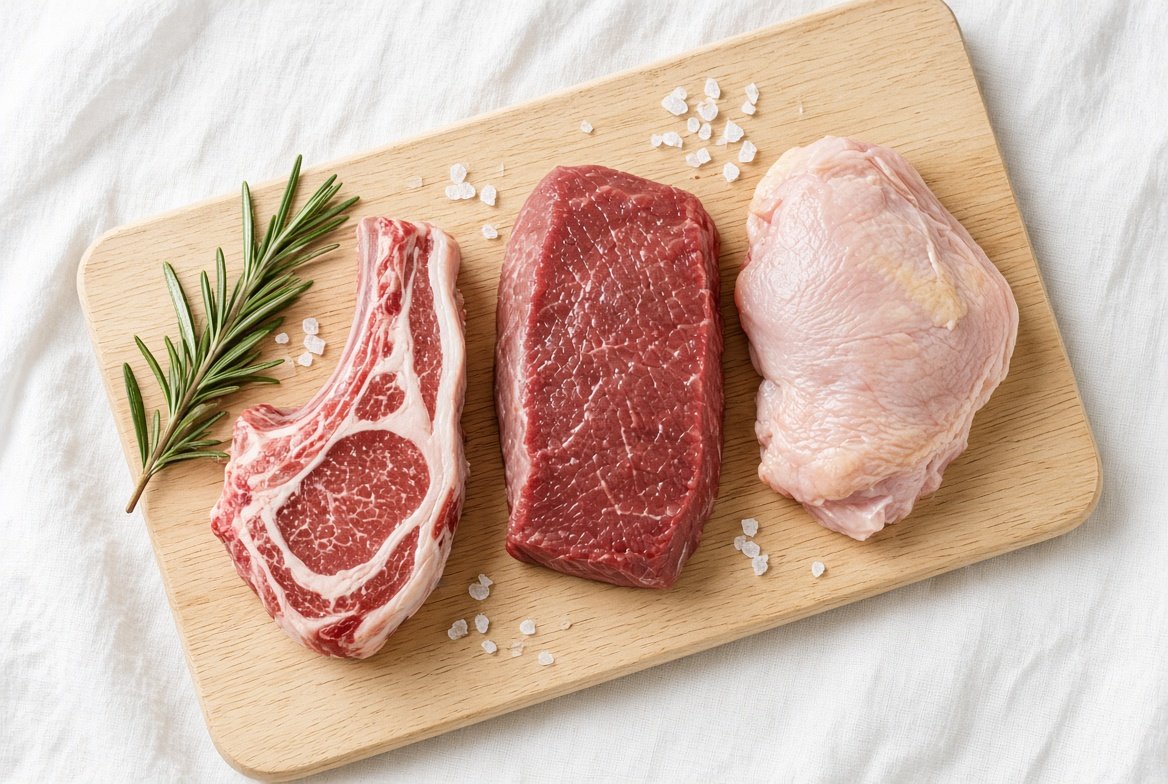
In food science the division of meat into “red” and “white” is a term of trade, not of biology [1]. Meat colour is set by myoglobin, the oxygen-storing protein of muscle, and every warm-blooded animal — cattle, sheep, goats, camels, chickens, turkeys, rabbits — makes it in every muscle [1][2]. What differs between a lamb chop and a chicken breast is the amount, not the kind. The pale breast of an intensively reared bird is simply a muscle with little myoglobin, built for short bursts rather than sustained work; the thigh of the same bird can be as dark as veal [3]. Colour is a continuum, and the red/white line is drawn at a commercially convenient point on it [1].
Doctors who ban “red meat” while permitting poultry therefore create a false distinction — one that leaves the patient eating the same saturated fat and cholesterol the restriction was meant to limit [4][5]. The rest of this article explains why, and what meat actually is.
Key Takeaways
- All warm-blooded animal meat is myoglobin-containing muscle — “white meat” is a marketing category, not a biological one
- Poultry and livestock share the same defining compounds: saturated fat and cholesterol — chicken breast carries more cholesterol per 100 g than lean beef
- Cholesterol is an animal compound; plant foods contain none
- Fish is the exception among animal foods — for its fat, not its cholesterol: little saturated fat, abundant omega-3
- Legumes and cereals together supply every essential amino acid, with fibre and without cholesterol; only vitamin B12 must come from animal foods
- Complete bleeding at slaughter and proper maturation decide the quality of meat
- Meat is a good food, not an essential one — a component, not a foundation
The Red and White Myth: A Scientific Correction
Muscle is built from two principal fibre types. Oxidative fibres are rich in myoglobin and mitochondria and support sustained activity; they give meat its red colour. Glycolytic fibres run on stored glycogen for rapid bursts and hold little myoglobin; they give meat a paler tone [3]. Every species has both, and the balance responds to the animal’s life: activity shifts muscle towards the oxidative type, confinement and selection for rapid growth shift it towards the glycolytic type [3]. That is why a free-ranging bird is darker than a battery bird, and why the same rule holds for cattle.
The clinical consequence is measurable. In a direct laboratory comparison of bison, beef, elk and chicken, chicken breast contained more cholesterol per 100 g than beef loin or round [4]. The reference values of the United States Department of Agriculture say the same: skinless chicken thigh 133 mg per 100 g cooked, lamb leg 87 mg, chicken breast 85 mg, lean beef sirloin 82 mg, goat 75 mg [5]. The cut, the fat trim and the cooking method decide the cholesterol in a portion; the colour of the flesh does not. There is no “white meat.” There is only meat.
What Meat Actually Contains
Lean muscle from any warm-blooded species is chemically similar [3][6]:
| Component | In all warm-blooded meat |
|---|---|
| Protein, about 20–22% (rich in lysine) | Yes |
| Haem iron, zinc, selenium | Yes |
| Vitamin B12 and other B vitamins | Yes |
| Saturated fat | Yes |
| Cholesterol | Yes |
| Dietary fibre | No |
| Phytosterols, polyphenols, vitamin C | No |
Cholesterol is an animal compound. Plants make sterols of their own — phytosterols — but no plant food contributes dietary cholesterol in any meaningful amount [5]. Saturated fat and cholesterol travel together in animal foods, and it is the pattern of a diet high in both, and low in fibre, that the cardiovascular evidence consistently links to harm [7][8].
Haem iron cuts both ways. It is the most absorbable form of iron in the diet — a genuine strength of meat for anyone at risk of anaemia. It is also, in a meta-analysis of prospective studies, associated with an 18% higher relative risk of colorectal cancer at high intake, through mechanisms involving oxidation in the gut [9]. The same compound is a benefit at moderate intake and a risk at habitual high intake — which is the theme of this article.
Fish is the exception — but not for the reason usually given. Fish contains cholesterol in amounts comparable to lean meat. What sets it apart is its fat: little saturated fat and abundant long-chain omega-3, which is why the evidence for regular fish consumption points towards lower cardiovascular mortality rather than higher [10]. We treat this fully in our article on fish as nature’s true white meat.
Rigor Mortis and Maturation: The Biochemistry of Tenderness
Meat is unusual among foods in requiring post-mortem processing. Grains, legumes, fruit and vegetables can be eaten as harvested; meat must pass through slaughter, bleeding, evisceration and maturation before it is fit for the table.
After slaughter the muscle still holds ATP. As oxygen and energy substrates run out, actin and myosin lock into the rigid actomyosin complex — rigor mortis — over a few hours in poultry and up to a day in cattle [3][11]. Meanwhile anaerobic glycolysis accumulates lactic acid, and muscle pH falls from about 7.0 to an ultimate value near 5.4–5.7 [3][11]. That mild acidity is not a defect: it slows bacterial growth and is one reason a properly handled carcass keeps.
Rigor is then dismantled by the muscle’s own enzymes — the calcium-activated calpains first, the lysosomal cathepsins later — which cut the structural proteins of the myofibril and make the meat tender [12][13]. Meat that has not completed this maturation stays tough however long it is cooked; the enzymes must do their work first [13]. Traditional cultures knew this as hanging or ageing; modern meat science has simply measured it.
Bleeding: The Decisive Step
How completely an animal is bled decides much of what follows. Residual blood supplies iron, protein and a near-neutral pH — a culture medium for bacteria and a driver of fat oxidation [14][15]. In a controlled study on goats, animals whose bleed-out was poorest retained the most haemoglobin in the muscle and gave meat with the most lipid oxidation and the highest bacterial counts over two weeks of storage; well-bled animals, including those slaughtered without stunning, kept best [14]. In rabbits, slaughter without stunning gave greater blood loss, less residual haemoglobin, and meat that oxidised and spoiled more slowly than after gas stun-killing [15].
Two precisions. First, the advantage belongs to complete bleeding, not to any particular rite: the same research group found that goats bled under light anaesthesia bled as fully as conscious animals, with no difference in keeping quality [16]. Second, the familiar observation that a well-bled carcass does not bloat while an animal that died of disease does, and that such meat keeps longer without refrigeration, is consistent with these findings — but it is tradition, not a measured result. What the studies establish is this: a rested animal, a beating heart at the moment of the cut, and free drainage give the cleanest, most stable meat. Slaughter method is a food-quality variable, not only a cultural one.
Protein: Meat Is Not the Primary Source
The claim that meat is the indispensable protein food is not accurate. Compared honestly — on a dry-weight basis, since meat is 70% water and dried legumes are not — lentils, chickpeas and beans contain 20–25% protein and soybeans over 35%, against about 21–22% for lean raw meat; per calorie the two are close [17]. Every plant protein contains all nine essential amino acids; what varies is the proportion, so that cereals (lower in lysine) and legumes (lower in sulphur amino acids) complement each other over a day [17]. Meat’s real strengths are its haem iron, its lysine, and vitamin B12, which is found in useful amounts only in animal foods [6]. Those are reasons to include meat; they are not reasons to build a diet on it.
| Protein source | Protein (dry basis) | Cholesterol | Saturated fat | Fibre |
|---|---|---|---|---|
| Lean meat | ≈ 70–80% | Yes | Yes | No |
| Legumes | 20–25% | No | Trace | Yes |
| Soybeans | 35–40% | No | Low | Yes |
| Fish | ≈ 75–85% | Yes | Low | No |
| Eggs, milk | High | Yes | Yes | No |
Dry-basis figures; lean meat and fish are mostly water, so their fresh-weight protein is about 20–22%. Sources: USDA FoodData Central [5]; Mariotti & Gardner [17].
Digestion and the Missing Fibre
Meat is a slow food. A meal rich in protein and fat leaves the stomach far more slowly than a starchy or vegetable meal — several hours rather than one — because the stomach meters fat and protein out to the intestine at the rate the pancreas can handle [18]. That is neither good nor bad in itself; it is why a meat meal is satiating, and why it sits heavily when eaten in quantity or without exertion.
What meat lacks matters as much as what it contains. It brings no fibre, and fibre is what the plant half of the plate supplies. Across nearly 250 prospective studies and trials, people eating 25–29 g of fibre a day had 15–30% lower all-cause and cardiovascular mortality and lower rates of colorectal cancer than those eating least [8]. A diet in which meat displaces legumes, whole grains and vegetables loses that protection twice over: it gains saturated fat and haem iron, and it loses the fibre that moderates both.
Modern Intensive Systems: The Quality Question
Confinement, high-energy concentrates and selection for rapid growth push muscle towards glycolytic fibres and fatter carcasses — paler, softer meat of lower sensory quality [3]. Free-ranging animals that move and graze develop more myoglobin, leaner carcasses and more flavour, and their fat carries a better fatty-acid profile: in the same comparison cited above, range-fed animals had markedly more omega-3 and conjugated linoleic acid than feedlot-fed animals or chicken [4]. Intensive systems add further variables — feed composition and veterinary drug use — that traditional husbandry did not. Much of what is blamed on “meat” is a consequence of how it was produced.
Meat in Its Place
Meat is one food among many. It can be omitted entirely without nutritional harm, provided B12 is obtained elsewhere [17]. It is lawful and useful when of good quality and eaten occasionally — at festivals, at family tables, once a week or less — within a diet whose daily base is plants. The large prospective studies support exactly this middle course: cardiovascular mortality rises with habitual red and processed meat intake, about 1.8% for every additional 10 g a day [7], while the evidence against the occasional portion of unprocessed meat is graded weak [19]. Daily consumption carries a measurable cost; occasional consumption does not measurably show one.
That integrated pattern — plants as the daily base, meat as an occasional concentrated food — was characteristic of Mediterranean and pastoral diets before the modern era, and it remains consistent with the best available science [20]. Meat is a good food, not an essential food. It is a component, not a foundation.
Conclusion: Facts, Not Marketing
All warm-blooded muscle is the same tissue, coloured to a greater or lesser degree by the same protein. Poultry and livestock share the same saturated fat and cholesterol; cholesterol is animal, fibre is plant; fish stands apart for its fat, not its cholesterol. Quality depends on the animal’s life, the completeness of bleeding and the patience of maturation. And the healthiest use of meat is occasional rather than habitual — chosen for the animal’s origin and the cut, never for a colour on a label. Nature provides diversity. Tradition teaches moderation. Science reveals the balance.
Scientific Sources and References
- Keeton JT, Dikeman ME. “Red” and “white” meats — terms that lead to confusion. Animal Frontiers. 2017;7(4):29–33. doi:10.2527/af.2017.0440
- Suman SP, Joseph P. Myoglobin chemistry and meat color. Annual Review of Food Science and Technology. 2013;4:79–99. PMID 23190143
- Listrat A, Lebret B, Louveau I, et al. How muscle structure and composition influence meat and flesh quality. The Scientific World Journal. 2016;2016:3182746. PMID 27022618
- Rule DC, Broughton KS, Shellito SM, Maiorano G. Comparison of muscle fatty acid profiles and cholesterol concentrations of bison, beef cattle, elk, and chicken. Journal of Animal Science. 2002;80(5):1202–1211. PMID 12019607
- U.S. Department of Agriculture, Agricultural Research Service. FoodData Central, SR Legacy: chicken thigh, meat only, roasted (FDC 172388); lamb leg, lean only, roasted (172487); chicken breast, meat only, roasted (171477); beef top sirloin, lean only, broiled (168635); goat, roasted (175304). fdc.nal.usda.gov
- Gille D, Schmid A. Vitamin B12 in meat and dairy products. Nutrition Reviews. 2015;73(2):106–115. PMID 26024497
- Bhandari B, Liu Z, Lin S, et al. Long-term consumption of 10 food groups and cardiovascular mortality: a systematic review and dose response meta-analysis of prospective cohort studies. Advances in Nutrition. 2023;14(1):55–63. PMID 36811594
- Reynolds A, Mann J, Cummings J, Winter N, Mete E, Te Morenga L. Carbohydrate quality and human health: a series of systematic reviews and meta-analyses. The Lancet. 2019;393(10170):434–445. PMID 30638909
- Bastide NM, Pierre FH, Corpet DE. Heme iron from meat and risk of colorectal cancer: a meta-analysis and a review of the mechanisms involved. Cancer Prevention Research. 2011;4(2):177–184. PMID 21209396
- Mozaffarian D, Rimm EB. Fish intake, contaminants, and human health: evaluating the risks and the benefits. JAMA. 2006;296(15):1885–1899. PMID 17047219
- Geldenhuys G, Muller N, Frylinck L, Hoffman LC. Post mortem rigor development in the Egyptian goose (Alopochen aegyptiacus) breast muscle (pectoralis): factors which may affect the tenderness. Journal of the Science of Food and Agriculture. 2016;96(1):271–279. PMID 25641020
- Koohmaraie M. The role of Ca2+-dependent proteases (calpains) in post mortem proteolysis and meat tenderness. Biochimie. 1992;74(3):239–245. PMID 1610937
- Kaur L, Hui SX, Morton JD, Kaur R, Chian FM, Boland M. Endogenous proteolytic systems and meat tenderness: influence of post-mortem storage and processing. Food Science of Animal Resources. 2021;41(4):589–607. PMID 34291209
- Sabow AB, Zulkifli I, Goh YM, et al. Bleeding efficiency, microbiological quality and oxidative stability of meat from goats subjected to slaughter without stunning in comparison with different methods of pre-slaughter electrical stunning. PLoS One. 2016;11(4):e0152661. PMID 27035716
- Nakyinsige K, Fatimah AB, Aghwan ZA, Zulkifli I, Goh YM, Sazili AQ. Bleeding efficiency and meat oxidative stability and microbiological quality of New Zealand White rabbits subjected to halal slaughter without stunning and gas stun-killing. Asian-Australasian Journal of Animal Sciences. 2014;27(3):406–413. PMID 25049968
- Sabow AB, Sazili AQ, Zulkifli I, et al. A comparison of bleeding efficiency, microbiological quality and lipid oxidation in goats subjected to conscious halal slaughter and slaughter following minimal anesthesia. Meat Science. 2015;104:78–84. PMID 25732178
- Mariotti F, Gardner CD. Dietary protein and amino acids in vegetarian diets — a review. Nutrients. 2019;11(11):2661. PMID 31690027
- Goyal RK, Guo Y, Mashimo H. Advances in the physiology of gastric emptying. Neurogastroenterology & Motility. 2019;31(4):e13546. PMID 30740834
- Lescinsky H, Afshin A, Ashbaugh C, et al. Health effects associated with consumption of unprocessed red meat: a Burden of Proof study. Nature Medicine. 2022;28(10):2075–2082. PMID 36216940
- Willett WC, Sacks F, Trichopoulou A, et al. Mediterranean diet pyramid: a cultural model for healthy eating. American Journal of Clinical Nutrition. 1995;61(6 Suppl):1402S–1406S. PMID 7754995
Last reviewed: September 2026. Vivid Remedy publishes independently researched, evidence-based content cross-referenced against current peer-reviewed literature. This content does not constitute medical advice.