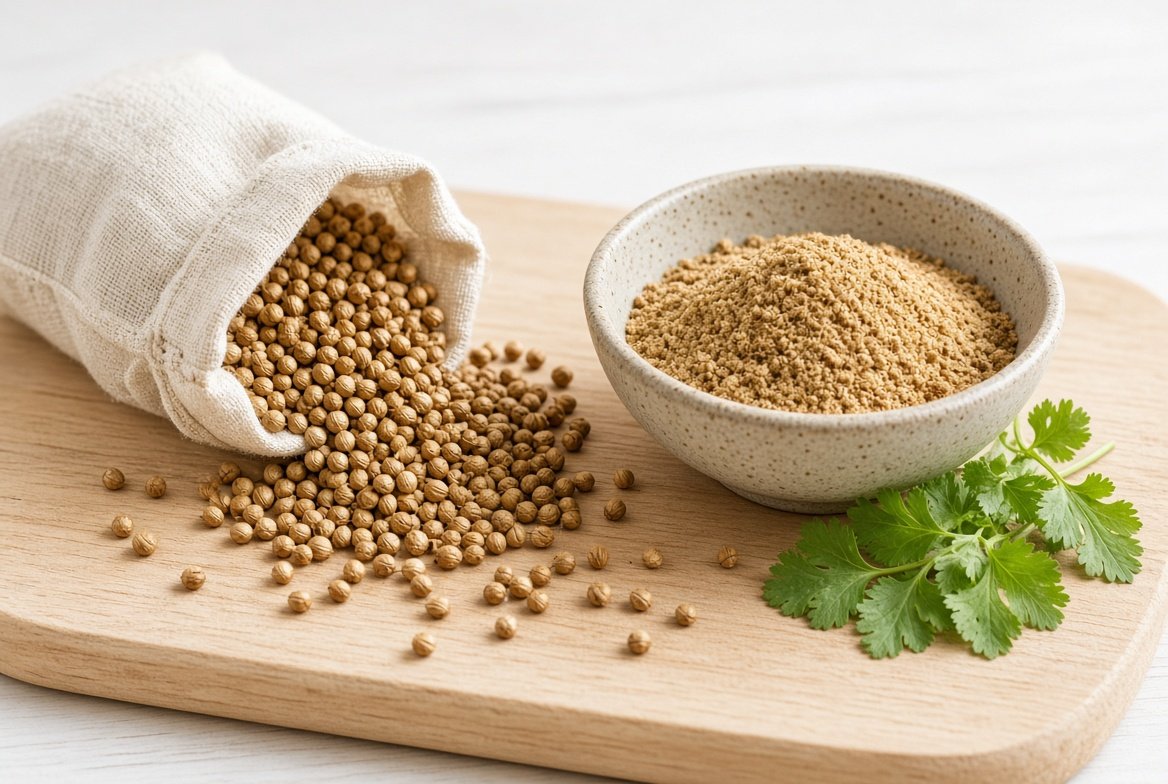
This article reviews the composition and the evidence for coriander seed as a food and traditional remedy. It is not medical advice. Coriander is a spice, not a treatment: anyone on glucose-lowering or lipid-lowering medication should not change it on the strength of an article, and anaemia must be investigated by a physician, not treated with a spice.
Introduction: The Hollow Seed That Holds More Than It Shows
In the world of spices, some names command attention: turmeric, cinnamon, black seed. Others fade into the background — used daily, yet never truly seen. Coriander seed (Coriandrum sativum) is among the forgotten ones.
The seed itself appears unremarkable. It is hollow — a dry, light shell that seems to hold nothing. Farmers in some regions dislike it for that reason: several sacks of coriander weigh what a single sack of wheat does. It is, by all outward appearances, an empty thing.
And yet that hollow husk carries an oil rich in plant sterols, a phenolic fraction with documented antioxidant activity, a fibre content near 40%, and a mineral profile — calcium, iron, copper, manganese — that few spices match gram for gram [1][2][3]. It is dismissed as a flavouring, a decoration in pickles and stews. The evidence says it deserves better. This article sets out what coriander seed actually contains, what the trials show, and what it can reasonably be expected to do — without the exaggeration that surrounds “superfoods.” The short reference version is in our coriander seed entry.
Key Takeaways
- Coriander seed oil is rich in plant sterols, with β-sitosterol as its principal sterol; its fatty acid signature is petroselinic acid
- Per 100 g it supplies about 1 mg of copper, 16 mg of iron and 700 mg of calcium — but a teaspoon is under 2 g, so it is a contributor, not a supplement
- Plant sterols compete with cholesterol for absorption; at 2 g/day they lower LDL by about 10% — an amount no spice provides, but one that a seed-rich diet contributes to
- One small randomised trial found 1 g/day of coriander seed powder for six weeks improved glucose, insulin resistance and lipids in type 2 diabetes
- Anaemia is not simply iron deficiency: inflammation (hepcidin), copper status and lead exposure can each block the use of iron the body already has
- Coriander is not a cure for anything — it is a traditional medicinal food that supports normal digestion and metabolism
The Sterol Fraction: β-Sitosterol and Its Companions
Coriander seed contains roughly 15–20% oil, and that oil is unusual twice over. Its dominant fatty acid is petroselinic acid, an isomer of oleic acid found almost nowhere else in the diet; and its sterol fraction is led by β-sitosterol, with stigmasterol and campesterol behind it [1][2]. A 2016 comparison of seed oils confirmed β-sitosterol as the main sterol of coriander oil and petroselinic acid as its signature [1].
Why sterols matter: they are structural cousins of cholesterol — similar enough to compete with it for a place in the mixed micelles that carry fat across the gut wall, different enough that the body absorbs them poorly [4][5]. The net effect is that less dietary and biliary cholesterol enters the bloodstream. The clinical dose is well established: a review of 41 trials concluded that about 2 g of plant sterols a day lowers LDL cholesterol by roughly 10% [6].
Honesty about amounts. A teaspoon of ground coriander weighs under 2 g and contains a few milligrams of sterols, not grams. No spice, used as a spice, delivers the sterol dose of a fortified margarine. What coriander does is belong to a family of traditional seeds — flax, sesame, black seed, fenugreek, anise, fennel, caraway — that together, eaten daily, keep a steady stream of sterols, fibre and phenolics in the diet. The evidence for plant-sterol-rich dietary patterns is good [4][6]; the evidence for coriander alone as a cholesterol treatment is limited to animal work, where seed powder lowered lipids in rats fed a high-fat diet [7]. The same logic applies to the whole grain and seed foundation of the diet, which we set out in our article on cereals.
The Mineral Fraction: Copper, Iron and Calcium
Per 100 g, the USDA reference values give coriander seed about 1 mg of copper, 16 mg of iron, 709 mg of calcium, 1.9 mg of manganese and 42 g of dietary fibre [3]. Gram for gram, that is a mineral density few foods reach. Per teaspoon, it is 2% of the daily copper allowance and a similar fraction of the others. Both statements are true, and both belong in the same sentence: coriander is a meaningful contributor when used generously and daily, not a supplement.
Copper deserves the emphasis it rarely gets. It is the cofactor of ceruloplasmin, the enzyme that oxidises iron so it can be loaded onto transferrin and carried to the marrow; of cytochrome c oxidase in energy production; of superoxide dismutase in antioxidant defence; and of the enzymes that cross-link collagen [8]. Without adequate copper, iron cannot be mobilised from its stores, and a copper-deficiency anaemia results that no amount of iron will correct [8].
The Anaemia Question: Why Iron Deficiency Is Not the Whole Story
Traditional practice put coriander in the diet of the pale and the tired. Modern haematology explains why “take iron” is so often the wrong answer — and, in doing so, makes a case for foods that supply the cofactors of iron use rather than iron alone.
Inflammation: the hepcidin lock
Anaemia of chronic disease is among the most common anaemias worldwide, and its defining feature is that iron is present but trapped: locked inside macrophages and unavailable to the marrow [9][10]. The gatekeeper is hepcidin, a liver hormone. Under inflammation — infection, autoimmune disease, obesity, chronic kidney disease — hepcidin rises, binds the iron-export channel ferroportin and destroys it, and iron stops leaving the cells that hold it [10]. The patient may have normal or high ferritin and still be anaemic. Iron tablets in that setting do little, and in active infection may feed the pathogen [9].
Lead: the blocked enzyme
Lead inhibits several enzymes of haem synthesis, including ferrochelatase, the enzyme that inserts iron into protoporphyrin to make haem. When it is blocked, zinc takes iron’s place and zinc protoporphyrin accumulates in red cells — the classic laboratory fingerprint of lead exposure [11]. Iron is present; it simply cannot be used.
Copper and the other cofactors
An expert review of nutritional anaemia “beyond iron” concludes that deficiencies of copper, riboflavin, vitamin A, folate and B12 each impair red-cell production and that anaemia should be approached as a network of nutrients, not a single one [8]. Before iron is prescribed, the questions to ask are: is there inflammation? is copper adequate? is there lead? Coriander answers none of these questions — but a diet in which such seeds are eaten daily supplies copper, iron and the fibre that shapes the gut, which is more than a tablet does.
Blood Sugar and Lipids: What the Trials Show
Coriander’s reputation as an “anti-diabetic plant” is old, and the laboratory gave it a mechanism a quarter-century ago: coriander extract both stimulated insulin release from pancreatic cells and had insulin-like effects on glucose uptake in muscle cells in vitro, and improved glucose handling in diabetic mice [12]. Aqueous extracts of the seed have since been shown to lower blood glucose and improve lipids in diabetic rats, and the seed’s phenolic fraction is under study for its effects on obesity and the metabolic syndrome [2][13].
Human evidence is recent and small. In a randomised, double-blind, placebo-controlled trial, 40 patients with type 2 diabetes took 1 g of coriander seed powder daily for six weeks; fasting glucose, insulin, HOMA-IR, total cholesterol, triglycerides, LDL and a marker of oxidative stress all improved significantly compared with placebo [14]. That is one trial, six weeks, 20 patients per arm — encouraging, not conclusive. A scoping review of culinary doses of herbs and spices for the metabolic syndrome places coriander among the spices with early clinical signal, alongside cinnamon, ginger and turmeric [15].
Its close traditional companion, fenugreek, has more: a meta-analysis of ten trials found fenugreek supplementation lowered fasting glucose, two-hour glucose and HbA1c in people with diabetes, with no effect in healthy subjects [16]. The two seeds share the same place in traditional seed blends, and the pattern of evidence — real effects, modest size, in people who already have the condition — is the same.
On blood pressure, the evidence is animal only: coriander fruit extract lowered blood pressure and acted as a diuretic in rats, through calcium-channel and cholinergic mechanisms [17]. It should be quoted as that — a plausible traditional use with a mechanism, not a proven human effect.
The conclusion is measured: coriander seed is a reasonable part of the diet of a person with diabetes — not because it treats diabetes, but because it brings fibre, sterols and phenolics to the plate and, on early evidence, nudges glucose and lipids the right way. Medication is not touched.
Traditional Use: The Digestive Seed
For most of its history coriander was a digestive remedy. The pharmacognosy literature records its use as a carminative, stomachic and antispasmodic across the Mediterranean, the Middle East and South Asia, and the essential oil — 60–70% linalool — carries both its aroma and its documented antibacterial and antifungal activity [2][18]. Modern pharmacology supports the antispasmodic tradition: in isolated gut tissue coriander relaxes contracted smooth muscle, which is the mechanism behind relief of cramping and gas [17].
Human data exist, with a caveat. In an eight-week pilot trial in irritable bowel syndrome, a preparation combining coriander with lemon balm and mint reduced the severity and frequency of abdominal pain and bloating significantly more than placebo [19]. Coriander was one of three ingredients; the result supports the traditional blend, not the seed alone. A 2024 double-blind trial of a coriander-and-caraway formula reported improvement in functional dyspepsia on the same principle [20]. What harms the gut in the first place is a separate question, and we cover what damages gut bacteria on its own terms.
Practical Guidance: How to Use Coriander Seed
- Buy whole, grind fresh. The volatile oil that carries the flavour and much of the activity is lost within weeks of grinding; whole seed keeps for a year in a closed jar
- Toast briefly in a dry pan before grinding — it deepens the flavour and does not harm the sterols
- Use generously in everyday cooking — one to two teaspoons a day in soups, stews, lentils, roasted vegetables and marinades is the traditional level, and the only level with any human data behind it
- For digestion, a tea of lightly crushed seed after a heavy meal, alone or with fennel and cumin — the classic carminative trio
- In seed blends with flax, sesame, black seed and fenugreek — sprinkled on yoghurt, salads or bread — for the steady daily intake of sterols and fibre that the evidence favours
- Whole seeds in pickling brine — the traditional use that also preserves the oil
Safety
Coriander seed is generally recognised as safe at culinary doses and has a long record of daily use [2]. Allergy is rare but documented, usually in people already sensitive to other Apiaceae (celery, carrot, fennel, caraway). Because it may modestly lower blood glucose, anyone on insulin or sulphonylureas who begins using it in quantity should watch for low readings. There is no evidence-based therapeutic dose beyond culinary amounts; there is no reason to take it as capsules. In pregnancy and breastfeeding, culinary use is regarded as safe; concentrated extracts have not been studied.
Conclusion: The Hollow Seed Is Not Empty
Coriander seed is a paradox. It looks hollow, weighs nothing, and is dismissed by the farmer who grows it and the cook who uses it. Inside the husk are an oil rich in β-sitosterol, a phenolic fraction with real antioxidant activity, 40% fibre, and a mineral density that includes the copper most diets lack. It is not a miracle. It is a food — one whose compounds the body recognises and uses — and a small, honest body of evidence now says what tradition always said: eaten daily, as part of a seed-rich, plant-based table, it does a little good for the gut, the blood lipids and the blood sugar. That is more than most spices can claim, and it is enough.
Scientific Sources and References
- Kozłowska M, Gruczyńska E, Ścibisz I, Rudzińska M. Fatty acids and sterols composition, and antioxidant activity of oils extracted from plant seeds. Food Chemistry. 2016;213:450–456. PMID 27451203
- Laribi B, Kouki K, M’Hamdi M, Bettaieb T. Coriander (Coriandrum sativum L.) and its bioactive constituents. Fitoterapia. 2015;103:9–26. PMID 25776008
- U.S. Department of Agriculture, Agricultural Research Service. FoodData Central, SR Legacy: Spices, coriander seed (FDC 170922). fdc.nal.usda.gov
- Calpe-Berdiel L, Escolà-Gil JC, Blanco-Vaca F. New insights into the molecular actions of plant sterols and stanols in cholesterol metabolism. Atherosclerosis. 2009;203(1):18–31. PMID 18692849
- Ling WH, Jones PJ. Dietary phytosterols: a review of metabolism, benefits and side effects. Life Sciences. 1995;57(3):195–206. PMID 7596226
- Katan MB, Grundy SM, Jones P, Law M, Miettinen T, Paoletti R. Efficacy and safety of plant stanols and sterols in the management of blood cholesterol levels. Mayo Clinic Proceedings. 2003;78(8):965–978. PMID 12911045
- Chithra V, Leelamma S. Hypolipidemic effect of coriander seeds (Coriandrum sativum): mechanism of action. Plant Foods for Human Nutrition. 1997;51(2):167–172. PMID 9527351
- Farrell CC, Burkhead JL, Collins JF, et al. The role of micronutrient deficiencies in nutritional anemia beyond iron: an expert perspective on the scope and strength of the current evidence. Advances in Nutrition. 2026 (online 3 Jul). PMID 42398768
- Weiss G, Goodnough LT. Anemia of chronic disease. New England Journal of Medicine. 2005;352(10):1011–1023. PMID 15758012
- Ganz T. Hepcidin and iron regulation, 10 years later. Blood. 2011;117(17):4425–4433. PMID 21346250
- Labbé RF, Vreman HJ, Stevenson DK. Zinc protoporphyrin: a metabolite with a mission. Clinical Chemistry. 1999;45(12):2060–2072. PMID 10585337
- Gray AM, Flatt PR. Insulin-releasing and insulin-like activity of the traditional anti-diabetic plant Coriandrum sativum (coriander). British Journal of Nutrition. 1999;81(3):203–209. PMID 10434846
- Scandar S, Zadra C, Marcotullio MC. Coriander (Coriandrum sativum) polyphenols and their nutraceutical value against obesity and metabolic syndrome. Molecules. 2023;28(10):4187. PMID 37241925
- Zamany S, Barzegar A, Aghapour B, Ferdosi F. Effects of dietary supplementation with coriander seed powder on serum lipid profile, glycemic indices, and oxidative stress biomarkers in patients with type 2 diabetes mellitus: a randomized, double-blind, placebo-controlled trial. Preventive Nutrition and Food Science. 2025;30(6):529–538. PMID 41492428
- Mackonochie M, Rodriguez-Mateos A, Mills S, Rolfe V. A scoping review of the clinical evidence for the health benefits of culinary doses of herbs and spices for the prevention and treatment of metabolic syndrome. Nutrients. 2023;15(23):4867. PMID 38068725
- Neelakantan N, Narayanan M, de Souza RJ, van Dam RM. Effect of fenugreek (Trigonella foenum-graecum L.) intake on glycemia: a meta-analysis of clinical trials. Nutrition Journal. 2014;13:7. PMID 24438170
- Jabeen Q, Bashir S, Lyoussi B, Gilani AH. Coriander fruit exhibits gut modulatory, blood pressure lowering and diuretic activities. Journal of Ethnopharmacology. 2009;122(1):123–130. PMID 19146935
- Nouioura G, El Fadili M, El Hachlafi N, et al. Coriandrum sativum L. essential oil as a promising source of bioactive compounds with GC/MS, antioxidant, antimicrobial activities: in vitro and in silico predictions. Frontiers in Chemistry. 2024;12:1369745. PMID 38974992
- Vejdani R, Shalmani HR, Mir-Fattahi M, et al. The efficacy of an herbal medicine, Carmint, on the relief of abdominal pain and bloating in patients with irritable bowel syndrome: a pilot study. Digestive Diseases and Sciences. 2006;51(8):1501–1507. PMID 16868824
- Azimi M, Esfandiarpour M, Raeiszadeh M, Salajegheh F, Saeidpour Parizi A. The efficacy of the herbal formula of Bunium persicum and Coriandrum sativum on clinical symptoms of patients with functional dyspepsia: a double-blind randomized controlled trial. Complementary Medicine Research. 2024;31(5):416–426. PMID 38981452
Last reviewed: September 2026. Vivid Remedy publishes independently researched, evidence-based content cross-referenced against current peer-reviewed literature. This content does not constitute medical advice.