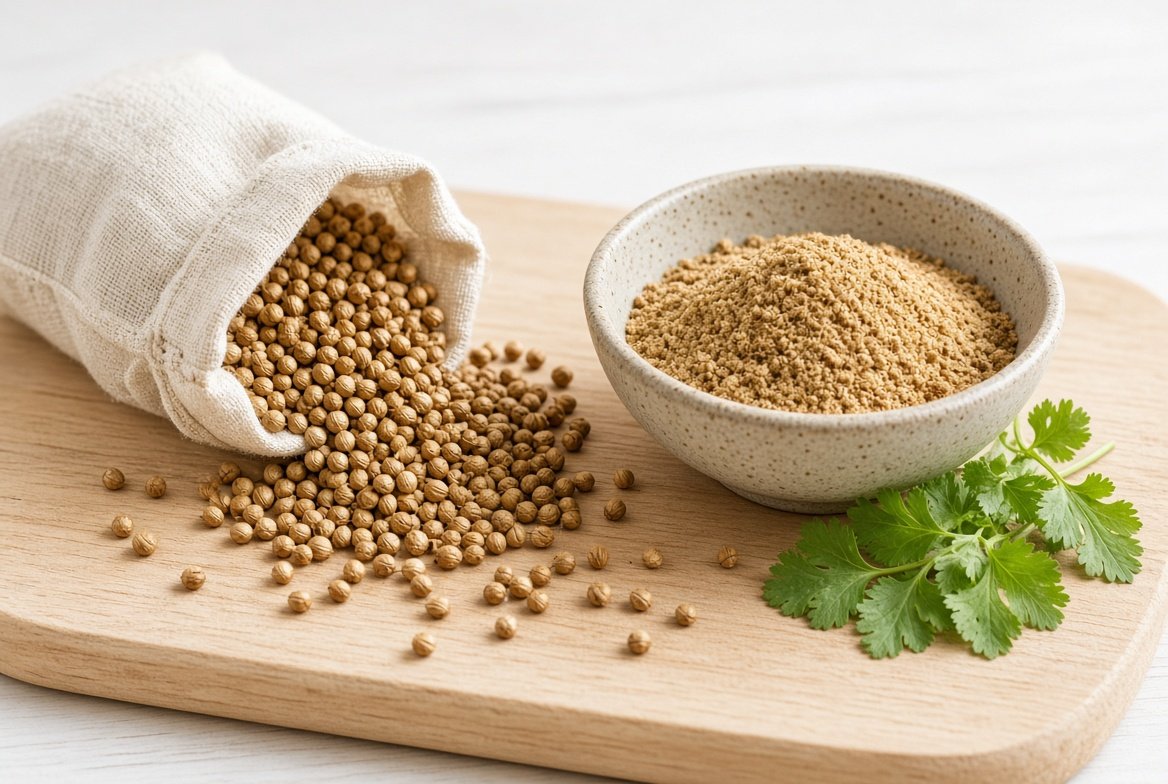
Coriandrum sativum L. · Apiaceae · native to the Mediterranean basin, cultivated worldwide · dried fruit (“seed”) and fresh leaf
Identification
An erect, hairless annual, 20–60 cm tall, of the carrot family — the same family as caraway, anise, fennel, cumin and parsley. The lower leaves are broad and lobed; the upper leaves are finely cut into narrow thread-like segments. The flowers are small, white to pale pink, in compound umbels, and the whole fresh plant has the pungent, green, faintly soapy smell that divides opinion so sharply [1].
The “seed” is botanically a fruit — a globose schizocarp, 1.5–5 mm across, pale brown to straw-coloured when ripe, marked with five straight primary ribs alternating with four wavy secondary ribs. It splits into two halves (mericarps) that enclose a hollow cavity. Ripe fruit smells warm, sweet and citrus-tinged — nothing like the fresh leaf [1]. Two cultivated types exist: the large-fruited (var. vulgare), grown for the spice, and the small-fruited (var. microcarpum), richer in essential oil and grown for distillation [1].
Traditional use
Coriander is among the oldest recorded spices: fruits have been recovered from Bronze Age sites around the eastern Mediterranean and it appears in the earliest medical papyri and herbals [1]. Across the Mediterranean, the Middle East and South Asia its traditional roles are consistent — a carminative for wind and bloating, a digestive taken after heavy meals, an antispasmodic for colic, and a flavouring that makes pulses and preserved meats more digestible [1]. Ethnobotanical surveys also record its use for menstrual complaints and, in cosmetics, as a fragrance and skin wash [1].
In the kitchen the ground fruit is a foundation spice of spice blends, slow-cooked pulse soups, pickling brines and preserved meats; the fresh leaf is a herb and garnish with an entirely different chemistry. The two should not be confused: the fruit’s aroma is linalool, the leaf’s is decanal and related aldehydes [1].
What’s in it
Essential oil
The fruit yields 0.3–1% essential oil, dominated by linalool — typically 55–80% depending on origin, variety and ripeness — with γ-terpinene, α-pinene, camphor, geranyl acetate and limonene behind it [1][2]. Linalool carries the aroma and most of the documented antibacterial and antifungal activity of the oil [2].
Fixed oil, fatty acids and sterols
The fruit also contains 15–25% fixed oil with an unusual signature. Its dominant fatty acid is petroselinic acid (C18:1 n-12), an isomer of oleic acid almost unique to the carrot family, at about 73% of total fatty acids, with linoleic (14%), oleic (6%) and palmitic (3%) acids [3]. The unsaponifiable fraction is rich in phytosterols — about 6.7 g/kg of oil — led by β-sitosterol (35% of sterols), stigmasterol (24%) and Δ⁷-stigmastenol (18%), with tocols (≈500 mg/kg) and a little squalene [3][4].
Minerals and fibre
| Per 100 g dried fruit | Amount |
|---|---|
| Dietary fibre | 42 g |
| Calcium | 709 mg |
| Potassium | 1,267 mg |
| Phosphorus | 409 mg |
| Iron | 16.3 mg |
| Manganese | 1.9 mg |
| Copper | 0.98 mg |
Values from the USDA reference database [5]. A teaspoon of ground coriander weighs under 2 g, so these are dense figures per weight and modest per serving — useful context for any claim made about the seed’s minerals.
Phenolics
Caffeic and chlorogenic acids, quercetin and kaempferol glycosides and related flavonoids, with measurable antioxidant activity in vitro; this fraction is the subject of current work on obesity and the metabolic syndrome [1][6].
What the evidence shows
Stated carefully: the composition is thoroughly characterised; the human evidence is thin and recent. In the laboratory, coriander extract stimulates insulin release and has insulin-like effects on glucose uptake [7]; in rats, seed powder lowers blood lipids and fruit extract lowers blood pressure and relaxes gut smooth muscle [8][9]. In people, one randomised, double-blind trial — 40 patients with type 2 diabetes, 1 g of seed powder daily for six weeks — found significant improvements in fasting glucose, insulin resistance, total cholesterol, triglycerides, LDL and a marker of oxidative stress against placebo [10]. For digestion, an eight-week pilot trial of a three-herb blend containing coriander reduced abdominal pain and bloating in irritable bowel syndrome more than placebo [11]. These are small studies, and the blend result cannot be credited to coriander alone. We go through them in our article on coriander seed’s sterols, copper and metabolic effects.
Cautions
- Allergy. Rare but documented, most often in people already sensitive to other members of the carrot family (celery, carrot, fennel, caraway) or to mugwort pollen; reactions to the leaf are more common than to the fruit [1].
- Blood sugar. May modestly lower glucose. Anyone on insulin or sulphonylureas who begins using it in quantity should watch for low readings; medication is not to be changed on the strength of a spice.
- Pregnancy, breastfeeding and children. Culinary amounts are regarded as safe and have been used across cultures for millennia. Concentrated extracts and essential oil have not been studied in pregnancy and should be avoided.
- Not a medicine. There is no evidence-based therapeutic dose beyond culinary use; the only human trial used 1 g/day, which is half a teaspoon.
- Drug interactions: none documented at culinary doses.
Origin, and how to recognise the real thing
Coriander is cheap and grown on every continent, so gross adulteration is uncommon; the quality problems are age, poor drying and pre-grinding. What to look for:
- Buy whole. Ground coriander loses its linalool within weeks; whole fruit keeps its oil for a year or more in a closed jar away from light. Grind what you need.
- The senses. Good whole fruit is uniform, pale straw to light brown, dry and intact, and smells warm, sweet and citrus-like when crushed between the fingers. Grey, dull, split or dusty fruit, or fruit that smells of nothing, is old. A musty or mouldy note means poor drying — reject it.
- Two types. Large, round, pale fruit is the culinary type, milder and sweeter; small, darker fruit is the oil type, sharper and more aromatic. Both are genuine; they are not interchangeable in a recipe.
- The chemistry. A genuine coriander fixed oil is defined by its petroselinic acid; an essential oil by linalool as the dominant component. Any accredited laboratory can confirm both by gas chromatography [2][3].
Back to the Herbs & Plants Index.
References
- Laribi B, Kouki K, M’Hamdi M, Bettaieb T. Coriander (Coriandrum sativum L.) and its bioactive constituents. Fitoterapia. 2015;103:9–26. PMID 25776008
- Hajlaoui H, Arraouadi S, Noumi E, et al. Antimicrobial, antioxidant, anti-acetylcholinesterase, antidiabetic, and pharmacokinetic properties of Carum carvi L. and Coriandrum sativum L. essential oils alone and in combination. Molecules. 2021;26(12):3625. PMID 34199316
- Uitterhaegen E, Sampaio KA, Delbeke EI, et al. Characterization of French coriander oil as source of petroselinic acid. Molecules. 2016;21(9):1202. PMID 27617992
- Kozłowska M, Gruczyńska E, Ścibisz I, Rudzińska M. Fatty acids and sterols composition, and antioxidant activity of oils extracted from plant seeds. Food Chemistry. 2016;213:450–456. PMID 27451203
- U.S. Department of Agriculture, Agricultural Research Service. FoodData Central, SR Legacy: Spices, coriander seed (FDC 170922). fdc.nal.usda.gov
- Scandar S, Zadra C, Marcotullio MC. Coriander (Coriandrum sativum) polyphenols and their nutraceutical value against obesity and metabolic syndrome. Molecules. 2023;28(10):4187. PMID 37241925
- Gray AM, Flatt PR. Insulin-releasing and insulin-like activity of the traditional anti-diabetic plant Coriandrum sativum (coriander). British Journal of Nutrition. 1999;81(3):203–209. PMID 10434846
- Chithra V, Leelamma S. Hypolipidemic effect of coriander seeds (Coriandrum sativum): mechanism of action. Plant Foods for Human Nutrition. 1997;51(2):167–172. PMID 9527351
- Jabeen Q, Bashir S, Lyoussi B, Gilani AH. Coriander fruit exhibits gut modulatory, blood pressure lowering and diuretic activities. Journal of Ethnopharmacology. 2009;122(1):123–130. PMID 19146935
- Zamany S, Barzegar A, Aghapour B, Ferdosi F. Effects of dietary supplementation with coriander seed powder on serum lipid profile, glycemic indices, and oxidative stress biomarkers in patients with type 2 diabetes mellitus: a randomized, double-blind, placebo-controlled trial. Preventive Nutrition and Food Science. 2025;30(6):529–538. PMID 41492428
- Vejdani R, Shalmani HR, Mir-Fattahi M, et al. The efficacy of an herbal medicine, Carmint, on the relief of abdominal pain and bloating in patients with irritable bowel syndrome: a pilot study. Digestive Diseases and Sciences. 2006;51(8):1501–1507. PMID 16868824
Last reviewed: September 2026. This entry describes traditional and documented use. It is not medical advice.