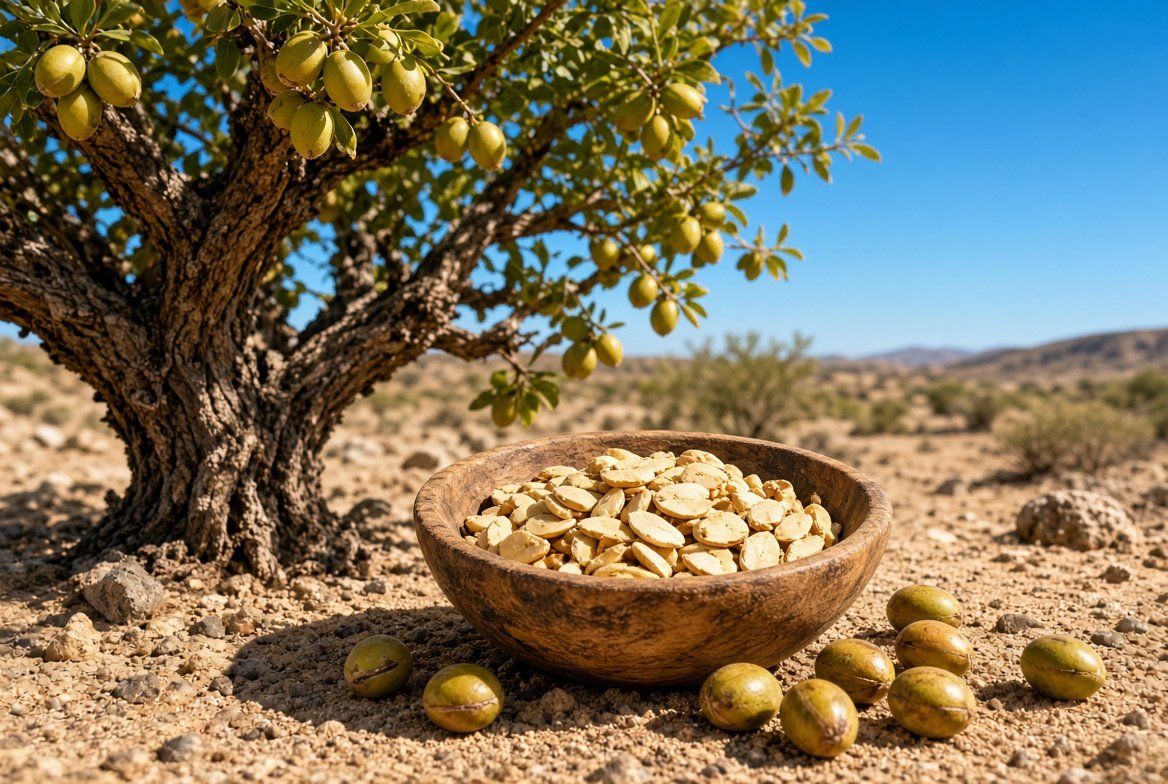
Argania spinosa (L.) Skeels · Sapotaceae · Souss valley, south-western Morocco · kernel oil
Traditional use
The argan tree is not merely a botanical curiosity; it is an ecological and cultural anchor of south-western Morocco, where it has thrived for millennia across an estimated 800,000 hectares. It is endemic — its natural range is confined to the semi-arid Souss and the neighbouring Atlas foothills, and nowhere else on earth does it grow wild [4].
From the fruit, a kernel inside a hard nut yields an oil that has been at the centre of Amazigh (Berber) household life for centuries: poured over bread and couscous, stirred into amlou with almonds and honey, and rubbed into skin and hair. Until recent decades, production was entirely a family and cooperative activity performed by women using stone mills — roughly 58 hours of labour for 2 to 2.5 litres of oil [4][5].
Since the mid-1990s, women’s cooperatives and then industrial producers have turned argan oil into a globally traded speciality oil, with a Moroccan quality standard, a protected geographical indication, and — inevitably — a market for fakes [4][8].
What’s in it
What distinguishes argan oil from the crowded field of vegetable oils is not a single remarkable property but a constellation of minor compounds — particularly γ-tocopherol, schottenol and spinasterol — whose concentrations and ratios are rarely matched in common edible oils [1].
Fatty acids
Unsaturated fatty acids make up roughly 76–82% of the total [2][3]:
| Fatty acid | Typical range | Note |
|---|---|---|
| Oleic acid (C18:1, ω-9) | 44–55% | Principal monounsaturate |
| Linoleic acid (C18:2, ω-6) | 25–37% | Essential polyunsaturate |
| Palmitic acid (C16:0) | 10–19% | Principal saturate |
| Stearic acid (C18:0) | 3–12% | Secondary saturate |
The oleic-to-linoleic ratio is markedly different from olive oil, which carries more oleic and far less linoleic acid [1]. That ratio matters for both oxidative stability and nutrition — we compare the two oils properly in a separate article.
Tocopherols (vitamin E)
Unlike olive oil, where α-tocopherol predominates, argan oil is dominated by γ-tocopherol — a mean of 483 ± 11 mg/kg in the reference analysis, against α-tocopherol as the major form in olive (190 mg/kg) and sunflower oil (532 mg/kg) [1]. Total tocopherols vary by origin and processing, typically 600 to over 900 mg/kg [2][3]. Whether the γ-form’s prevalence translates into a health advantage has been proposed, not demonstrated [1].
Sterols
Equally distinctive. While β-sitosterol is the predominant sterol in olive and sunflower oils, argan oil’s major sterols are schottenol (mean 147 ± 10 mg/kg) and spinasterol (122 ± 10 mg/kg) [1]. Together they make up the bulk of the sterol fraction — and, as we set out below, they are the oil’s chemical fingerprint.
Other minor components
Squalene (about 313 mg/100 g — less than olive oil, far more than sunflower) and phenolic compounds [1]. The edible, roasted oil has also been shown to contain coenzyme Q10 and melatonin [6]. Unsaponifiable matter runs 0.34–0.79% [2].
Edible vs cosmetic: the one decision that separates them
The two grades of argan oil come from the same kernels. They are separated by a single processing step: roasting.
Edible argan oil is cold-pressed from roasted kernels. A few minutes of roasting drives Maillard and Strecker reactions that give the characteristic nutty, toasted aroma and copper colour — the “nutty” and “roasty” notes that formal sensory panels treat as the hallmark of quality [3]. Roasting also improves the oil’s oxidative stability [3][4].
Cosmetic argan oil (INCI: Argania spinosa kernel oil) is pressed from unroasted kernels: pale gold, close to odourless, without the roast-derived volatiles. Its shelf life is shorter — on the order of six months under ordinary conditions [4][5].
| Edible | Cosmetic | |
|---|---|---|
| Kernels | Roasted | Unroasted |
| Colour | Copper | Gold |
| Aroma | Nutty, toasted | Neutral |
| Use | Food | Skin, hair, formulations |
| Oxidative stability | Higher | Lower |
How it is made — and why it matters for quality
Three methods exist. Traditional extraction — stone mill and hand pressing — is slow and gives oil of variable character, because roasting by eye is not reproducible [5]. Mechanical pressing is the modern standard: one operator can produce 4–6 litres in about 13 hours, and cold-pressed roasted-kernel oil holds acceptable sensory quality for at least 20 weeks in ordinary storage [3][5]. Solvent extraction is for industry and laboratories.
Comparisons of the three found no method inherently superior on every parameter; what decides quality is care at each step, from fruit collection to storage [2]. One traditional practice fails outright: kernels recovered from fruit that goats have eaten and passed. Oil from those kernels has markedly degraded sensory quality — cheesy, fusty off-notes — and is unsuitable for food [2].
What the evidence shows
Stated carefully: the composition of argan oil is thoroughly characterised; the health effects in humans are not. The oil’s unusual profile has led researchers to propose cardiovascular and chemopreventive benefits [1][4], and a handful of small human trials on blood lipids exist — but they are few, short and small. The Amazigh population that has eaten it daily for centuries is a reason to study it, not a substitute for the studies [4]. We go through what those trials actually found in our article on argan oil as food.
Cautions
- Allergy. Rare, but real: anaphylaxis to argan oil has been reported in the medical literature [7]. Anyone with a history of reactions to tree nuts or seeds should try a small amount first.
- Rancidity. A high-linoleic oil oxidises. Keep it in dark glass, closed, away from heat; edible oil that has lost its nutty aroma or smells cheesy or musty is past its best [3].
- Not a medicine. There is no evidence-based therapeutic dose. Culinary amounts — a spoonful or two a day, as in the traditional diet — are the only quantities with any human data behind them [4].
- Drug interactions: none documented. Pregnancy and breastfeeding: no data either way; treat it as a food, not a supplement.
Origin, and how to recognise the real thing
Because the tree grows wild only in Morocco, and because tens of kilograms of fruit go into a single litre, genuine argan oil cannot be cheap. That economic fact is the reason a large share of what is sold as “pure argan oil” is diluted with sunflower, soybean or other oils [8]. What to look for:
- The label. Argane is a protected geographical indication in Morocco. Look for the PGI mark, the name of the cooperative, and the harvest or pressing year. A lab report for the lot is the gold standard.
- The senses. Edible oil is copper-coloured with a clear roasted, nutty aroma and a slight natural haze; cosmetic oil is pale gold and nearly odourless. A strong smell in “cosmetic” oil, or no smell in “edible” oil, is wrong. Cheesy, fusty or rancid notes mean poor kernels or poor storage [2][3].
- The chemistry. Argan’s fingerprint is its sterol profile: schottenol and spinasterol, almost no β-sitosterol [1]. An oil cut with sunflower or soybean shows β-sitosterol and a shifted fatty-acid profile — detectable by GC, and increasingly by NMR methods that read the whole lipid signature at once [8][9]. Any accredited lab can run it.
- The price. If a litre of “pure argan” costs less than the fruit it takes to make it, it isn’t.
Back to the Herbs & Plants Index.
References
- Khallouki F, Younos C, Soulimani R, et al. Consumption of argan oil (Morocco) with its unique profile of fatty acids, tocopherols, squalene, sterols and phenolic compounds should confer valuable cancer chemopreventive effects. European Journal of Cancer Prevention. 2003;12(1):67–75. PMID 12548113
- Hilali M, Charrouf Z, El Aziz Soulhi A, Hachimi L, Guillaume D. Influence of origin and extraction method on argan oil physico-chemical characteristics and composition. Journal of Agricultural and Food Chemistry. 2005;53(6):2081–2087. PMID 15769139
- Matthäus B. Quality parameters for cold pressed edible argan oils. Natural Product Communications. 2013;8(1):37–41. PMID 23472455
- Charrouf Z, Guillaume D. Should the amazigh diet (regular and moderate argan-oil consumption) have a beneficial impact on human health? Critical Reviews in Food Science and Nutrition. 2010;50(5):473–477. PMID 20373191
- Charrouf Z, Guillaume D. Argan oil: occurrence, composition and impact on human health. European Journal of Lipid Science and Technology. 2008;110(7):632–636. doi:10.1002/ejlt.200700220
- López LC, Cabrera-Vique C, Venegas C, et al. Argan oil-contained antioxidants for human mitochondria. Natural Product Communications. 2013;8(1):47–50. PMID 23472457
- Astier C, Benchad Yel A, Moneret-Vautrin DA, Bihain BE, Kanny G. Anaphylaxis to argan oil. Allergy. 2010;65(5):662–663. PMID 19839978
- Aziz AA, et al. A systematic literature review on the current detection tools for authentication analysis of argan oil. Journal of Cosmetic Dermatology. 2022;21(1):71–84. PMID 34658114
- Słomczyńska P, et al. The application of ¹H NMR, GC and UV-Vis techniques to the analysis of the fatty acid profile as quality of argan oil. International Journal of Molecular Sciences. 2025;26(11):5322. PMID 40508131
Last reviewed: September 2026. This entry describes traditional and documented use. It is not medical advice.