Introduction
Collagen is the most abundant structural protein in the human body. It forms the framework of skin, bone, muscle, tendon, ligament, blood vessel and organ. It is the biological glue that gives nearly every tissue its strength, firmness and integrity [1].
And it has become the centre of a booming supplement industry. Powders, capsules and drinks, all promising firmer skin, stronger joints, renewed vitality. The message is always the same and always simple: consume collagen, and your body will have more collagen.
This is not how human physiology works.
The body does not absorb intact proteins. It dismantles every protein into amino acids, then rebuilds its own proteins according to its own needs and the cofactors available to it. Swallowing collagen supplies amino acids — not ready-made collagen. Those amino acids become collagen only if the necessary enzymes, minerals and vitamins are present too.
You cannot eat collagen to get collagen. The body builds it. What the body needs is the complete nutritional matrix that whole food already provides.
What Collagen Actually Is and Does
Collagen provides:
- Elasticity and firmness in skin
- Tensile strength in bone — it is the principal protein of the organic bone matrix
- The connective tissue linking muscle to bone through tendon
- Structural support in the lining of the digestive tract
- Integrity of blood-vessel walls
- The overall firmness and solidity of the body
On ageing. With age, collagen fibres become more heavily cross-linked and more rigid [1]. This is why meat from an older animal is tougher and needs longer cooking — the same chemistry, visible on a plate.
On cooking. Heat denatures collagen’s triple helix and converts it into gelatin [2]. Anyone who has simmered cow trotters — krawee’ al-baqar — and watched the liquid turn sticky and set to jelly has watched that transformation happen. It is the clearest everyday demonstration of what collagen is.
Digestion: Why Swallowed Collagen Never Becomes Your Collagen
Every dietary protein takes the same road [3]:
- Stomach — pepsin begins breaking it into smaller peptides
- Small intestine — pancreatic proteases continue the work
- Brush border — membrane enzymes finish the job, releasing free amino acids and small peptides
- Absorption — those amino acids cross into the bloodstream
What arrives in your blood is amino acids, not collagen molecules. Whether they are ever assembled into new collagen depends entirely on the cofactors present and on the body’s own regulatory signals [3].
The analogy is exact. Buying collagen powder and expecting it to become collagen in your skin is like buying bricks and expecting them to assemble themselves into a house. You still need the architects — the enzymes. The workers — the cofactors. And the blueprint — genetic and hormonal regulation.
Deliver bricks to an empty site and you get a pile of bricks.
What the Body Actually Needs to Build Collagen
Copper, and the Enzyme That Depends On It
Lysyl oxidase is the enzyme that creates the cross-links giving collagen its mechanical strength [4]. It is a copper-dependent enzyme. Without adequate copper it cannot work properly, cross-linking fails, and the collagen produced is structurally weak [4][5].
No copper, no collagen worth having. That is not rhetoric — it is the documented role of copper in connective tissue biosynthesis [5].
Copper is also the mineral we found at the centre of the iron problem, for the same kind of reason: it is a cofactor the body cannot substitute. We set that out in why you are deficient.
Zinc
Zinc is required across tissue repair and collagen deposition, and both deficiency and adequacy measurably affect how well tissue rebuilds itself [6].
Vitamin C — the One Without Which Nothing Works
Vitamin C is an essential cofactor for prolyl hydroxylase and lysyl hydroxylase, the enzymes that hydroxylate proline and lysine residues. That modification is required for a stable collagen triple helix [7].
Remove it and collagen synthesis fails. This is scurvy — and scurvy is not a vitamin story, it is a collagen story. Wounds reopen, gums bleed, vessels leak, because the body has lost the ability to build its own structure [7].
Vitamin A
Vitamin A influences collagen metabolism in skin — it counters the elevated collagen-degrading enzymes of aged skin and stimulates collagen accumulation [8].
The Amino Acid Building Blocks
Collagen is unusually rich in glycine — roughly one residue in three — along with proline and hydroxyproline [9]. And the body can synthesise proline from glutamic acid, so foods supplying glutamic acid feed the proline pool directly [9].
This matters practically. Glutamic acid is in barley, in starches, in fruit, in green legumes. The proline in your skin can come from a bowl of barley.
Nature Already Supplies Everything Needed
| Nutrient | Natural sources |
|---|---|
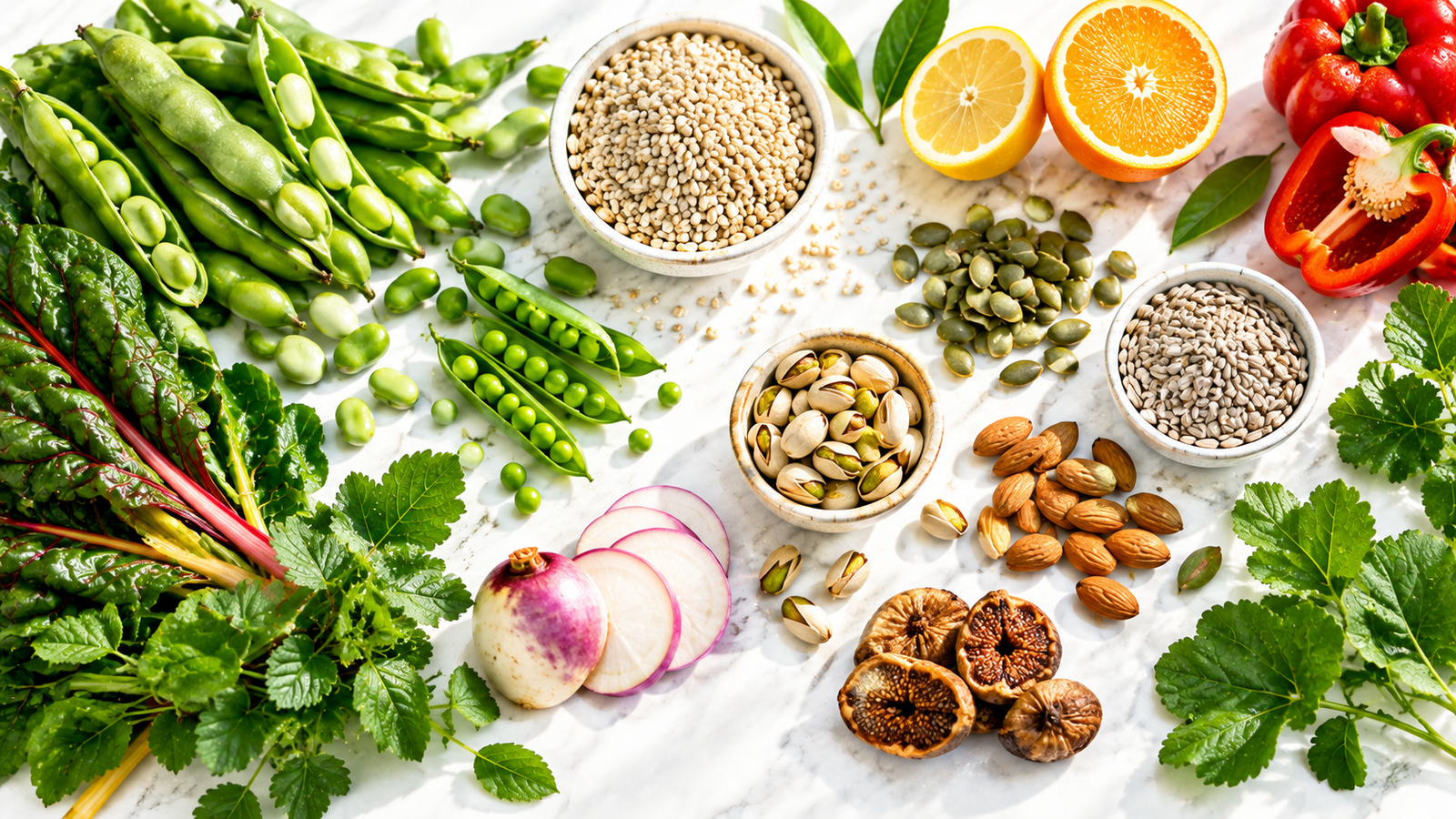
| Copper | Green legumes, wild greens, turnips, pistachios, dried figs, green barley |
| Zinc and manganese | Seeds, nuts, legumes, leafy greens |
| Vitamin A (beta-carotene) | Barley grass, mallow, sorrel, chard, cauliflower, cabbage, green onions, leeks |
| Vitamin C | Fresh vegetables and fruit, especially green legumes |
| Vitamin E | Almonds, walnuts, pistachios, sunflower, sesame, flax, pumpkin seeds |
| Glutamic acid (proline precursor) | Barley, other starches, fruit, green legumes |
Traditional populations ate these foods together — green legumes and wild greens alongside barley and corn, seeds and nuts, fresh vegetables and fruit. In season. In combination. In balance.
That combination is the point. Nature delivers the complete package — amino acids, vitamins and minerals arriving together. An isolated supplement delivers a fragment.
What Interferes With Collagen Production
Caffeine
Laboratory work on human skin fibroblasts shows caffeine reduces collagen biosynthesis in a dose-dependent way, partly through effects on prolidase activity and receptor signalling [10].
Heavy coffee, energy drinks and caffeinated sodas therefore work against the tissue you are trying to maintain — and the effect compounds in people who also smoke. The body absorbs the insult for years. Then it stops absorbing it.
Smoking
Tobacco smoke impairs collagen synthesis and accelerates the breakdown of collagen already built, which is why smokers’ skin ages early and their tissue loses integrity [11].
A Damaged Gut
A healthy microbiota supports absorption of the amino acids and cofactors collagen synthesis requires [12]. Dysbiosis reduces nutrient uptake, and reduced uptake means less raw material — and the causes are set out in what damages gut bacteria.
And the gut itself is a collagen structure. The intestinal lining sits on collagen-rich connective tissue, and weakness there is one plausible contributor to increased intestinal permeability [13]. The direct claim that irritable bowel syndrome is caused by collagen weakness in the intestinal lining has not been established, and we will not state it as fact. What is well supported is the two-way relationship: gut health governs the supply of collagen’s materials, and collagen governs the structure of the gut.
Disease is rarely one thing. Causes overlap and intertwine. The microbiota is one of the real factors in collagen metabolism, and when it is damaged, collagen production is one of the things that suffers.
Traditional Eating Already Contained the Solution
Long before isolated supplements, people were routinely eating exactly the foods that supply collagen’s building blocks and cofactors:
- Seasonal green legumes and wild greens
- Barley and corn — for glutamic acid
- Seeds and nuts — for vitamin E and minerals
- Fresh vegetables and fruit — for vitamin C
- Turnips, pistachios, dried figs — for copper
Eaten together, in season, in balance. See wild greens and forgotten roots and essential staple foods.
The modern pattern — refined starch, processed products, heavy caffeine — displaces precisely these foods. The deficiency is manufactured before the supplement is sold.
The Supplement Illusion
Collagen powder is digested into amino acids like any other protein. Those amino acids may or may not be used to make collagen.
Without copper, zinc, vitamin C and vitamin A, the body cannot complete synthesis and cross-linking no matter how many amino acids you supply.
The industry profits from exactly this gap in understanding. People stop eating the foods that support collagen synthesis; their tissue weakens; and they are then sold collagen — on the implication that swallowing the finished product restores what is missing.
The biochemistry says otherwise:
- Collagen powder is broken down into amino acids, like any protein
- The body may or may not route those amino acids into collagen
- Without cofactors, it cannot build collagen at all
- Supplements supply fragments. Food supplies the matrix.
None of which makes protein intake unimportant — it makes isolated collagen the wrong lever. We set out how to judge any supplement in which supplements do you actually need.
The Practical Path Forward
Prioritise the natural sources
- Green legumes and wild greens — copper, zinc, vitamin C
- Barley and corn — glutamic acid, the proline precursor
- Seeds and nuts — vitamin E and minerals
- Fresh vegetables and fruit — vitamin C and vitamin A
- Turnips, pistachios, dried figs — copper
Limit what blocks it
- Excessive caffeine — reduces collagen biosynthesis [10]
- Smoking — impairs synthesis and accelerates breakdown [11]
- Processed food and refined starch — displace the nutrient-dense foods that carry the cofactors
Support the supporting systems
- Movement. Mechanical loading drives collagen turnover and adaptation in tendon and connective tissue [14]
- Gut health — absorption is upstream of everything
- Seasonal eating — see why you are deficient
Frequently Asked Questions
Does collagen powder work at all?
Not the way it is sold. It is digested into amino acids like any other protein [3], and whether those amino acids become collagen depends on cofactors you may not have. As a protein source it is unremarkable; as a way of delivering collagen to your skin, the physiology does not support it.
Why does vitamin C matter so much for skin?
Because collagen cannot be built without it. Vitamin C is a required cofactor for the hydroxylation step that stabilises the collagen triple helix [7]. Scurvy is what collagen failure looks like.
Can I get enough copper from food?
Yes — green legumes, wild greens, turnips, pistachios, dried figs and green barley all carry it. Copper deficiency is usually a pattern problem, not a scarcity problem.
Does bone broth give me collagen?
It gives you gelatin — denatured collagen [2] — which your gut then breaks into amino acids. It is good food. It is not a delivery system for collagen.
Does caffeine really damage collagen?
Laboratory studies on human skin fibroblasts show dose-dependent reduction in collagen biosynthesis [10]. This is cell-culture evidence, not a clinical trial, so treat it as a reason for moderation rather than alarm — particularly alongside smoking, where the evidence in humans is much stronger [11].
Is glycine or proline worth supplementing?
Rarely. Glycine and proline are not usually the limiting factor — cofactors are. And proline can be made from the glutamic acid in barley, legumes and fruit [9].
Will exercise help my skin and joints?
Mechanical loading is one of the real stimuli for collagen turnover in tendon and connective tissue [14]. Movement is not a cosmetic add-on here — it is part of the signal that tells the body to build.
Conclusion
Collagen is not something you swallow ready-made. It is a protein your body builds, when you give it the complete set of materials nature already provides.
You cannot eat collagen to get collagen. You feed the body the whole matrix — copper, zinc, vitamin C, vitamin A, vitamin E, and the amino acids that come from barley, legumes and greens — and it does the building itself, as it always has.
Nature provides in balance. The body builds. Health follows.
Scientific Sources and References
- Shoulders M.D., Raines R.T. — Collagen structure and stability. Annual Review of Biochemistry, 2009; 78:929–958. PMID: 19344236. Link
- Liu D., Nikoo M., Boran G., et al. — Collagen and gelatin. Annual Review of Food Science and Technology, 2015; 6:527–557. PMID: 25884286. Link
- Erickson R.H., Kim Y.S. — Digestion and absorption of dietary protein. Annual Review of Medicine, 1990; 41:133–139. PMID: 2184718. Link
- Trackman P.C. — Lysyl oxidase isoforms and potential therapeutic opportunities for fibrosis and cancer. Expert Opinion on Therapeutic Targets, 2016; 20(8):935–945. PMID: 26848785. Link
- O’Dell B.L. — Roles for iron and copper in connective tissue biosynthesis. Philosophical Transactions of the Royal Society of London B, 1981; 294(1071):91–104. PMID: 6118903. Link
- Lin P.H., Sermersheim M., Li H., et al. — Zinc in wound healing modulation. Nutrients, 2017; 10(1):16. PMID: 29295546. Link
- Peterkofsky B. — Ascorbate requirement for hydroxylation and secretion of procollagen: relationship to inhibition of collagen synthesis in scurvy. American Journal of Clinical Nutrition, 1991; 54(6 Suppl):1135S–1140S. PMID: 1720597. Link
- Varani J., Warner R.L., Gharaee-Kermani M., et al. — Vitamin A antagonizes decreased cell growth and elevated collagen-degrading matrix metalloproteinases and stimulates collagen accumulation in naturally aged human skin. Journal of Investigative Dermatology, 2000; 114(3):480–486. PMID: 10692106. Link
- Wu G., Bazer F.W., Burghardt R.C., et al. — Proline and hydroxyproline metabolism: implications for animal and human nutrition. Amino Acids, 2011; 40(4):1053–1063. PMID: 20697752. Link
- Donejko M., Przylipiak A., Rysiak E., et al. — Influence of caffeine and hyaluronic acid on collagen biosynthesis in human skin fibroblasts. Drug Design, Development and Therapy, 2014; 8:1923–1928. PMID: 25342885. Link
- Morita A. — Tobacco smoke causes premature skin aging. Journal of Dermatological Science, 2007; 48(3):169–175. PMID: 17951030. Link
- Nicholson J.K., Holmes E., Kinross J., et al. — Host-gut microbiota metabolic interactions. Science, 2012; 336(6086):1262–1267. PMID: 22674330. Link
- Camilleri M. — Leaky gut: mechanisms, measurement and clinical implications in humans. Gut, 2019; 68(8):1516–1526. PMID: 31076401. Link
- Rosborg B., Kjaer M., Svensson R.B., et al. — Physical activity and other modifiers of extracellular matrix dynamics in healthy and diseased tendon tissue. American Journal of Physiology — Cell Physiology, 2025; 328(6):C2085–C2094. PMID: 40375785. Link