Abstract
Modern science can now map the genetic and physiological basis of the differences between men and women. These differences are not philosophical or ideological — they are measurable, documented, and reproducible in the laboratory. This article sets out what those differences are, how they shape disease risk and hormonal function, and what they mean for how a woman should eat.
Introduction
There is no difference in intellect between men and women. A woman can study any field — engineering, medicine, mathematics. Where the mind is concerned, there is nothing to separate them. A meta-analysis of forty-six separate meta-analyses found men and women more similar than different across the great majority of psychological variables, including cognitive ability [1].
But the body is another matter. There are real, measurable differences in composition, in circulation, in immunity, in the chemistry of the brain, and in how the body responds to pain and to stress. These differences have consequences — for disease risk, for hormonal balance, and for what a woman’s body needs from food.
1. Differences in the Body
A. Body Composition
A healthy woman carries roughly 20 to 30% body fat; a healthy man roughly 12 to 20% [2][3]. This is not excess — a woman needs those stores. Essential fat — the minimum the body must keep to function — is generally put at around 10 to 13% of body mass in a woman against 2 to 5% in a man, because her body is built for reproduction, pregnancy and lactation.
B. Muscle Mass
Muscle and fat are distributed differently between the sexes, and this is one of the largest structural differences between a man’s body and a woman’s [4].
C. Heart Rate
A woman’s resting heart rate runs a few beats per minute faster than a man’s, and the variability of her heart rhythm differs measurably too [5]. Her heart is smaller, so it must beat faster to move the same volume of blood.
D. Hand Temperature and Heat
A woman’s hands hold a different temperature from a man’s. Men and women regulate heat differently — in how much they produce, how they lose it, how they sweat, and how they perceive cold [6][7].
E. The Thyroid and the Menstrual Cycle
The thyroid gland changes its activity across the menstrual cycle, and thyroid function and menstrual function are measurably linked [8]. The thyroid is also the body’s regulator of heat: thyroid hormone controls thermogenesis and energy balance [9], and it is the central hormone of cold adaptation [10]. When the body must prepare itself against cold, it is the thyroid that does it [11]. Selenium status interacts with both sex hormones and thyroid metabolism [12], and thyroid disease is far more common in women, affecting reproduction directly [13].
That selenium dependency is worth understanding properly, because it is easy to get wrong in both directions — the food sources vary four-fold and the safe ceiling is real.
F. The Chemistry of the Brain
The brain’s chemistry is not evenly distributed between its two halves. Norepinephrine is measurably lateralised in the human thalamus [14]. In rats, noradrenaline and dopamine sit at different concentrations in the left and right frontal cortex [15], and norepinephrine, serotonin and choline uptake are lateralised in the hippocampus [18]. In humans, dopamine drives left-hemispheric lateralisation of neural networks during speech [16], and serotonin regulation has been described in terms of asymmetry and its relation to mood since the 1970s [17].
And the two sexes are not the same in these systems. Male and female brains are neurochemically distinct in their dopamine, serotonin and GABA markers [19]. In one PET study, men synthesised serotonin about 52% faster than women — a difference the authors suggested may contribute to the lower rate of major depression in men [52]. Men also show greater dopamine release in the striatum in response to stimulants in several studies [19].
This may be part of why women are more prone to disorders of mood, and men to disorders of impulse — though the neurochemistry is one strand among several, alongside hormones, life circumstances and how each sex is diagnosed.
2. Differences in Disease
A. Autoimmune Disease
Autoimmune disease is a woman’s disease. Women account for roughly 78 to 80% of all cases [20]:
- Lupus — about 9 in 10 patients are women
- Rheumatoid arthritis — 3 to 1
- Multiple sclerosis — 3 to 1
The reasons lie in hormones, in genes carried on the X chromosome, and in how immune cells behave [21].
Because the burden falls so heavily on women, the herbal claims made around autoimmune disease deserve particular scrutiny — what the research on immune-active plants actually establishes, and where it stops, is worth reading before acting on any of it.
B. Pain
Women feel more pain. They report it more often and more intensely across many conditions, and in the laboratory they show lower pain thresholds and lower tolerance than men [22][23].
Women also respond differently to the drugs given for it. Sex differences in opioid analgesia are documented clinically and experimentally [24], drug metabolism differs between the sexes [25], and analgesic response varies by drug class and by the kind of pain [26].
C. Cancers of the Hormonal System
Breast, ovarian and uterine cancers grow in tissues governed by estrogen and progesterone. They are hormone-dependent malignancies [27], and breast cancer risk in particular tracks a woman’s lifetime exposure to her own estrogen [28]. Hormonal balance is therefore not a comfort question. It is a cancer question.
D. Osteoporosis
Women lose bone faster and start from a lower peak. Add the fall in estrogen after menopause and a longer life, and the result is a far higher rate of osteoporosis.
E. Allergy
Allergy follows the same pattern of unequal burden, and the exposures are ordinary ones. The allergens women meet most sit in the kitchen, the cleaning cupboard and the cosmetics bag — and where they are ignored, they progress toward asthma.
3. What a Woman’s Body Needs
A. Folic Acid
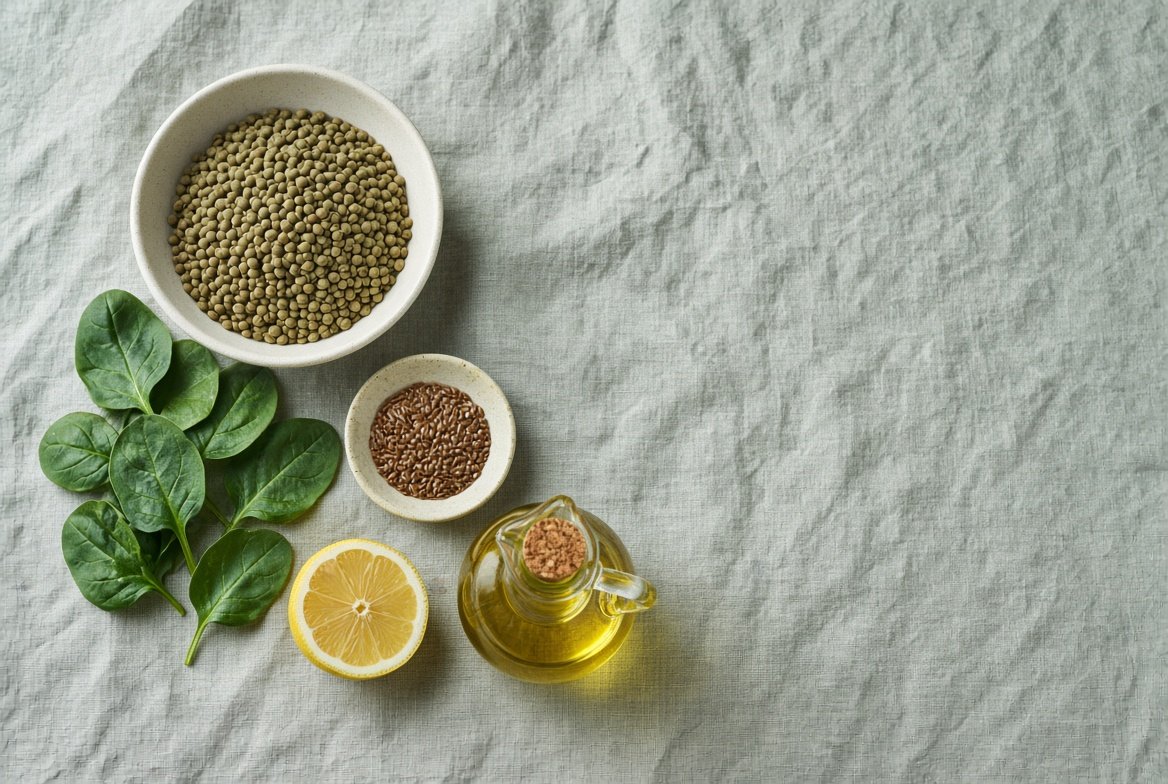
Folate is above all a plant vitamin. It is found in dark leafy greens, in legumes — lentils, chickpeas, beans — and in fortified grains. Most animal foods carry little; liver is the notable exception [29]. Legumes are the first source.
It is required for DNA synthesis and repair, for the pathways that build serotonin and norepinephrine, and above all for neural tube development in early pregnancy [30].
Legumes carry more than folate: they deliver the sulfur amino acids, the molybdenum and the tryptophan cofactors alongside it — the biochemistry of that food group is set out in full separately.
B. Omega-3 Fatty Acids
Omega-3 fatty acids are needed to build hormones and other secretions. EPA and DHA are the precursors of the eicosanoids — the signalling molecules that govern inflammation, cellular function and hormone synthesis [31] — and they carry their own role in cancer prevention [32].
They are found in oily fish, and in flaxseed, chia, walnuts and pumpkin seeds.
C. Phytoestrogens
Phytoestrogens can modulate the hormonal system. The isoflavones of soy and the lignans of flaxseed bind to estrogen receptors and modulate hormonal signalling [33], and the clinical and epidemiological literature on them has been reviewed at length [34].
They are found in soy, flaxseed, sesame, legumes and whole grains.
D. Olive Oil
Olive oil carries monounsaturated fat and polyphenols that act against inflammation. It is the foundation of the Mediterranean pattern, which in a large randomised trial reduced major cardiovascular events [35].
E. Iron
A woman loses iron every month that a man does not. Iron deficiency and iron deficiency anaemia are among the most common nutritional conditions in women of reproductive age, and the loss is tied directly to menstruation [44]. Where bleeding is heavy the link to deficiency is direct and well documented [45], and clinical guidelines treat it as something to be looked for rather than waited for [46].
Iron from plants is absorbed less readily than iron from flesh – but ascorbic acid changes that. Vitamin C taken with a plant meal markedly increases absorption of non-haem iron [47][48]. A squeeze of lemon over lentils or greens is not decoration. It is chemistry.
Sources: lentils, chickpeas, beans, dark leafy greens, sesame and pumpkin seeds – eaten alongside a source of vitamin C.
F. Calcium and Vitamin D
Bone is where the cost of the hormonal shift is finally paid. Calcium and vitamin D together support bone mineral density, and their role has been examined in premenopausal women specifically [49].
Sources: sesame, almonds, leafy greens, small fish eaten with the bones, and sunlight.
G. Iodine
Iodine is the raw material of the thyroid, and the thyroid – as section 1E set out – governs both the cycle and the body’s response to cold. The requirement rises in pregnancy, and deficiency at that stage carries consequences for the child [50][51].
Sources: sea vegetables, fish, and iodised salt.
4. The Diet for a Woman
The pattern the evidence supports is plant-based, built on:
- Legumes — for folic acid and phytoestrogens
- Leafy greens — for folic acid and minerals
- Omega-3 sources — fish, flaxseed, chia, walnuts
- Olive oil as the principal fat
- Whole grains — for fibre and lignans
- Nuts and seeds — sesame, pumpkin, almonds
- Sea vegetables — for iodine and trace minerals
- A source of vitamin C at every meal — citrus, peppers, tomatoes — to unlock the iron in the plants beside it
Plant-based patterns carry a lower overall cancer incidence in meta-analysis [36], and lower incidence of the female cancers specifically in cohort data [37]. Both are observational findings — they show association, and the people who choose such diets differ in other ways too — but the direction is consistent across studies.
To limit: excess saturated fat from animal foods, processed foods, and red and processed meat.
5. Hormonal Contraception
The contraceptive pill does not act the same way in every body. A nationwide cohort of more than a million women found hormonal contraception associated with later antidepressant use and diagnosed depression, most strongly in adolescents [38]. Weight change is separately documented with some progestin-only methods [39].
What one woman tolerates, another does not. This belongs with a doctor who knows her history.
6. The Weight of the Emotions
What a woman carries in her heart, her body carries too.
A systematic review and meta-analysis found stress-related psychosocial factors associated with higher cancer incidence in healthy populations, and with poorer survival among those already diagnosed [40]. The mechanisms run through immune function, inflammation and the endocrine system rather than by any direct path from grief to tumour [41].
Whether treating the mind changes survival is still argued in the literature, and the trials do not all agree [42][43]. But that sadness and prolonged distress leave a mark on the body is not in dispute.
Frequently Asked Questions
Is there a difference in intelligence between men and women?
No. Across the great majority of psychological measures, including cognitive ability, men and women are more alike than different [1]. The differences between them are in the body, not the mind.
Why do women get autoimmune disease so much more than men?
Roughly four in five autoimmune patients are women [20]. The causes are hormonal, genetic — genes carried on the X chromosome regulate immune function — and immunological [21]. Lupus alone runs about nine women to every man.
Is a plant-based diet really better for a woman?
Plant-based patterns are associated with lower overall cancer incidence [36] and lower incidence of breast, ovarian and uterine cancer [37]. The Mediterranean pattern, built on olive oil, cut major cardiovascular events in a randomised trial [35].
Where does a woman get folic acid?
Mainly from plants. Legumes first — lentils, chickpeas, beans — then dark leafy greens and fortified grains. Most animal foods carry little, liver being the exception [29].
Does the pill have real side effects?
Yes, and they vary by person. A cohort of over a million women linked hormonal contraception to later depression diagnosis and antidepressant use [38], and weight change is documented with some methods [39]. Speak to a doctor who knows your history.
Does a woman need more iron than a man?
Yes. She loses it every month, and iron deficiency is among the most common nutritional conditions in women of reproductive age [44][45]. Plant iron is harder to absorb than animal iron – but vitamin C at the same meal substantially raises absorption [47][48]. Lemon over lentils is not garnish.
Does the state of the mind affect the body?
Stress-related psychosocial factors are associated with higher cancer incidence and poorer survival [40], working through immune function and inflammation [41]. Whether psychological treatment changes survival remains contested [42][43].
This article is part of our complete guide to Wellness & Mental Health — the gut-brain connection, stress, sleep and emotional wellbeing.
References: Scientific Sources Supporting This Article
Every source below was checked against PubMed and the CrossRef DOI registry. Each link resolves to the paper cited.
Cognitive Ability
- Hyde, J. S. (2005). “The gender similarities hypothesis.” American Psychologist, 60(6), 581–592. doi:10.1037/0003-066X.60.6.581
Body Composition
- Gallagher, D., Heymsfield, S. B., Heo, M., et al. (2000). “Healthy percentage body fat ranges: an approach for developing guidelines based on body mass index.” American Journal of Clinical Nutrition, 72(3), 694–701. doi:10.1093/ajcn/72.3.694
- Abernathy, R. P., & Black, D. R. (1996). “Healthy body weights: an alternative perspective.” American Journal of Clinical Nutrition, 63(3 Suppl), 448S–451S. doi:10.1093/ajcn/63.3.448
- Janssen, I., Heymsfield, S. B., Wang, Z. M., & Ross, R. (2000). “Skeletal muscle mass and distribution in 468 men and women aged 18–88 yr.” Journal of Applied Physiology, 89(1), 81–88. doi:10.1152/jappl.2000.89.1.81
Cardiovascular Function
- Ramaekers, D., Ector, H., Aubert, A. E., et al. (1998). “Heart rate variability and heart rate in healthy volunteers.” European Heart Journal, 19(9), 1334–1341. doi:10.1053/euhj.1998.1084
Thermoregulation
- Yanovich, R., Ketko, I., & Charkoudian, N. (2020). “Sex Differences in Human Thermoregulation: Relevance for 2020 and Beyond.” Physiology, 35(3), 177–184. doi:10.1152/physiol.00035.2019
- Greenfield, A. M., Alba, B. M., Giersch, G. E. W., & Seeley, A. D. (2023). “Sex differences in thermal sensitivity and perception.” Physiology & Behavior, 263, 114126. doi:10.1016/j.physbeh.2023.114126
The Thyroid, the Cycle, and Cold
- Jacobson, M. H., Howards, P. P., Darrow, L. A., et al. (2018). “Thyroid hormones and menstrual cycle function in a longitudinal cohort of premenopausal women.” Paediatric and Perinatal Epidemiology, 32(3), 225–234. doi:10.1111/ppe.12462
- Silva, J. E. (1995). “Thyroid hormone control of thermogenesis and energy balance.” Thyroid, 5(6), 481–492. doi:10.1089/thy.1995.5.481
- Laurberg, P., Andersen, S., & Karmisholt, J. (2005). “Cold adaptation and thyroid hormone metabolism.” Hormone and Metabolic Research, 37(9), 545–549. doi:10.1055/s-2005-870420
- Zhang, Z., Boelen, A., Kalsbeek, A., & Fliers, E. (2018). “TRH Neurons and Thyroid Hormone Coordinate the Hypothalamic Response to Cold.” European Thyroid Journal, 7(6), 279–288. doi:10.1159/000493976
- Zagrodzki, P., Ratajczak, R., & Wietecha-Posłuszny, R. (2007). “The interaction between selenium status, sex hormones, and thyroid metabolism in adolescent girls in the luteal phase of their menstrual cycle.” Biological Trace Element Research, 120(1–3), 51–60. doi:10.1007/s12011-007-8012-8
- Krassas, G. E. (2000). “Thyroid disease and female reproduction.” Fertility and Sterility, 74(6), 1063–1070. doi:10.1016/s0015-0282(00)01589-2
Lateralisation of Brain Chemistry
- Oke, A., Keller, R., Mefford, I., & Adams, R. N. (1978). “Lateralization of norepinephrine in human thalamus.” Science, 200(4348), 1411–1413. doi:10.1126/science.663623
- Slopsema, J. S., van der Gugten, J., & de Bruin, J. P. C. (1982). “Regional concentrations of noradrenaline and dopamine in the frontal cortex of the rat: dopaminergic innervation of the prefrontal subareas and lateralization of prefrontal dopamine.” Brain Research, 250(1), 197–200. doi:10.1016/0006-8993(82)90970-2
- Fuertinger, S., & Simonyan, K. (2018). “Dopamine drives left-hemispheric lateralization of neural networks during human speech.” Journal of Comparative Neurology, 526(5), 920–931. doi:10.1002/cne.24375
- Mandell, A. J., & Knapp, S. (1979). “Asymmetry and mood, emergent properties of serotonin regulation.” Archives of General Psychiatry, 36(8), 909–916. doi:10.1001/archpsyc.1979.01780080083019
- Valdes, J. J., Mactutus, C. F., Cory, R. N., & Cameron, W. R. (1981). “Lateralization of norepinephrine, serotonin and choline uptake into hippocampal synaptosomes of sinistral rats.” Physiology & Behavior, 27(2), 381–383. doi:10.1016/0031-9384(81)90284-5
- Cosgrove, K. P., Mazure, C. M., & Staley, J. K. (2007). “Evolving knowledge of sex differences in brain structure, function, and chemistry.” Biological Psychiatry, 62(8), 847–855. doi:10.1016/j.biopsych.2007.03.001
Autoimmune Disease
- Ngo, S. T., Steyn, F. J., & McCombe, P. A. (2014). “Gender differences in autoimmune disease.” Frontiers in Neuroendocrinology, 35(3), 347–369. doi:10.1016/j.yfrne.2014.04.004
- Whitacre, C. C. (2001). “Sex differences in autoimmune disease.” Nature Immunology, 2(9), 777–780. doi:10.1038/ni0901-777
Pain and Analgesia
- Bartley, E. J., & Fillingim, R. B. (2013). “Sex differences in pain: a brief review of clinical and experimental findings.” British Journal of Anaesthesia, 111(1), 52–58. doi:10.1093/bja/aet127
- Mogil, J. S. (2012). “Sex differences in pain and pain inhibition: multiple explanations of a complex phenomenon.” Nature Reviews Neuroscience, 13(12), 859–866. doi:10.1038/nrn3360
- Fillingim, R. B., & Gear, R. W. (2004). “Sex differences in opioid analgesia: clinical and experimental findings.” European Journal of Pain, 8(5), 413–425. doi:10.1016/j.ejpain.2004.01.007
- Ciccone, G. K., & Holdcroft, A. (1999). “Drugs and sex differences: a review of drugs relating to anaesthesia.” British Journal of Anaesthesia, 82(2), 255–265. doi:10.1093/bja/82.2.255
- Fillingim, R. B., King, C. D., Ribeiro-Dasilva, M. C., et al. (2009). “Sex, gender, and pain: a review of recent clinical and experimental findings.” The Journal of Pain, 10(5), 447–485. doi:10.1016/j.jpain.2008.12.001
Hormone-Dependent Cancers
- Henderson, B. E., & Feigelson, H. S. (2000). “Hormonal carcinogenesis.” Carcinogenesis, 21(3), 427–433. doi:10.1093/carcin/21.3.427
- Key, T. J., Verkasalo, P. K., & Banks, E. (2001). “Epidemiology of breast cancer.” The Lancet Oncology, 2(3), 133–140. doi:10.1016/S1470-2045(00)00254-0
Folic Acid
- Bailey, L. B., & Gregory, J. F. (1999). “Folate metabolism and requirements.” The Journal of Nutrition, 129(4), 779–782. doi:10.1093/jn/129.4.779
- Czeizel, A. E., & Dudás, I. (1992). “Prevention of the first occurrence of neural-tube defects by periconceptional vitamin supplementation.” New England Journal of Medicine, 327(26), 1832–1835. doi:10.1056/NEJM199212243272602
Omega-3 Fatty Acids
- Jump, D. B. (2002). “The biochemistry of n-3 polyunsaturated fatty acids.” Journal of Biological Chemistry, 277(11), 8755–8758. doi:10.1074/jbc.R100062200
- Larsson, S. C., Kumlin, M., Ingelman-Sundberg, M., & Wolk, A. (2004). “Dietary long-chain n-3 fatty acids for the prevention of cancer: a review of potential mechanisms.” American Journal of Clinical Nutrition, 79(6), 935–945. doi:10.1093/ajcn/79.6.935
Phytoestrogens
- Patisaul, H. B., & Jefferson, W. (2010). “The pros and cons of phytoestrogens.” Frontiers in Neuroendocrinology, 31(4), 400–419. doi:10.1016/j.yfrne.2010.03.003
- Messina, M. (2016). “Soy and Health Update: Evaluation of the Clinical and Epidemiologic Literature.” Nutrients, 8(12), 754. doi:10.3390/nu8120754
Olive Oil and the Mediterranean Pattern
- Estruch, R., Ros, E., Salas-Salvadó, J., et al. (2018). “Primary Prevention of Cardiovascular Disease with a Mediterranean Diet Supplemented with Extra-Virgin Olive Oil or Nuts.” New England Journal of Medicine, 378(25), e34. doi:10.1056/NEJMoa1800389 — the 2018 republication with corrected randomisation analysis; the 2013 version of this trial was retracted.
Plant-Based Diets and Cancer
- Dinu, M., Abbate, R., Gensini, G. F., Casini, A., & Sofi, F. (2017). “Vegetarian, vegan diets and multiple health outcomes: A systematic review with meta-analysis of observational studies.” Critical Reviews in Food Science and Nutrition, 57(17), 3640–3649. doi:10.1080/10408398.2016.1138447
- Tantamango-Bartley, Y., Jaceldo-Siegl, K., Fan, J., & Fraser, G. (2013). “Vegetarian diets and the incidence of cancer in a low-risk population.” Cancer Epidemiology, Biomarkers & Prevention, 22(2), 286–294. doi:10.1158/1055-9965.EPI-12-1060
Hormonal Contraception
- Skovlund, C. W., Mørch, L. S., Kessing, L. V., & Lidegaard, Ø. (2016). “Association of Hormonal Contraception With Depression.” JAMA Psychiatry, 73(11), 1154–1162. doi:10.1001/jamapsychiatry.2016.2387
- Lopez, L. M., Ramesh, S., Chen, M., et al. (2016). “Progestin-only contraceptives: effects on weight.” Cochrane Database of Systematic Reviews, 2016(8), CD008815. doi:10.1002/14651858.CD008815.pub4
Emotional State and Physical Health
- Chida, Y., Hamer, M., Wardle, J., & Steptoe, A. (2008). “Do stress-related psychosocial factors contribute to cancer incidence and survival?” Nature Clinical Practice Oncology, 5(8), 466–475. doi:10.1038/ncponc1134
- Spiegel, D. (2012). “Mind matters in cancer survival.” Psycho-Oncology, 21(6), 588–593. doi:10.1002/pon.3067
- Chow, E., Tsao, M. N., & Harth, T. (2004). “Does psychosocial intervention improve survival in cancer? A meta-analysis.” Palliative Medicine, 18(1), 25–31. doi:10.1191/0269216304pm842oa
- Fu, W. W., Popovic, M., Agarwal, A., et al. (2016). “The impact of psychosocial intervention on survival in cancer: a meta-analysis.” Annals of Palliative Medicine, 5(2), 93–106. doi:10.21037/apm.2016.03.06
Iron
- Cappellini, M. D., Santini, V., Braxs, C., & Shander, A. (2022). “Iron metabolism and iron deficiency anemia in women.” Fertility and Sterility, 118(4), 607-614. doi:10.1016/j.fertnstert.2022.08.014
- Munro, M. G., Mast, A. E., Powers, J. M., et al. (2023). “The relationship between heavy menstrual bleeding, iron deficiency, and iron deficiency anemia.” American Journal of Obstetrics and Gynecology, 229(1), 1-9. doi:10.1016/j.ajog.2023.01.017
- Mansour, D., Hofmann, A., & Gemzell-Danielsson, K. (2021). “A Review of Clinical Guidelines on the Management of Iron Deficiency and Iron-Deficiency Anemia in Women with Heavy Menstrual Bleeding.” Advances in Therapy, 38(1), 201-225. doi:10.1007/s12325-020-01564-y
- Teucher, B., Olivares, M., & Cori, H. (2004). “Enhancers of iron absorption: ascorbic acid and other organic acids.” International Journal for Vitamin and Nutrition Research, 74(6), 403-419. doi:10.1024/0300-9831.74.6.403
- Hallberg, L., Brune, M., & Rossander, L. (1989). “Iron absorption in man: ascorbic acid and dose-dependent inhibition by phytate.” American Journal of Clinical Nutrition, 49(1), 140-144. doi:10.1093/ajcn/49.1.140
Calcium, Vitamin D and Bone
- Mendez-Sanchez, L., Clark, P., Winzenberg, T. M., et al. (2023). “Calcium and vitamin D for increasing bone mineral density in premenopausal women.” Cochrane Database of Systematic Reviews, 1(1), CD012664. doi:10.1002/14651858.CD012664.pub2
Iodine
- Glinoer, D. (2001). “Pregnancy and iodine.” Thyroid, 11(5), 471-481. doi:10.1089/105072501300176426
- Chittimoju, S. B., & Pearce, E. N. (2019). “Iodine Deficiency and Supplementation in Pregnancy.” Clinical Obstetrics and Gynecology, 62(2), 330-338. doi:10.1097/GRF.0000000000000428
Sex Differences in Serotonin Synthesis
- Nishizawa, S., Benkelfat, C., Young, S. N., et al. (1997). “Differences between males and females in rates of serotonin synthesis in human brain.” Proceedings of the National Academy of Sciences, 94(10), 5308–5313. PMID 9144233