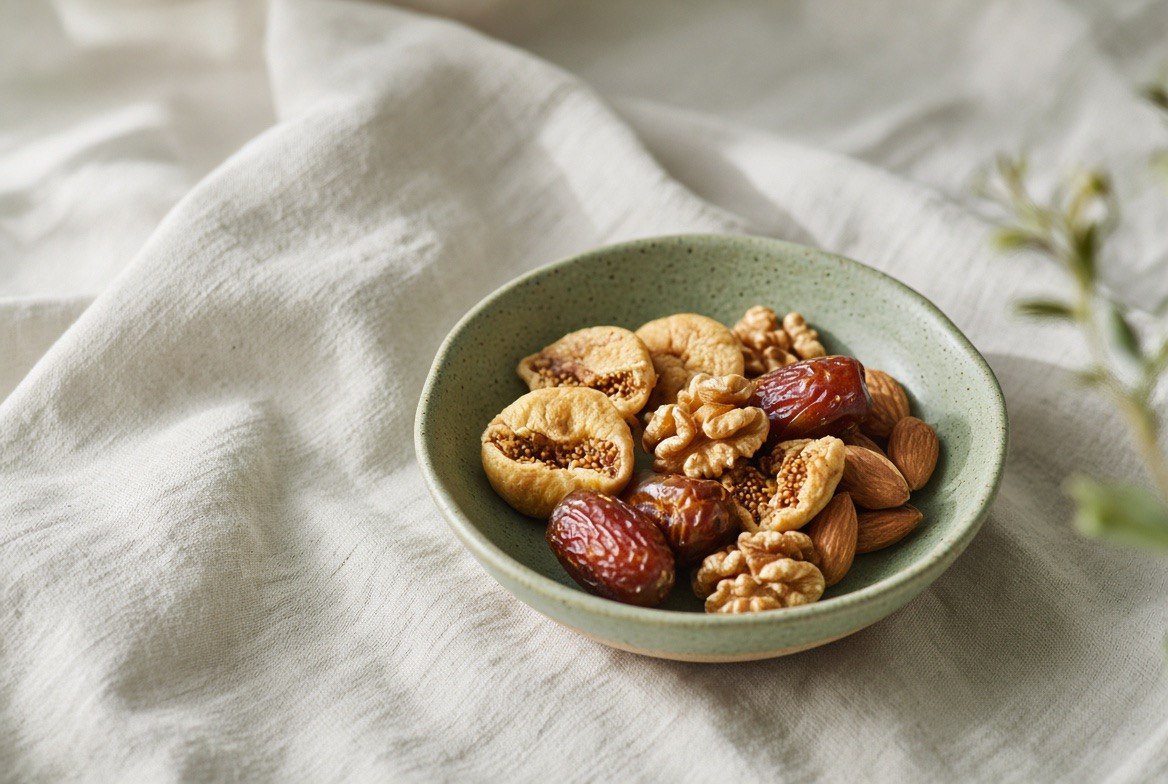
For centuries, Mediterranean, Middle Eastern, and North African kitchens have paired sweet dried fruits with nuts and roasted chickpeas. That simple combination was never just about taste. It was also a practical way to preserve energy, flavor, and nourishment before refrigeration existed.
Today, modern nutrition can explain part of what those food traditions understood. It cannot justify every superlative, but it can help us separate real benefits from exaggeration.
This article walks through what dried fruits and nuts actually offer, what the evidence supports, and where portion control matters.
1. Sweet Dried Fruits: Sweet, But Not Empty
Dates, figs, raisins, and prunes are concentrated by removing water. That means their natural sugars become more concentrated than in fresh fruit.
For example, dried figs contain roughly 48 g of sugar per 100 g, raisins around 59 g, and dates about 63 g. So yes — dried fruits are sweet. But they are not just sugar.
They also provide:
- Potassium
- Magnesium
- Calcium, especially in dried figs and raisins
- Some iron
- Fiber
- Polyphenols and other antioxidant compounds
One study found that dried fruits showed measurable antioxidant activity, which means they contain plant compounds beyond basic nutrients. That is a long way from “empty calories.”
Fiber and Gut Health
Sweet dried fruits provide roughly 3.7–9.8 g of fiber per 100 g, depending on the fruit.
That fiber includes soluble fibers such as pectin and insoluble fibers. Soluble fiber can form a gel in the digestive tract and slow digestion, which may help reduce blood sugar spikes compared with eating sugar alone. Fiber also feeds beneficial gut bacteria and supports the production of short-chain fatty acids.
This is one reason dried fruit behaves differently from a spoonful of table sugar. But “behaves differently” does not mean “unlimited.” Dried fruits still raise blood sugar, and portion control is essential.
2. Nuts: Nature’s Fatty Fruits
Almonds, walnuts, pistachios, cashews, and peanuts are technically seeds or legumes, but culturally we treat them as nuts. They are rich in unsaturated fats, low in saturated fat, and completely cholesterol-free.
They also provide:
- Vitamin E
- Magnesium
- Copper, manganese, and zinc
- Plant protein
- Fiber
- Polyphenols
Heart and Blood Vessel Health
The evidence for nuts and heart health is reasonably consistent.
A large systematic review and meta-analysis found that higher nut intake was associated with a lower risk of cardiovascular disease, total cancer, and all-cause mortality. The PREDIMED trial also showed that a Mediterranean diet supplemented with nuts reduced major cardiovascular events.
A smaller randomized crossover trial in people with type 2 diabetes found that walnut consumption improved endothelial function — a marker of blood vessel health.
This does not mean nuts are medicine. It means they are a beneficial whole food when they replace less healthy snacks.
Walnuts, Omega-3, and Vitamin E
Walnuts are among the richest common nuts in alpha-linolenic acid, the plant-based omega-3 fatty acid. They also contain vitamin E, a fat-soluble antioxidant.
In food, vitamin E can help protect fats from oxidation. In the body, vitamin E has antioxidant roles as well. The idea that vitamin E acts as a molecular “bodyguard” for omega-3 inside walnuts is a useful image, but it is not a proven biological mechanism. What is true is simpler: walnuts deliver omega-3, vitamin E, magnesium, and fiber in the same food.
There is a larger point behind that. Seeds and nuts are one of the food groups that has quietly left modern eating altogether — not reduced, but largely absent from the Western pattern — and the fatty acids, minerals and phytoestrogens they carry leave with them. We make that case in why you are deficient: the food groups we forgot.
Protein, Amino Acids, and Trace Minerals
Nuts supply plant protein and amino acids, including L-arginine and tryptophan.
- L-arginine is used by the body to make nitric oxide, which helps blood vessels relax.
- Tryptophan is a building block for serotonin and melatonin.
Nuts also contain copper, manganese, and zinc, which are cofactors for the body’s antioxidant enzyme superoxide dismutase. That is real, but it does not mean a handful of nuts will measurably improve antioxidant status. It simply means nuts provide the mineral building blocks.
3. The Traditional Pairing: Why It Works Nutritionally
Combining dates or figs with nuts and roasted chickpeas makes practical nutritional sense:
- Dried fruit gives quick carbohydrate, fiber, potassium, and some minerals.
- Nuts provide protein, unsaturated fat, vitamin E, magnesium, and fiber.
- Chickpeas add more protein and fiber, increasing satiety.
This is a nourishing, portable snack or mini-meal. It is not a proven cure for aging, cognitive decline, or metabolic disease. The benefit is that it is a whole-food alternative to ultra-processed snacks.
Some research does suggest that food matrix can affect how polyphenols are absorbed, meaning whole foods may act differently from isolated supplements. That supports the general idea of eating whole foods rather than chasing isolated compounds. But it does not prove that every isolate loses its benefit.
4. Processing: What to Look For
Drying always reduces vitamin C, because ascorbic acid is sensitive to oxygen and heat. This happens with sun drying too.
Many commercial dried fruits are treated with sulfites to preserve bright color and extend shelf life. Sulfites are safe for most people at regulated levels, but sulfite-sensitive individuals — especially some people with asthma — may need to avoid them.
Check labels for:
- Sulfur dioxide
- Potassium metabisulfite
- E220–E228 additive codes
“Sun-dried” or “unsulfured” dried fruits tend to look darker and less uniform. That is mostly a cosmetic difference, not a guarantee of clinical superiority. But for people avoiding additives, unsulfured dried fruit is the more traditional choice.
5. Portion Ideas
Because dried fruits and nuts are calorie-dense, portion size matters.
| Food | Traditional serving | What it mainly supplies |
|---|---|---|
| Dates | 2–4 whole, about 40–80 g | Potassium, fiber, natural sugars |
| Dried figs | 2–3 dried, about 40–60 g | Calcium, fiber |
| Raisins | 1 small handful, about 30 g | Potassium, fiber |
| Walnuts | 7–10 halves, about 28–35 g | ALA omega-3, magnesium, vitamin E |
| Almonds | 20–25 whole, about 28–35 g | Vitamin E, magnesium, fiber |
| Pistachios | 1 small handful, about 28 g | Copper, fiber, vitamin B6 |
These amounts are not medical prescriptions. They are traditional serving sizes that keep energy intake reasonable.
Frequently Asked Questions
Are dried fruits too high in sugar for people with diabetes?
Dried fruits are concentrated in sugar, so they do raise blood glucose. Pairing them with nuts or protein can slow digestion somewhat, but it does not remove the carbohydrate load.
Some observational studies link whole fruit intake with lower type 2 diabetes risk, but dried fruit is more energy-dense than fresh fruit. If you have diabetes, portion control and individual blood glucose monitoring are essential. Consult your physician or dietitian.
Are roasted nuts as healthy as raw nuts?
Dry-roasted, unsalted nuts are generally fine. The main concerns are added oils, salt, and very high roasting temperatures.
Raw or dry-roasted, unsalted nuts are the most commonly recommended forms in clinical literature.
How do I identify naturally dried versus industrially processed dried fruits?
Look at the ingredient label.
- Naturally dried or unsulfured fruits usually list only the fruit itself.
- Sulfited products list sulfur dioxide, potassium metabisulfite, or E220–E228.
Natural sun-dried fruits tend to look darker and less uniform — dark brown dates, dark orange-brown apricots. That is not a guarantee of better nutrition, but it is a useful label-reading skill.
Can this food combination replace supplements?
For healthy people eating a varied whole-food diet, nuts and dried fruits can help meet daily needs for magnesium, potassium, vitamin E, copper, and fiber.
They cannot replace clinically indicated supplements in documented deficiency states. Whole-food forms are generally preferred, but not automatically superior to every supplement in every situation.
Deciding which supplements you actually need — and which blood test settles the question before you spend anything — is covered in which supplements do you actually need.
How should dried fruits and nuts be stored?
Heat, light, and oxygen are the main threats. Store them in airtight glass containers in a cool, dark place.
Walnuts, because of their omega-3 content, are best refrigerated or frozen if not consumed within a few weeks of opening. Dried fruits generally keep for 6–12 months when stored properly.
Important Safety Notes
- Nut and peanut allergy: Nuts are common allergens. Avoid if allergic.
- Choking risk: Whole nuts are a choking hazard for young children. Do not give whole nuts to children under 4.
- Kidney disease: Dried fruits are high in potassium, and nuts contain phosphorus. People with chronic kidney disease may need to limit these foods.
- Potassium-raising medication: ACE inhibitors, ARBs and potassium-sparing diuretics all raise blood potassium. Large or daily portions of dried fruit add to that load. Ask the doctor who prescribed them.
- Sulfite sensitivity: Some people with asthma may react to sulfites. Read labels carefully.
- Diabetes: Dried fruits are concentrated carbohydrate sources and should be portioned carefully.
Two of those are medication interactions rather than food problems, and they are easy to miss because the food is healthy. The wider set — what to watch for when a good diet meets a prescription — is set out in when diet fights medication.
This article is educational, not medical advice. Existing conditions — diabetes, allergies, kidney disease, or metabolic disorders — warrant a clinician’s input before dietary change.
Conclusion
Dried fruits and nuts are traditional, nutrient-dense foods. They provide fiber, minerals, healthy fats, and plant compounds that fit well into a balanced diet.
They are not miracle cures, and they are not unlimited foods. When respected in whole-food form and eaten in mindful portions, they offer a simple, real-food alternative to heavily processed snacks.
That is the quiet wisdom behind the traditional bowl of dates, figs, nuts, and chickpeas: nourishment that is ordinary, available, and honest.
Dried fruits and nuts sit within the broader framework set out in our guide to Essential Staple Foods.
Sources
- Vinson JA, Zubik L, Bose P, Samman N, Proch J. Dried fruits: excellent in vitro and in vivo antioxidants. Journal of the American College of Nutrition, 2005. PMID: 15670984. https://pubmed.ncbi.nlm.nih.gov/15670984/
- Keast DR, O’Neil CE, Jones JM. Dried fruit consumption is associated with improved diet quality and reduced obesity in US adults. Nutrition Research, 2011. PMID: 21745628. https://pubmed.ncbi.nlm.nih.gov/21745628/
- Aune D, et al. Nut consumption and risk of cardiovascular disease, total cancer, all-cause and cause-specific mortality. BMC Medicine, 2016. PMID: 27916000. https://pubmed.ncbi.nlm.nih.gov/27916000/
- Estruch R, et al. Primary Prevention of Cardiovascular Disease with a Mediterranean Diet Supplemented with Extra-Virgin Olive Oil or Nuts. New England Journal of Medicine, 2018. PMID: 29897866. https://pubmed.ncbi.nlm.nih.gov/29897866/
- Ma Y, et al. Effects of walnut consumption on endothelial function in type 2 diabetic subjects. Diabetes Care, 2010. PMID: 19880586. https://pubmed.ncbi.nlm.nih.gov/19880586/
- Muraki I, et al. Fruit consumption and risk of type 2 diabetes. BMJ, 2013. PMID: 23990623. https://pubmed.ncbi.nlm.nih.gov/23990623/
- Stanhope KL, et al. Consuming fructose-sweetened, not glucose-sweetened, beverages increases visceral adiposity and lipids and decreases insulin sensitivity. Journal of Clinical Investigation, 2009. PMID: 19381015. https://pubmed.ncbi.nlm.nih.gov/19381015/
- Malik VS, et al. Sugar-sweetened beverages and risk of metabolic syndrome and type 2 diabetes: a meta-analysis. Diabetes Care, 2010. PMID: 20693348. https://pubmed.ncbi.nlm.nih.gov/20693348/
- Reynolds A, et al. Carbohydrate quality and human health: a series of systematic reviews and meta-analyses. Lancet, 2019. PMID: 30638909. https://pubmed.ncbi.nlm.nih.gov/30638909/
- Makki K, et al. The Impact of Dietary Fiber on Gut Microbiota in Host Health and Disease. Cell Host & Microbe, 2018. PMID: 29902436. https://pubmed.ncbi.nlm.nih.gov/29902436/
- Atkinson FS, et al. International tables of glycemic index and glycemic load values: 2008. Diabetes Care, 2008. PMID: 18835944. https://pubmed.ncbi.nlm.nih.gov/18835944/
- Bohn T. Dietary factors affecting polyphenol bioavailability. Nutrition Reviews, 2014. PMID: 24828476. https://pubmed.ncbi.nlm.nih.gov/24828476/
- EFSA Panel on Dietetic Products, Nutrition and Allergies. Scientific Opinion on pectins and reduction of post-prandial glycaemic responses. EFSA Journal, 2010. https://doi.org/10.2903/j.efsa.2010.1747
- Palmer BF, Clegg DJ. Physiology and pathophysiology of potassium homeostasis. Advances in Physiology Education, 2016. PMID: 27756725. https://pubmed.ncbi.nlm.nih.gov/27756725/
- USDA FoodData Central. https://fdc.nal.usda.gov
- Dietary Guidelines for Americans, 2020–2025. https://www.dietaryguidelines.gov